

1. BOOK NEWS
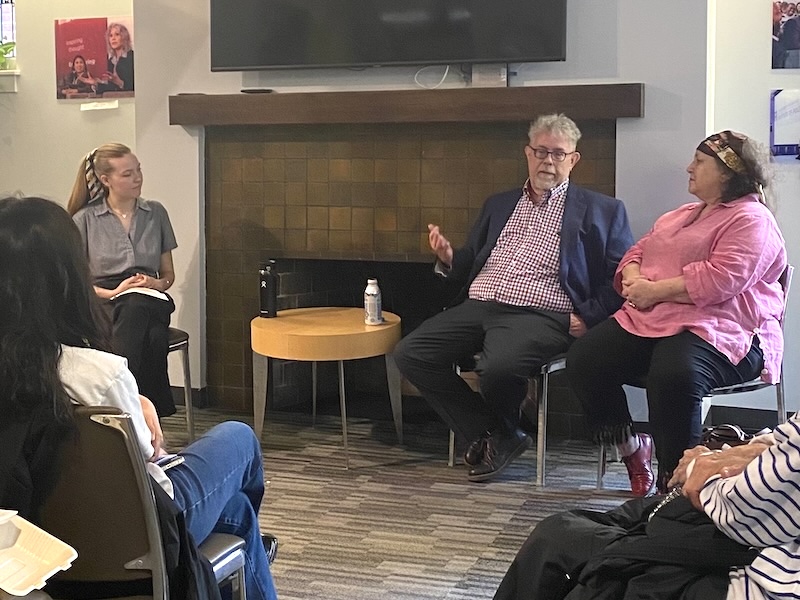
Had a chat with Carrie Nahabedian and students at the University of Chicago’s Institute of Politics about Chicago restaurant culture, and sold a few books. My son’s girlfriend accompanied me as my official photographer because she wanted to go to the Institute for Study of Ancient Cultures (the former Oriental Institute) afterwards, and was delighted that the folks there, not sure how to refer to her, called her my Chief of Staff (something their speakers no doubt usually have), so she has a new nickname. See pics of our South Side adventure, including pie, here.
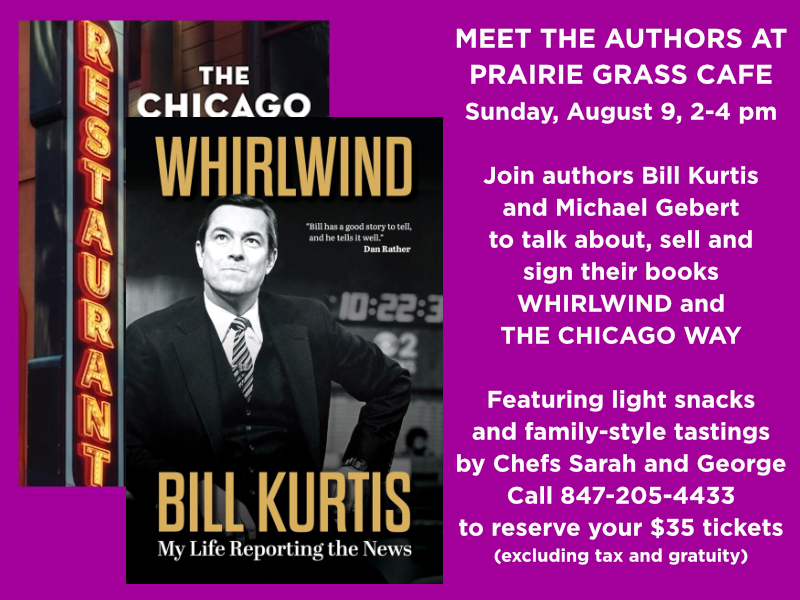
In the meantime, my main next public event is at the Old Town Triangle Association on Thursday; I’ll have books to sell there, too.
If you’ve read it, why not leave an Amazon review? I’ve got several, but can always use more.
And I’m such a trendsetter—I write a book and soon lots of people are doing it! I’ve mentioned Maggie Hennessy’s book on hamburgers and plan to interview her here (but I’ve been slowed down at everything by a spring cold), and now comes word that Chicago mag’s Amy Cavanaugh has been a major contributor to a book about regional recipes from Eater, called Eaterland: Recipes and Stories From Across the United States. The title is a bit presumptuous from a site whose landscape keeps shrinking, but that’s no shade on Cavanaugh, whose newsletter Anerican Weekender is a must-subscribe guide to adult road trips in quest of regional food and drink; she’s an ideal choice for covering the midwest in the book.
2. ALINEASTACK
Years ago I went to the French Laundry, and discovered a problem with coming late to widely celebrated restaurants—which was that I knew all the famous dishes from their cookbook and other sources, and so the standouts were familiar even if I had never eaten them before. (The ones that were new were not standouts, generally speaking—which is probably just the luck of the draw; out of ten new dishes, how many will typically come to be classics?)
Grant Achatz of course came out of the kitchen at the French Laundry, but now, after twenty years, finds himself at Alinea in a similar situation. People come in expecting Hot Potato Cold Potato, the helium balloon dessert, and so on. He’s just been doing a kind of greatest hits tour in other cities, but as he explains in the first post at a new Substack, he also used that as a chance to explore what would be next (no pun intended) for Alinea’s subsequent years:
The world tour was never meant to be a victory lap. It was an homage, twenty years of work brought to audiences who had never experienced it, and to those who had loved it and wanted one last moment with it. The Hot Potato Cold Potato, the Black Truffle Explosion, the balloon, the tabletop dessert, cocktails served inside ice, pillows of scented air. We carried all of it, city after city, twenty-eight weeks a year on the road. For many people in those rooms, it was their first encounter with what Alinea had spent two decades building. For our team, it was a chance to perform that repertoire together one final time, to own it completely before letting it go.
What we gained was immeasurable. Core memories forged with a team that gave everything. Relationships built in cities and kitchens around the world that will last the rest of our careers. Inspiration absorbed from places and people we would never have encountered otherwise. I would not trade a single week of it.
Were the lackluster reviews during that period a result of being away, of dividing our attention across continents while Chicago waited? Maybe. Probably. No matter who you are, no matter what you have built over twenty-five years, sometimes the view from inside is the last thing you can trust. It takes something from the outside, arriving without warning and without apology, to show you what you could not see yourself. I am not ashamed of that. I am grateful for it. Because what came into focus was a return to the only thing that has ever mattered here.
But there was another layer to the tour that I did not speak about publicly at the time. I have wanted to move Alinea in a specific direction for nearly ten years, and the tour gave me a place to hide and test it quietly, without announcement, without the weight of expectation that comes with doing it at home.
Read the whole thing; it raises interesting questions about being an artist in this craft, and how you keep your spark alive.
3. WATCH ME PULL A RABBIT OUT OF MY HAT
Before it was Lawry’s Prime Rib, the onetime McCormick Mansion was the Kungsholm Puppet Theater—and that’s one of those things you can hardly imagine today, adults going to a puppet show for a night out. Now there’s something else in that space you can hardly imagine—a magic-driven dinner experience called The Eye and the Hand. Anthony Todd at Chicago:
“A lot of people think this is dinner with magic. That’s not what it is,” explains Bre Smith, the EVP of Operations for the venue. This is not some cheesy dinner show; this is a fully immersive experience, beginning from the moment guests walk in the door. When you arrive, you’ll receive a hand-illustrated map of the venue and an itinerary for your evening, guiding you from space to space — perhaps a cocktail first, then your first magic show, then dinner, then another show or a stop for another drink. “We wanted this to feel like a space you could get lost in,” says Smith. With an over-the-top design by famed designer David Rockwell, wandering should be a lot of fun.
4. BUYER AND CELLAR
Grimod feels about Cellar Door Provisions kind of the way I do—if you want a philosophically coherent tasting menu (not all are, certainly) but want about twenty fewer courses and two fewer hours than, say, Feld, on a particular evening, it’s the answer at the moment:
Within a breezy bistro setting, chefs Ethan Pikas and Alex Cochran serve à la carte fare whose dynamism, creativity, and outright deliciousness can rival the work of those one-, two-, and three-Michelin-star sanctums. Indeed, it is perhaps because the restaurant (though holding a Bib Gourmand) is free of those suffocating “fine dining” expectations that it can afford to take such big swings.
The resulting dishes may at times be challenging, but they always have something interesting to say: pushing sourcing, technique, and the very conception of what a “starring” ingredient can or should be to a thought-provoking (though never needlessly provocative) extreme. Ironically, this is not even the most polarizing iteration of CDP to exist. However, by tempering its locavore philosophy just a little, the team—post-pandemic—has shaped a cuisine that reliably restores and reinvigorates even the most jaded of palates.
5. GOING VIRAL
Not where you’d have expected to find Titus Ruscitti in the old days, but he looks at five places doing the kind of cross-cultural food that goes viral now:
A lot of these viral food spots started as pop-ups as is the case with our next stop – Smash Jibarito in Humboldt Park. These guys paid their dues on the pop-up circuit and now have a spiffy new brick & mortar on Division. It’s the perfect fit for their hit smash burgers inspired by the classic Jibarito sandwiches that originated in this Puerto Rican enclave. This means instead of buns they’re using flattened and fried green plantains aka tostones to hold their smashed beef patties. The menu is tight with just a few burgers, some sides, and one wildcard item which is their twist on a pizza puff. The plantain “bun” on these burgers holds up better than you’d think and adds some extra crunch to the mix. Pictured below is “estilo Animal” aka Animal Style ala In-N-Out and it’s a damn good burger.
6. ODD’S BODKIN
I’m sure I’ve met forager Dave Odd somewhere, but mostly I just know his name, which tends to come up around this time every year as ramps kick off prime midwestern produce season. Eddie Lakin contacted me to ask if I wouldwrite a piece about him, but he wound up writing one himself, at Michael Nagrant’s The Hunger:
Dave Odd guarantees that if you to take a walk with him, he’ll show you at least 50 edible plants growing wild along the way.
Now, “meet your maker” is obviously exaggerated for effect, but it does very much feel that way. For most of us in 2026 USA, the concept of going to a park, picking a random plant and eating it is utterly foreign and scary. It’s not something most of us do. Eating 50 of them? Yeah, that seems almost like you’ve got a death wish.
But is doing something like that actually that far out there?
That’s why I’d like to de-mystify the concept of public foraging and start to close the gaping hole in our understanding of where food comes from and how it ends up on our plates.
7. MAHARAJI NICK
I recently saw an Indian place downtown, called Maharaj, and my first thought was, I wonder if Nick Kindelsperger has been there? Indeed he has, now:
Just don’t expect any fireworks. The chicken tikka masala features a very mild and creamy sauce, with only a slight background of spice. Still, the chicken is impressively juicy, and the sauce is deeply comforting. The same could be said of the dal makhani, a very rich and silky smooth lentil dish, bulked out with tomatoes and ginger.
Fortunately, on the side you’ll find two chutneys, a bright green and slightly spicy mint chutney and a tangy tamarind chutney. Both work wonders on the milder dishes, adding freshness and acidity.
8. LOOP THE LOOP
Kit Graham worked in the West Loop almost two decades ago, and she talks about how the hot hot hot neighborhood has evolved since then, a subject, of course, I also tackle in my book:
When I worked in the West Loop in 2008, it was a meatpacking district. It was gritty. When I went to get lunch, men in white butcher coats were hanging out on the sidewalk, taking a cigarette break. On a hot day, I would need to cover my nose to block the smell of meat juices on the sidewalk. My friends expressed concern over my safety. It was an area that felt empty and overlooked. A place people went to work, not a place to go for fun.
One thing that astounds me is the number of large restaurants that have opened in the neighborhood year after year. Nia, a Mediterranean restaurant, claims to be the longest-standing restaurant in the West Loop. This seemed shocking considering that Nia opened on February 15, 2008. How could the oldest restaurant in the West Loop be only 18?
I think the first place I ever went along there, when you didn’t really go there (but Jerry Kleiner was changing that), was that Mexican restaurant with the shiny metal exterior near Randolph and Halsted.
9. PRESUMED INOCENCIO
If you know Carnitas Uruapan, you probably mainly think of it in terms of son and present-day manager Marcos Carbajal. But his father Inocencio started the business in the 70s, and Louisa Chu profiles him as one of Chicago’s food icons (I think this has something to do with the awards they just announced):
Carbajal didn’t do it alone. He had a family carnitas recipe from their hometown of Uruapan in the Mexican state of Michoacán, the legendary birthplace of the iconic dish. And he had his wife and co-founder, the enigmatic Abigail Carbajal. Eventually, their only child would return to the family business, becoming a James Beard Awards semifinalist for Outstanding Restaurateur.
10. PIGS IN A BUILDING
Speaking of Pilsen, Kevin Pang visits Cerdito Muerto, the bar in a pre-Chicago fire Pilsen building. Watch the video here.
11. JA-VEGGIE-KA
At WBEZ, Courtney Kueppers looks at the rise of Javauneeka Jacobs, the TV-ready young co-chef of Frontera Grill, as she helps guide it in a somewhat new direction:
Still just 29, the Harvard, Illinois, native is now redefining what vegetable-forward dining looks like at one of Chicago’s longest-standing destination restaurants. And her skills are gaining wider recognition: She won the Food Network’s competition show “Chopped” in 2023 and, more recently, a Banchet Award for Chicago’s Rising Chef of the Year.
But even as her star rises, Jacobs insists she has no interest in opening a restaurant of her own. Instead, she is innovating from her post at Frontera and bringing new vegetable dishes to the regional Mexican menu, which has long been heavy on pork, chicken and beef.
12. EVERYTHING BLURS TOGETHER
When you can buy everything online, retail experiences have to step up their attraction. Lisa Shames talks about three retail stores also becoming “third spaces” with food and drink alongside retail.
13. TIPPING POINT
One of the things that came up at the U of C talk of course had to do with the minimum wage laws and tipping—and hearing Carrie Nahabedian talk about how much servers can make in a restaurant like hers, and how the servers won’t even care about what the base wage is, because it’s such a small percentage of their total income and mostly gets withheld for taxes anyway, drove home to me that the restaurant industry is so varied, from fancy downtown restaurants to neighborhood mom and pops, that there’s no real one-size-fits-all answer, and any legislative attempt to deal with it will be a blunt instrument at best.
And yet tipping is not only alive but spreading—paying by card at a screen means that the opportunity to build in three levels of tipping at the very top range, 20%-25%-30%, including in situations like coffee shops where you used to think you were being a high roller by leaving a buck or two in a jar, but which are very far from the kind of service you get over two hours at a table. Nothing against coffee shops, but if I go with my kids, order coffee and pastries for everybody and find that I’m given options starting at $7 and going up—for an interaction that lasted 30 seconds at the counter, well, it feels like a hustle. Mind you, there’s a Venezuelan-owned coffee and pastry place I go a lot, and the main kid I see at the counter is plainly in college, he always has a book to read and it’s always something you only get assigned (this week, he was reading Elias Canetti), and I like to feel virtuous and supportive, so I give him extra. Still, I’m 30 seconds of his day, not his best table at night.
I had an experience the other day that really made me want to see tipping die. I went into a pho place in my neighborhood. There are a couple of computer kiosks up front. Okay, fine, I order my soup, not too hard, we get to a tipping page, it’s actually on the low side, so I bump it up to 15% (I’ve never tipped 12% in my life!) Then I discover I have to put my name in and they’re just calling out names from the counter. Oh well, not much in the way of service, but I can handle that. I sit down and that’s when I see a paper sign on the wall asking me to carry my dishes to the “drop tray station.” I have to do everything the server does; there are three women behind the counter, seemingly having a good old time, but they essentially have nothing to do with my meal—it’s the kitchen and me, alone, in this transaction. (A male voice called out “Mike,” so I knew they didn’t even do that.) Now I’m kind of sore that I’ve been conned into leaving a tip for service—of which there literally wasn’t any.
When I posted a shorter tweet about this, a response came back that the other person never tips at kiosks. I think that’s fair; don’t tip until you’ve actually received service and feel confident the money will go to a human who served you. And I’m getting past any shyness about adjusting a presumed 20-25-30 tip downward for the service I actually receive and what I would give for it in a cash-only transaction. Maybe I sound like a cheap bastard, but I am sure that if we could analyze what I spend on tipping annually, it has climbed steadily in recent years—entirely because of automated systems, not humans, slipping higher and higher expectations past me. At that point I want to—I was going to say fight back, but I’m not fighting anyone, especially not hardworking servers. But I feel it’s up to me to reclaim the process for myself and tip what I think are logical amounts for the service I get; 20%+ for actual table service, a buck or two for friendly counter service—and nothing for no service at all.
14. LISTEN UP
Joiners talks to Lee Wolen (Boka, GG’s Chicken, etc.)
The Chef’s Cut talks to Gail Simmons of Top Chef. When Julia Thiel and I won a Beard award for Key Ingredient, our first clue that we might actually win was that we were seated at the same table as her.
Dish With David talks to Elizabeth Gartelos Morris and Beth Salantiny of Bridgeport’s Meze Table.
IN MEMORIAM
Rodney Alex was a server and sommelier who opened Juicy Wine Co., a wine shop on Milwaukee, and made small-batch Zinfandel under his own label. He was reportedly injured in a traffic accident a year or so ago and never recovered, passing on April 18. Among many tributes, Alpana Singh described him on Instagram:
He was the kind of person who said yes before you even finished your sentence. When I came to him with the idea for a charity event benefiting the Illinois Pug Rescue, he stopped me mid-pitch and said, “No more — let’s do it.” He donated Juicy Wine Bar for the day, and the Pug Chug was born. That was Rodney.
A true bon vivant and free spirit. Thoughtful, kind, and caring to his core — but never without that glint of mischief in his eye and a glass he was ready to share with whoever was nearby. He was a purveyor of joy, and the wine world is a little less bright without him. My deepest condolences to his family and friends. Rodney, I hope you’re pouring something truly spectacular up there. You’ve more than earned it.