

1. BOOK NEWS
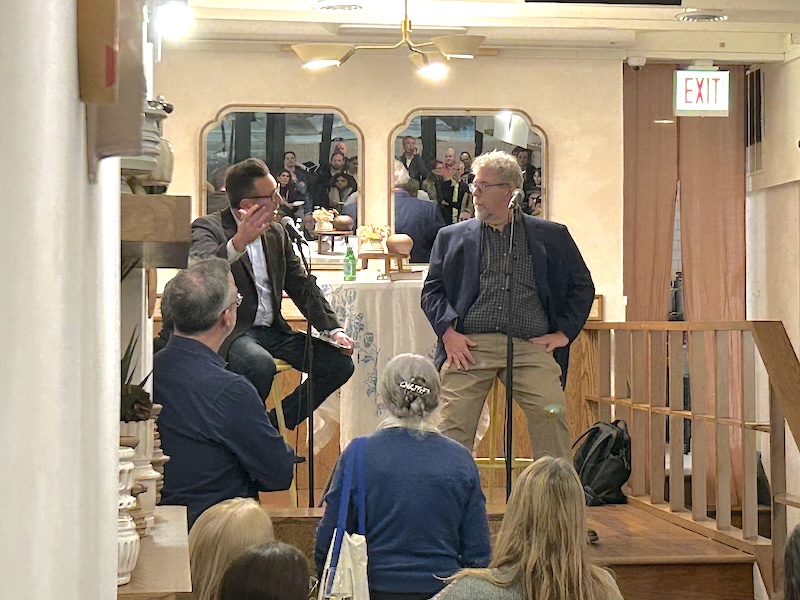
My book is out! Tuesday was the official release date, and also the date of the launch party, held at LouLou by Lula. (See this week’s photo.) Big thanks to Jason Hammel and everyone from Lula/LouLou who helped make it happen; to Steve Dolinsky, who did a terrific job running a 30-40 minute Q&A, both his own questions and a few from the audience; to Kevin Hickey, who sent along some Duck Dogs to augment the canapes from Lula; and to about 60 people who showed up, from old friends to a couple of restaurant folks to a bunch of readers of this newsletter. It’s always a pleasure to meet you, dear reader!
Anyway, it was a really lively event (Friend of Fooditor Rebecca Fyffe posted some nice pics from it here), and I sold and signed a bunch of books. But we had some left over which I signed for the bookstore to have inventory, so if you want one, head over to City Lit Books, just a few doors south of Lula, and you’ll find them there. Or you can order from them to have a signed copy shipped. I just popped over there and signed some more on Friday.
If you wished you’d had the chance to see me talk about the book and answer questions, no fear—your next chance will be when I do a Zoom talk for Culinary Historians of Chicago and Greater Midwest Foodways, Thursday February 12 at 7 pm. Go here for more info about attending it.
On to more publicity! Another nice print piece, by Daniel Hautzinger at WTTW, talks about the long span of continuity between restaurant people in Chicago:
Charlie Trotter’s eponymous Lincoln Park restaurant was one of the most famous and influential in America. But when we first meet Trotter in The Chicago Way: An Oral History of Chicago Dining, a new book by longtime food reporter Michael Gebert, he’s a high schooler dining at The Bakery before his prom. Kevin Boehm is one of the most successful restaurateurs in Chicago, with The Girl & the Goat, Boka, and Momotaro among the many spots he has opened with his partner Rob Katz under the name Boka – but his first appearance in the book is as a young man who has the wine list from Gordon faxed to him in order to precisely plan out a tight budget; he and his girlfriend go to Chicago just to have this one meal.
“I wanted to introduce everybody at their early point and follow them through,” says Gebert.
So far it’s mostly been print pieces plus my morning show appearances last week, but the podcast attention is beginning—exciting for me to get a chance to talk at greater length. First up was with David Manilow (who’s interviewed in the book about Check, Please!), a really good half hour conversation that includes him talking about reacting to reading himself quoted by someone else. Go here, or find The Dining Table in your podcast app.
And I returned to a favorite program I’ve been on several times before—Outside the Loop with Mike Stephen. Our ten-minute chat ran early Saturday morning on WGN Radio; now you can go here to catch up with it,
That’s all for this week, but more to come!

2. DADA DATA
An old joke: how many Dadaists does it take to change a lightbulb? Four to put an alligator in the piano, and two to shave the Pope. Now that we have that out of the way, here’s Amy Cavanaugh on Pizza Dada, the new slice joint in Sterling Hall, from Matt Sussman of Table, Donkey and Stick:
Much to my chagrin, Chicago has never been a slice town. Matt Sussman (Table, Donkey and Stick; Danke) shares that lament. Growing up in Westchester County, New York, “there were three different places I could walk to for a slice,” he recalls. While we aren’t there yet in Chicago, Pizza Dada, which Sussman runs with pizzaiolo Steve Owens at Sterling Food Hall, is filling that slice void downtown.
3. YOU HAD ME AT FLAMMKUCHEN
For me, Michael Nagrant’s review of Bad Johnny’s Wood-Fired Pizza Kitchen at The Long Room buries the lede—my wife has been a fan of tarte flambée, aka flammkuchen, ever since she spent a summer in Strasbourg (hence the dual French-German name), and the flammkuchen gets just a passing mention:
I will also never turn down a flammkuchen and Johnny’s with thick bacon batons and caramelized tangles of onion is a massive hit.
Oddly, what he really liked at this bar and pizza parlor was… soup:
the soul-satisfying capper (as the thermostat was headed to subzero temps the night I visited) was a bowl of Siberian mushroom soup featuring a deeply thick broth enriched with sauerkraut, fire roasted cabbage, Janies Mill rye berries, and an aged focaccia cracker. The whole thing is rustic and hearty enough to gel with the friendly chill confines of the Long Room, but also refined and balanced and it would not have been out of place at [John] Pragalz’s former restaurant employer Sixteen. It reminded me a lot of the Polish bigos stew I grew up with.
4. WHO’S NEXT?
A couple of times now I’ve been asked the same question about a story told in the content of my book—if Trotter replaced Banchet, and Achatz replaced Trotter, what will come next? What’s the next revolution in dining, and who’s the next star who’ll bring it to us? In fact, that’s the point that Grimod makes about Feld after a year and a half:
I left Feld as a fan: not just of Potashnick’s own personal redemption but of what the restaurant, over the long haul, would do to drag our dining scene into the future. The chef’s chosen style (kindred with the experimentation shown at places like Cellar Door Provisions and Smyth) was presented so effectively and approachably that he naturally formed the vanguard of a movement to appreciate ingredient sourcing—as well as the more challenging, intellectual side of that process—more than sheer deliciousness at every turn. Potashnick would open the door for a generation of chefs to take bigger risks, in pursuit of novel ideas, rather than playing it safe in an effort to suit the caprices of the market.
5. DAN DAN DISH
Titus Ruscitti does a round up of Dan Dan Noodles, a classic, comforting Chinese dish:
One of the things I love about Dan Dan is how it varies from spot to spot. Ordering a bowl of Dan Dan is like getting a scratch off ticket. Much like a pot of chili there’s a base most recipes follow but exact ingredients vary. The blueprint for a bowl of Dan Dan starts with thin and chewy noodles served with preserved vegetables, minced meat, and scallions sitting in a puddle of spicy oil commonly made up of sesame paste, chili oil, Sichuan peppercorns, soy sauce, and black vinegar. Though regional variations abound and no two spots make them the same way. Some versions are soupier, other versions come served cold, in Taiwan they use peanut sauce. Lots of spots use chopped peanuts but some do not. Some bowls are spicy while others are savory. The noodles vary from spot to spot too. Chinese wheat noodles are the traditional choice but in Japan they have their own version called TanTan and it’s made with ramen noodles as it’s commonly consumed at ramen spots.
6. AUGUST BELMONT
The Belmont Tavern closed decades ago, so when the PR talks about its history, well, not sure very many remember that. Still, the reopening of this old place—by a longtime bar guy who is, amazingly, named Nick Kokonas, but is not that one—has much to like. Anthony Todd at Chicago:
Originally opened in 1890 as a butcher shop and saloon, it operated under various owners and various identities until about 2000. At that point, the classic bar, with its Old Style sign and blue windows, shut its doors and sat just about abandoned. “It was pretty much being used as a storage unit; it was packed with things,” explains Kokonas. …despite the neglect, much of Belmont Tavern’s original charm was still there, including the bar. “When I saw the amount of history that was still there, I walked in and had this moment where I realized I was opening a bar.”
Lisa Shames also talks about it for Eater:
When it came to crafting the beverage menu, affordability was front and center for Kokonas. All the cocktails will be $12. “I want this to be a casual environment, but just because you’re in a casual environment doesn’t mean that you can’t have extraordinary cocktails,” he says.
7. HAPPY 100TH BIRTHDAY GUS
Louisa Chu marks her 10th anniversary at the Tribune by marking the 100th birthday of Gus Rickette, who founded Uncle Remus fried chicken.
Q: What is your most memorable moment?
A: Serving the Black Panthers. They stood up as nobody else did. I was right there, and I was glad to feed them.
[Rickette and his late wife] fed the Black Panther Party through Royal Chicken in 1968. He secretly dropped off food to party headquarters just east of the restaurant. Meanwhile, the Panthers fed the community through their Free Breakfast for Children Program.
8. MINT MILANO
With the Olympics in Milan, and in his new position as Food Guy, Kevin Pang visits Il Milanese, an Italian restaurant opposite Welles Park doing northern Italian food.
9. LEA BAKES
That’s what attracts Nick Kindelsperger to Lea French Cafe—the croissant you order was baked there:
Though Lea French Cafe appears at first glance like a generic quick-service chain — there are three locations, including two in the Loop — where everything is baked elsewhere and then trucked in, it’s actually doing the work right there.
You could also figure this out by ordering a croissant. Unlike the version you’ll find two doors down at Starbucks, which is made miles away and annoyingly soft and squishy, this one is crackly and flaky. In fact, eating one unleashes a wave of buttery, flaky crumbs all over the table. While not the best version in Chicago, it’s certainly better than than a quick-service chain on Michigan Avenue has any right to be.
10. KIMBAPDASHIAN
I haven’t been to the Golf Mill mall since my kids outgrew StrideRite shoes. Dennis Lee goes and finds the last survivor of the mall’s food court, K-Mom:
There’s no scent of Auntie Anne’s, no McDonald’s kiosk, no place selling bourbon chicken; there’s absolutely no food vendors in Golf Mill aside from this little place.
But when we walked up to the counter, we found that the menu was about as Korean as it gets, with no Westernized compromises. I loved that, so we got to ordering, aiming for a mix of snacks (we were at a mall, after all) and one main item. The menu covers many popular Korean dishes you’ve at least heard of by now, like dumplings, set lunches, soups, bibimbap, to noodles.
11. SILVER AND GOLD
I don’t know the couple behind Burl, a new restaurant in Evanston, but they have good resumes (One Off, Hogsalt, Galit, etc.) Here’s Daniel Hautzinger at WTTW:
All of those influences show up at Burl, even as the Carlins create their own identity. Like One Off, [chef Tom] Carlin is committed to local farms, with his tight menu spotlighting changing seasonal produce; this winter, that means items like cabbage with two kinds of mole or carrots with yogurt, dill, and pepitas. As at Galit, there’s a hearth to char vegetables and proteins and bake breads that come with a variety of spreads, like an eggplant conserva, chicken liver pate, and ricotta with honey and hazelnuts. (Burl uses wood in its hearth, unlike Galit, which uses coal.) And Hogsalt’s “commitment to guest experience” and “commitment to unwavering standards” will carry over to Burl thanks to [Rachel] Carlin-Canfora as the new restaurant finds its feet, Carlin says.
12. STEAK IN DOLTON
Not something you’d expect to hear about, but as WBEZ tells it, St. Patrick’s Steakhouse is inspired by the TV show “Power” and blends a steakhouse with a comedy club and more for the south suburbs.
By the way, it’s part of Chicago Black Restaurant Week this year; the Sun-Times has a good piece on this annual collection of restaurant specials, which runs (parallel to Restaurant Week) through the 22nd, and incidentally includes two new Banchet Award winners—Mahari and Sanders BBQ Supply.
13. ZEBULON E. LEE
The hot new Thai restaurant around Albany Park is Noodle Party, but The Infatuation turns up another one—Zaab E Lee, which sounds like a Confederate general:
Sampling a little bit of each section of the menu is the best way to eat here, but there are a few dishes that should be at the top of your wish list. Like pra sam rod—a perfectly fried whole fish blanketed in chili sauce—or citrusy chicken wings with a Grammy-worthy crunch. Our personal Zaab E Lee Best Practices also includes ordering khao soi, tom yum, and very spicy papaya salads, so it helps to have reinforcements. And if you can’t bring a whole squad, order as if you did—you’ll be doing future you a major solid by having leftovers.
14. LISTEN UP
At The Dish from Chicago Magazine, John Kessler and Amy Cavanaugh talk about John’s mostly-disappointed review of Class Act.
Joiners talks to Adam Sindler, of SHO Omakase and the family behind Kamehachi.
The Chef’s Cut talks to chef Byron Gomez, of Bruto in Denver.
As noted above, I talk about my book on The Dining Table.
IN MEMORIAM
I knew Joe Roy a little when we were both writing for Serious Eats Chicago in the aughts. I had no idea what happened to him after that, but he moved back to his native Fort Wayne and had three daughters, and got a law degree. Sadly, he was diagnosed last summer with neuroendocrine cancer, and word came that he died toward the end of January at 41. A GoFundMe for his care remains active to support his family here.