

1. POPE HUT
I get a ton of press releases, often of dubious relation to what I write about, but this had to be one of the most surprising I’ve ever gotten:
Chicago restaurant legends, Phil Stefani and Art Smith are teaming up with Pope Leo XIV and the Vatican on a new hospitality project to be located in Castel Gandolfo at Borgo Laudato Si’, a former Papal retreat that will now be open to the public.
And here you thought Leo would pull some strings to get an Aurelio’s in the Vatican city. The Trib has a story here, with even more of a Chicago angle:
The grounds are home to the Vatican’s seminal ecological project, the Borgo Laudato Si’, a 135-acre experiment in sustainable farming and environmental education. It’s designed to serve as a model for intertwining the protection of both creation and often-vulnerable populations such as migrants, refugees and those in poverty, said the Rev. Manuel Dorantes, the initiative’s managing director and a longtime Archdiocese of Chicago priest with deep ties to several area parishes.
2. COOK UP AND SHUT
I have some news: people in Chicago food don’t much like Trump. I know, I know, shocker! I might as well say he’s unpopular in Hollywood, or at Harvard. But it’s easy enough to see why a business which revolves so much around immigrant labor would have that objection, for one, to his policies—years ago, when Trump warned that if we didn’t deal with immigration there’d be taco trucks on every corner, my reaction was, cool! It sounded like a hip new way to promise voters a chicken in every pot—chicken tinga on every tortilla.
Lisa Shames has a piece at Michael Nagrant’s Substack about chefs objecting to the current political situation—mostly exactly the chefs you’d expect to hear it from:
[Jason] Vincent isn’t a stranger to ruffling others’ feathers when it comes to issues he’s passionate about. Back in 2018, Giant became one of the first independent Chicago restaurants to provide health insurance to its employees, tacking on a 2 percent surcharge to diners to help do so.
“I don’t think I’d be able to sleep at night if something happened to someone I employ and it was like ‘see you later,’” he says. Then there was the time Vincent endorsed Kamala Harris on Giant’s Instagram page, resulting in the loss of some 400 followers.
But for Vincent, weeding out customers is part of reason he’s publicly vocal. “I don’t want to cook dinner for the people who think my only responsibility is to shut up and cook,” he says, an opinion that transcends political parties. “When I’m thinking about stuff like the environment, the department of education, healthcare or whatever, my bottom line doesn’t fucking matter. It’s much bigger than that.”
And while Vincent wants to offer guests a respite when they come in for dinner, he adds, “It’s not my job to make people completely forget about the craziness of the world.”
I’m all for independents being independent in their views—it seems one of the main benefits to not being in a big restaurant group. At the same time, I wonder, in a place like Chicago where there are, in effect, merely factions within one party (white and black, LaSalle Street and socialist, etc.), who exactly is this going to convert? Doing practical things (like health care for staff) is useful and effective, but (to get all Ezra Klein for a moment) I don’t see snarking about the Orange Cheeto or Drumpf reaching anyone who doesn’t already agree with you. In fact, I think monolithically Democratic Illinois is a quintessential example of why Democrats got socked pretty hard in 2024—if you never encounter any other view, you’re liable to be very surprised when it wins.
I also think that seeing the world that way misses some pretty serious fissures that opened up during COVID. I don’t think CPS sending kids home for a couple of years, when young kids were the least vulnerable group to coronavirus, or Chicago mayors shutting the beaches and parks (when fresh air was a countermeasure to the spread of COVID), exactly impressed a lot of voters that anybody knew what they were doing, or cared about them. Restaurants getting soaked with imposed spending like installing igloos, when they didn’t have revenue coming in, maybe didn’t turn restaurateurs into Trump voters, but I suspect it sapped the enthusiasm for the Chicago political establishment in ways that haven’t been fully realized yet.
When I was talking to people in the restaurant industry about COVID for my book, I heard a lot of resentment toward the political world for kind of leaving the restaurant business out to hang—imposing impossible rules, letting some well-connected restaurants get away with violating all those rules, being slow to do anything to bail the industry out. I’m not saying that they made new Trump voters that way—that plainly didn’t happen in Chicago. But it just might have resulted in restaurant owners who, when the political establishment calls for money or favors, decide to let it go to voicemail—no matter what Trump does to solidify the Dem base.
3. SUCK IT UP
As the old joke would put it, the South Loop is five years away from being a hot restaurant neighborhood and has been for twenty years. But some pieces have fallen into place, and a new all-day cafe called Buttercup, owned by former Bear Israel Idonije, is one of them. Anthony Todd at Chicago mag:
“I live in the South Loop, I love the neighborhood, it’s a gem,” explains Idonije. “But if you want to do something sexy or catch a vibe, you are going to leave the neighborhood.” As a former South Loop resident myself, I see his point; despite abundant commercial property and tons of people, the neighborhood has just never quite managed to take off. Idonije has already been working on changing that with his other locations, and Buttercup is taking the next step. The spot isn’t just a bar; it’s also going to be open as an all-day café space. From 7 a.m. to 2 p.m., the bar will feature coffee from Sparrow Coffee, pastries, and baked goods. From 4 p.m. to late into the evening, it transforms into a cocktail bar with light bites.
4. THE ART’S OF EATING
I wrote a piece at Serious Eats years ago, lost to internet oblivion, about an unheralded Chicago dish: a sandwich of chicken breast marinated in something like Italian dressing, then grilled and put on a bun with mayo and tomato. A common enough thing in Greek hot dog and burger joints as an alternative to beef, not a food that’s got enough going on to achieve the acclaim that, say, Italian beef gets—but I knew the places where I liked to get it, as something lighter when my kids wanted hot dogs, say.
One place I liked for it was a burger and dog stand called Art’s Drive-In, located at North and Elston. It closed for a couple of years after a fire, but with the Salt Shed nearby, it seemed like it needed to come back, and it has, according to Titus Ruscitti—who doesn’t even mention my old favorite, but otherwise goes pretty in-depth on its menu by way of suggesting that the new Art’s is an improvement:
Before the fire Art’s was a prototypical Greek owned Chicago style fast food shack. You could get breakfast, lunch, or dinner there and the menu had everything from pancakes to Greek salad to their signature skirt steak sandwich. There used to be a ton of spots like Art’s all across the city but these Greek owned fast food diners are starting to fade away as time goes by (many retired and or moved to Glenview). Enter Alex – new owner of Art’s. Alex is a Greek American Chicago guy whose wife’s family used to run Art’s. When the family decided they wouldn’t be reopening after the fire, they worked out a deal to have Alex take it over. It’s a perfect match as Alex is quite the character and these type of spots always seemed to be run by characters back when I was a kid. Not only is Alex a hoot but he’s a passionate food person who’s serious about putting out a quality product.
5. KYOTEN GOLD
Understanding Hospitality has a late summer visit to Kyoten, and makes its farm to table dishes sound like Feld, not least because of the presence of Feld’s favorite farm:
Two tomatoes, perfectly peeled, sit in a broth of their own juices as before. Now, however, they come joined by a tangle of mozuku: a kind of Okinawan seaweed the chef terms “slimy” but “not gross slimy.” Opposite the plump, juicy Sungolds, these strands (nicknamed “sōmen” like the noodles) provide a fine sense of crunch and—yes—a mouthcoating, gelatinous consistency. This intriguing sensation does seem to extend the presence of the tomatoes (even if by trickery). Yet it is really the seaweed’s trace of brine and umami that makes the dish sing: driving the sweet tang of the fresh produce to a higher peak of intensity. Overall, this makes for a clear improvement on Phan’s original recipe—one in which the elegant addition of this solitary accompaniment yields such greater depth and persistence of flavor. Well done!
6. NADU WAH WAH
The Infatuation likes the idea of pan-regional Indian at Nadu, from the chef-owner of Indienne:
This Lincoln Park spot from the Indienne team impressively crams food from over 10 different regions into a thoughtfully curated two-page menu. And even after countless delicious handfuls of naan and beef roast, peppery bites of sea bream, and spoonfuls of paneer curry with ghee rice, we still haven’t gotten enough. Nadu’s diverse lineup of dishes is a masala-fueled blast worthy of our highest-rated Indian restaurant in Chicago.
7. LIFE ON THE LINE
I just went to Feld—more next week—and as soon as I saw the photo on this Trib story about life as a line cook, I recognized the kitchen (not hard as it’s on full view to the dining room). Anyway, the piece focuses on a day at work for both Caroline Schrope at Feld and Kurtis Kincaid at Le Bouchon, though I doubt he wanted to be known for botching his first batch of snails:
Usually, the escargot at Le Bouchon takes a handful of minutes: they’re prepped in the back with scoops of herb butter, so Kincaid just has to throw them in the oven during service. But the kitchen’s excitement distracted him, and Kincaid had left his first snail cooking for too long.
But that’s kind of the point of the piece—the glory goes to the chef, the hustle comes from the line cooks.
8. HAPPY FUN BALL
That was my instant thought when Dennis Lee started talking about a Korean place called FunBeerKing:
The exterior of the place really doesn’t explain much, and the windows are dark, so you can’t really peek in for a preview.
But if you poke around online, it’s still somewhat of a mystery. FunBeerKing is actually a Korean gastropub chain, but this Glenview location is the only one in the United States. Two more are slated to open, one in Las Vegas and one in Los Angeles, but for now we’re the only place that has one. Hooray, Chicago (Glenview)!
One of the things the restaurant’s site claims it’s known for is its K-Pizza, which features “a pillowy pastry crust, extra cheese, savory toppings, and a dusting of powdered sugar to top it off!” Close your eyes and let that sink in for a minute.
9. LISTEN UP
Joiners talks to Thai Dang of HaiSous and the soon-to-open Crying Tiger.
The Chef’s Cut talks to Buddha Lo of Huso in New York City.
WHAT MIKE ATE
When Jason Vincent and Ben Lustbader’s popular Logan Square spot Giant first opened in the 2010s, it was an instant favorite (not to mention the subject of this Fooditor piece). I went there many times and had various favorite dishes, led by the robustly savory eggplant dish which suggested the “fish fragrant eggplant” at Ed’s Potsticker House. But there was one problem—the menu never changed, and the day came that I had eaten everything at least three times. I don’t know when I last went, but it was before lockdown.
So the news that Giant (now just Vincent in the kitchen) had a side menu of “test kitchen” dishes which would be changing constantly was exactly the news I wanted to hear—Giant, but with new stuff! So I went to check it out on a recent Sunday night. Maybe it’s because it was Sunday, but there wasn’t that much on the supplementary menu—I ordered an arugula salad from it, which was fine but incredibly simple—arugula and some tomatoes in a vinaigrette. Can’t say it seemed that much of an experiment to test.
Otherwise, I’m pretty sure everything was something we’d had before. The things I liked best were the pastas, especially the “Sortalini,” something like a tortellini, little cups of pasta filled with creamy sauce, a longtime favorite (I think what’s inside it changed over time), and another with pesto. A piece of fish (I forget what) was also very nice, with an interesting assortment of vegetable accompaniments. Probably should have ordered my old friend the eggplant, too. But it seemed clear that things hadn’t changed that much, and I should just accept that every once in a great while, I will go to Giant and eat my favorites… again.
I heard about M’dakhan, a middle eastern restaurant in Bridgeview with the intriguing difference of smoking some of its meats in a Texas-style smoker, from Steve Dolinsky. Now, it’s a Muslim-owned restaurant, so you’re not going to get the thing that is most natural to a smoker in American barbecue—pork. Instead, the main draws are beef ribs and lamb neck/shoulder. We ordered the latter, which was tender, a little smoky, and perfectly happy. We also ordered some chunks of chicken cooked on skewers over a grill, as you typically see in places like Al-Bawadi a few blocks away, and a few typical side dishes—baba ghanoush and the cucumber salad that came with our meats, and of course mounds of rice. It was a pleasant meal… apart from the smoked lamb, almost identical to many other places in the Bridgeview area. So to maximize your results, favor the stuff from the smoker, the only thing that’s noticeably different.
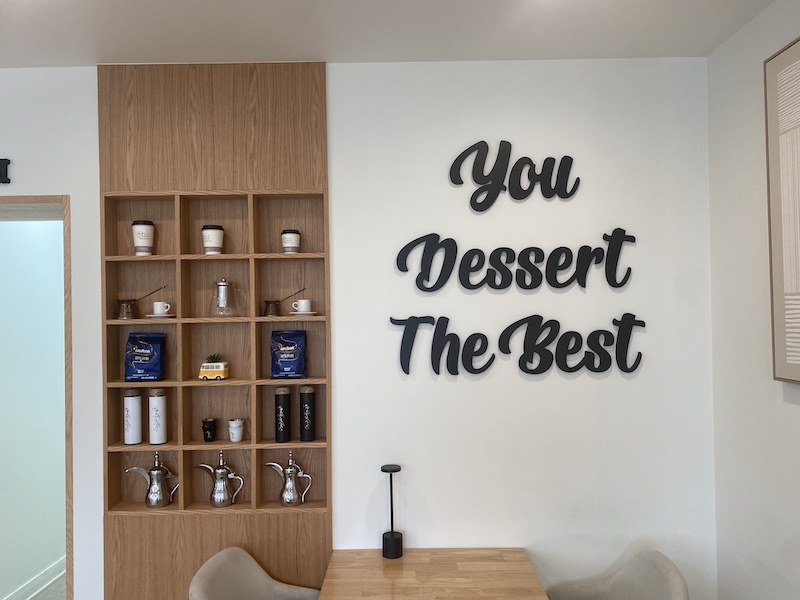
As I’d made the effort to shlep that far for lunch, I wanted to check out a few other places in this constantly changing neighborhood centered on far south Harlem, which I had also not been to since before lockdown. One new thing in the area is Yemeni coffee joints—all of which are posh enough that I assume they are, strictly speaking, Qatari or Saudi owned. The one I went to is called Jazwah, and the coffee is made in kind of a Turkish style, on a burner in a long-handled pot. There were also some desserts, which seemed mostly in the Italian style, nothing that unusual. I suspect the somewhat austere interior would be more fun at night, when Yemenis who don’t drink go out to socialize over coffee.
One last stop, in the same mall, was a dessert place called Milk Cake Bakery. Again in a clean-to-the-point-of-austere interior, the choices were various kinds of cake, the eponymous milk cake basically being like Mexican tres leches cake. The one I got was filled with chopped pistachios, and soaked in milk. It was pretty expensive—one square slice (probably the size of two slices of U.S. birthday cake) was somewhere in the mid-teens—but as soon as I got home and tried it, I instantly regretted that it was so far from me. Anyway, the Arab colony in Bridgeview is one of the busiest and most interesting ethnic dining areas in the region, and I will be back ro explore more soon.