

1. ALINEA AT TWENTY
Grant Achatz, in an interview for my (very) upcoming book, noted a key difference between Charlie Trotter’s when he was there, and The French Laundry when he went there:
I don’t know what Trotter’s was like when it opened. But in ’95, it had been open for like, eight years or so. With the French Laundry, it had only been around for a year and a half when I landed there… And so there was a newness, there was an excitement, but more than anything, everybody’s hair was on fire, because there was still a lot to accomplish.
I could have gone to French Laundry when it was almost that young, but I happened to pick a different, new and well-regarded place when I went out to Napa—Terra. (It closed in 2018.) I didn’t get to French Laundry until it was twenty-some years old, and had scattered the food world with dishes lots of people knew—Oysters and Pearls, Salmon Cornet, etc. And I observed something about what it’s like to be a famous, twenty-year-old restaurant—to steal from Dr. Samuel Johnson, there are dishes that are new and good, but the really good ones are not new—people want the chance to eat the classics they’ve seen in the cookbook, so we had, you guessed it, Oysters and Pearls and Salmon Cornet. And the ones that are new are not—well, I’m not going to say they weren’t good. But they weren’t new classics, on the whole. You can’t just set out to invent classics—you can create the possibility, but after that it’s a matter of getting lucky. So restaurants with fanous dishes, they inevitably become their own oldies act, and can’t scrap everything and start over without disappointing a lot of people who are there to hear “Darkness at the Edge of Town,” dammit.
So the New York Times wrote a piece about Alinea at twenty. And it basically portrays Alinea as an oldies act, glitzed up for the steady procession from diners from all over the world. On some level, it’s almost like the second night you make a dish, it’s already old hat. Only Charlie Trotter, who claimed never to repeat a dish (a question I dive into in depth in my book—let’s just say it’s sort of true, sort of not), could get around that, but the result was that nobody remembers any individual dish from Trotter’s, they remember the atmosphere. They remember him.
I could analyze the NYT piece further, but here’s a little secret—I don’t subscribe to the NYT. It doesn’t seem worth it to be able to read the two or three Chicago stories a year. I prefer to spend that money on Substacks, to support the future of food writing in a post-newspaper world. And so one of them covered it for me—Michael Nagrant at The Hunger, who rips into the genre of knocking the big names when they’re, if not down, old enough to be vulnerable:
They say things like the place isn’t as innovative as it once was (ironically the piece usually includes many examples of the chef still doing something almost no other restaurant in the world is) or that a few dishes during their meal suffered horribly. The horrible stuff is usually minor not even grounded in execution errors but murky subjective statements like “it wasn’t bold enough” “it seemed tired” “I don’t like that seasoning.”
…killing darlings brings the clicks. There are only sixteen Michelin three star targets in America and none of them are in Idaho. Eric Ripert, my man, watch your back. Le Bernardin fits the profile. You could be next.
Anyway, when you get past that, keep reading, because Nagrant has some very good capsule reviews of things he’s eaten, like gnocchi at Bistro Monadnock. Not in a cookbook, so it doesn’t have a big target on its back.

2. ON GOLDEN POND
There’s a bunch of new high end spots and no one has yet reviewed them. LIA, Nic and Junior’s. Trino, Omakase Box. And so the Tribune reviews… a restaurant that opened in 1998: North Pond. Admittedly, it has a new chef, who has also been on Top Chef: Cesar Murillo. Becoming the new chef of a place widely identified with the chef it had for twenty years (Bruce Sherman) is one of those things that makes it hard for people to get to know you, so congrats to Murillo for getting a profile—but that’s what it is, more than a review:
“I didn’t grow up eating a lot of good food,” said the chef. “My mom would make a pot of beans, and that’s what you ate the whole week, until the next week when she made the next pot of beans.”
…“I still see it as an advantage, the fact that I didn’t have good food growing up, because when I became an adult, I was able to almost experience food for the first time,” Murillo said. “I still remember trying fresh-squeezed orange juice for the first time, and I was 21 years old in San Francisco.”
3. ITHAKI MUSHROOMS
Ithaki Estiatorio is a new restaurant in Greektown trying to revitalize the neighborhood, says Anthony Todd in Dish:
[Owner Kosti] Demos notes that a lot of Chicago’s Greek food hasn’t evolved from the Greek-American cuisine of the 1960s, and it doesn’t reflect the current state of food in Greece. Instead of huge portions of lamb shanks and moussaka, Ithaki Estiatorio has a wood-burning grill, a large selection of whole fresh fish, and subtle takes on more familiar dishes. The seafood tower, practically an obligatory dish for a Chicago restaurant opening in 2025, is served with a green olive mignonette and prawns poached in oregano broth. Watermelon carpaccio is soaked in feta brine for an extra tang.
4. VAL’S HALLA
Grimod goes back to Valhalla for an August ’25 report, on the new location post-Time Out Market:
Transplanting Valhalla to Division Street meant finally building a dedicated world in which to showcase the chef’s ideas. The result was a shadowy, minimalist space defined by a single, winding chef’s counter, a curtained lounge, an open kitchen, and a moody trance soundtrack. It played host to an experience driven not by needless finery but by coordination, precision, detail in the right places, and streamlining of the rest. The restaurant represented conscious deconstruction and reconstruction of fine dining that only left what was felt to be most essential behind. Namely, paying just shy of $200 per person, guests would be cared for firsthand by four of Chicago’s finest craftspeople: Stephen Gillanders, Tatum Sinclair, Jelena Prodan, and Sammy Faze.
The cuisine had taken some clear steps forward, but many dishes also remained from the earlier location. More change and more growth would come in time, I was told, as the team settled in. Plus, the caliber of the cocktails, wine, and hospitality on offer certainly impressed me.
Having made my three visits over the course of the concept’s first two months, I bet that “2.0” deserved the upgraded rating its nickname suggested. The food hadn’t hit the kind of highs I expected, but it was reliably good. All the other foundations that were now in place (most importantly at the level of human capital) seemed to ensure that the menu would yield new peaks of pleasure in due time.
5. ON THE SIDE
I already had my moment with the pizza at Side Street Saloon—Steve Dolinsky touted the pizza and I dutifully went and tried. It wasn’t my thing, but I admired the idea of a tavern pizza place just blocks from me that had been plugging along, unknown to me, for ages. Anyway, Dennis Lee writes about it with the eye of a professional pizzaiolo:
After observing how pale everyone’s pies were, I asked for mine well-done, but still got a pale pie. Bing bong. After having made pizza for a long time, I’ve just got a simple theory as to why. As I mentioned, the place was packed, and everyone was eating pizza. If you’re cranking out that many pies with an oven that’s not designed for that kind of volume, it can take more than a while to come back up to temp. So I don’t think what I received is representative of what most people do on a regular day.
Other photos I’ve found on social media show pizzas with cheese that has been properly caramelized. I think I’ll just have to go back on a quieter day to see if my theory is correct.
6. FIRE IT
Did you know that the Chicago Fire’s meals are not just carefully planned for health and performance, they also come from one of Chicago’s favorite restaurant groups? Daniel Hautzinger at WTTW explains how One Off Hospitality feeds the soccer team:
What most people want to get out of dining at One Off Hospitality restaurants is pleasure: the luscious flavors of avec’s tomatoey bacon-wrapped dates, the heartiness of a loaf of Publican Quality Bread, the smoky grease of brisket hash at Dove’s Luncheonette. And enjoyment is part of feeding the Chicago Fire, too. “Things tend to get boring sometimes,” says Gregg Berhalter, the Fire’s head coach and director of football, and a former professional player himself. “So you need chefs with an imagination in keeping it fresh and keeping it flavorful.”
But food is also a utilitarian tool for the team, a fuel that they need in order to make it through a game, build muscle, and provide nutrients to keep them in good health. “They’re very aware of their diet,” says Gabriel Moya, the One Off chef de cuisine who leads the commissary kitchen at the training facility. “There’s a big difference in how they eat during the week [when they’re training] and how they eat before a game.”
7. VEDANTA HIGHWAY
Two writers recently let go in the media’s ongoing efforts to cut its own throat turned up with new pieces this week. First, Ahmed Ali Akbar, ex of the Tribune food department, published the first piece at his Substack Rad Brown Dad, about a Sikh dhaba on the Pennsylvania turnpike. A what? you ask. Well, a lot of truckers in America these days are Punjabis. And so, as happens wherever truckers go, places to eat pop up to feed them. So Akbar talks about them and their food:
For Punjabis, the “dhaba” is a romantic kind of thing, sort of like the 24-hour diner. They’re street-side eateries that are full of character, affordable and delicious. I’ve had my fair share of dhaba experiences in my travels through India and Pakistan. In the 90s, weaving through the Himalayan mountains, my family would have some of the most unique culinary experiences on benches sitting steps away from a sheer drop off of a mountain.
But he also muses, inevitably, about who he’s writing for when he’s not writing for a paycheck:
For me, writing is like getting blood from a stone. Reporting, on the other hand, is seamless. I am an extrovert reporter, one who loves thrusting myself into new situations. But pitching has always been the biggest stop gap; I know from conversations with others what makes a story. And I’ve always sold my writing, never finishing it for anyone but an editor. I don’t always know what my piece will be until I sit down to write and rewrite and rewrite. I know it’ll be good.
Meanwhile, in South Asians Recently Let Go, Ashok Selvam, former editor of Eater Chicago, pops up on Instagram with a video of a visit to Sho, the new sushi place in Old Town. It comes off kind of like an influencer video, but it’s the first one, I’m interested to see where he goes as he works his way toward a distinctive voice—not as an editor at Eater.
8. WHAT IS A RESTAURANT?
Eddie Lakin ponders this question, with a lengthy quote from Milwaukee chef Dan Jacobs thrown in. Anyway, here’s Eddie:
Restaurants are supposed to be places where whole foods are prepared fresh from scratch, at the very least. Right? Let’s have standards. That, we should expect. Soups and sauces should not be coming out of cryovac bags or cans. Vegetables should not be arriving at the back door par-cooked or frozen.
For me, working in this industry, that’s a floor-level expectation.
But it rules out a huge percentage of my restaurant options.
9. LISTEN UP
Culinary Historians of Chicago just did a program with the authors of a book about Wisconsin cheesemaking—including my friends Keith Burrows and Leslie Damaso who own the Mineral Point bookstore Republic of Letters. Go here to listen to the Zoom call.
Chewing has an episode, it says, about markets, chaos, and scoby snax. We’ll both have to listen to figure that one out.
Joiners talks to Chris Jung of Maxwells Trading.
The Chef’s Cut talks to Chef Ayesha Nurdjaja, of Shuka and Shukette in New York City.
WHAT MIKE ATE
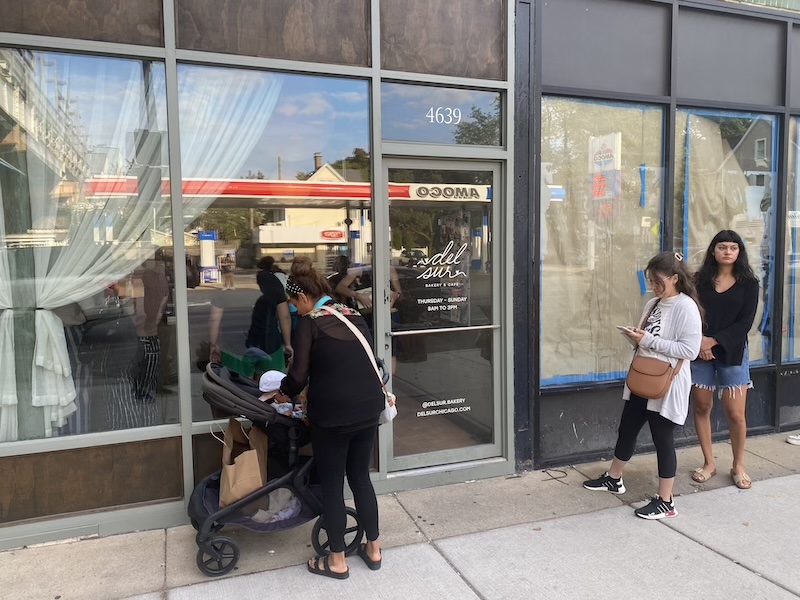
Well, as my picture this week suggests, the line at Del Sur Bakery is at a point now where I could see just swinging by to pick up some stuff—I already tried and liked their stuff, but back when they did a popup at Side Practice, before they had a two-block line every morning. So what do I think of their Filipino-influenced pastries? I continue to think they’re really tasty! I had a morning bun with calamansi filling, which was a bit too tart, but a thing that looked like an eclair and was flavored like turon (banana lumpia) was excellent, and the toasted rice croissant—not quite sure how or what toasted rice brought to a baked pastry, but It was very nicely done. If you haven’t been, go and spend five minutes in line, it’s worth it.
Bai Ordo is across the street from Harvestime, so I’ve noticed it for a while. What is it? One website I saw talks about Turkish food, but somewhere else I saw that it was Kyrgyz—and the fact that the staff all had Chinese-like features supports that notion (Kyrgyzstan borders China to the north of India). So… we ordered French food! Seriously, we ordered a variety of things which suggest that Kyrgyzstan is quite the culinary crossroads. Chicken and mushrooms in a mushroom and wine gravy—basically a French chicken fricasee. Grilled chicken kabobs, speared on a huge knife and served with rice topped with some (rather stringy) bits of lamb (I think). Manti, Turkish dumplings with a yogurt sauce on them. And a carrot salad concealing a hearty garlic punch. Oh, and one thing showing this is a restaurant run by people who are new to America—no napkins, but every table had a box of Kleenex, which you used for napkin purposes as best you could. Another, perhaps, was that each dish sent us home with more than enough for the next day.
The fricasee was the winner, happily comfy, happily devoured by my wife the next day; the chicken kabobs were good (if a little oversalty), the manti, alas, mainly tasted like rubbery pasta, little flavor from the meat stuffed inside it. But it was interesting, and I think there’s other corners of the menu worth exploring; I need to gather a group of six or eight some time to be able to try things (and not go home with a fortune in styrofoam containers).
Afterwards—with garlic on my breath—we went to a gelato place further west on Irving, Ciao Ciao Gelato & Cafe. I had no idea if it was a solo shop or part of a chain, and I thought it must be the latter when I saw the spread of something like 30 or 40 flavors, and the guy mentioned to someone else that they have 150 flavors in total (but not all at once, I assume). Anyway, it’s pretty nice, fairly authentic Italian-style gelato, like I’ll soon be enjoying at my film festival in Italy—the main thing that told me I was still in America was how huge the “one scoop” serving was. I only ate about half of it (black raspberry).