

So I went to an opening for the first time in months—too busy with the book and other things. But Adalina Prime, a steakhouse offshoot of hot Italian restaurant Adalina, seemed like a good time to go out and see other humans. So: spectacular interior, one of the most handsome I can remember seeing in a long time, and positively dripping money. The bites I had were impressive, not that party bites necessarily give you that clear a view of what dinner would actually be like, but this is a place that probably will see Friday night crowds as big as this event’s mob, so I think we can fairly say they can serve quality in quantity. Not in quantity any more are food writers; I only saw a couple I knew. And finally: Landan Twins! Haven’t seen them in years, didn’t know if they were still in the influencing or party-livening business, but there they were, each tanned to the point of looking half-Indian or something. So with or without food media, hot openings still happen.
1. POLISH WITH POLISH
(see, you pronounce the first one Poe-lish and the second one Paw-lish, and… oh never mind)
Liz Grossman has a piece at Chicago about Artur Wnorowski and Gosia Pieniazek, whose burgeoning mini-empir of modern Polish restaurants includes—so far—Pierogi Kitchen, Wurst Behavior and Spoko:
At Spoko… they serve maczanka (pulled meat sandwiches dipped in bone broth), ’80s-era gofry waffles with whipped cream and powdered sugar, and zapiekanka (a.k.a. Polish pizza). “The restaurants and nightclubs in Poland are open pretty much all night, so you’d leave the club at 5 a.m. and get a zapi,” says Wnorowski, who upgrades the Communist-era open-faced baguette with toppings like beets, goat cheese, mushrooms, and candied walnuts.

2. DIMMI THE LIGHT
Michael Nagrant talks about the parent of some friends, Barry Strum, who was enough of a foodie that he wrote a couple of times for Nagrant’s first iteration of Hungry Magazine. That leads to how his late friend would have felt about Bill Kim’s new Dimmi Dimmi:
The best dish from Dimmi Dimmi is the Orecchiette Tarantino, a nod to the restaurant that previously inhabited the space for over 30 years. These are not your typical Stuart Little sized mouse nuggets, but full size Van Gogh level ear-shaped gems of al dente housemade pasta swaddled in tomato cream and topped with piquant sausage dusted with parmesan snow.
Chicken parm is ubiquitous, but Barry would have loved that the Dimmi Dimmi kitchen indulges in a little iconoclasm by pairing the poultry not with usual angel hair in red sauce, but a thick rigatoni slicked with anise-perfumed pesto. The cutlet is juicy, and the visual appeal of the contrasting green and red sauces satiates the eyeballs.
He also goes to the Alston for a steak meal on an epic scale:
The gigantic oceanliner of a room is filled until midnight on weekends. It’s high wattage. I would have loved to have stepped foot in Morton’s or the Pump Room at their heights, but those departed souls who did might have loved the opportunity to experience The Alston.
Certainly they would have loved the “sole-whisperer” handiwork of [Jenner] Tomaska, the flaky white fish roasted on the bone buttressed with plum grapes slivers and garlicky creamy sauce Véronique.
3. TACOS DEL NORTE
“Anyone that says you have to go to Pilsen to get good tacos is seriously misinformed,” says Titus Ruscitti. Yeah, I’d go to Little Village instead—but his point is that there’s good Mexican food on the north side too:
Next we head even further north to Edgewater which is where you’ll find my favorite fish taco in all of Chicagoland. Edgewater Tacos has been around for a little while now and it’s become a bit of a neighborhood staple as their walk up window (no indoor seating) stays pretty busy throughout the day. It’s far north side location makes it a bit of a journey coming from Logan Square but it’s one I make a few times a year for their terrific tacos de pescado. There’s nothing special about them as far as prep or ingredients. They do a simple version using fresh fried beer battered cod, lettuce, tomato, and chipotle mayo on a warm corn tortilla and they’re perfect every time.
I just noticed that a stand in Mayfair I often drive by, and which it’s usually impossible to tell whether it’s open or hasn’t been for ten years, has a new life as a taco spot called No Pasa Nada, and Titus of course has been and has the report.
He also has a post about what to eat in Joliet:
According to AI approximately 33.5% of the population in Joliet identifies as Hispanic or Latino. This translates to roughly 50,510 people and tons of taco options. Tortilleria Sabor A Mexico is a lowkey one stop spot for all your taco needs. They make and sell thick corn tortillas on site and also package up their made on site salsas and have fillings like Nopalitos a La Mexicana which is cactus prepared with green chile peppers, white onions and red tomatoes. They’ll also make tacos for you right there using their delicious warm corn tortillas. The specialty of the house is a taco with cecina (dry cured beef), refried beans, and cheese and two of them will kill your hunger for the rest of the day.
4. MAXWELL DE MINIMIS
Grimod at Understanding Hospitality went to Maxwells Trading and decided what the star dishes are a while back. Now he pokes around the “B side” of the menu, to see what’s there and how it comes off:
[Erling] Wu-Bower and [Chris] Jung’s work with seasonal produce persists with a preparation titled “Plum Panzanella” ($24)… This item represents the latest in a series of collaborations with Loaf Lounge—more particularly, with the bakery’s marbled rye. Here, the bread is lightly toasted and serves as a vessel for stracciatella, the titular stone fruit, some bits of banana pepper, and a dressing of shiitake tsuyu (typically a dashi-, soy-, and mirin-based dipping sauce). When it reaches the tongue, this “Panzanella”almost seems to replicate its namesake salad. The bread retains some structure but is delightfully yielding: allowing the oozing cheese and moist segments of plum to all cohere. The resulting flavor here is expectedly sweet. But it is the traces of heat, tang, and umami, playing against the earthy quality of the rye, that really make this dish sing. This construction, so pleasurable, just feels effortless. It ranks as one of the surprise highlights of the night.
He also talks about how Indienne has been doing since it won the first Michelin star to go to an Indian restaurant in Chicago:
Indienne had not leveraged the award to slow down or begin to cash out. Rather, ownership had reinforced the staff, further refined the space, and tuned its cuisine (in terms of pacing and presentation) like clockwork. Objectively, I thought the food tasted better too—even if the dishes still did not quite reach that memorable, “best in the city” (irrespective of genre) caliber.
5. CHARTREUSE GOOSE
At the Reader, a piece on the very old-fashioned liqueur Chartreuse:
For decades, Chartreuse was considered old-fashioned—not something most people would order on its own, except maybe goths attracted to its romantic history, emerald hue, and spicy-sweet flavor like a liquid clove cigarette… Then the Last Word—a cocktail made from equal parts Chartreuse, gin, maraschino liqueur, and lime juice—became one of the biggest drinks of the cocktail revival in the early aughts. Chartreuse suddenly had a place on the front bar, and mixologists delighted in experimenting with its range.
6. ITHAKI OF THE KILLER TOMATOES
At WTTW, Daniel Hautzinger talks about Ithaki, a new Greek restaurant from a veteran Greek restaurant family, in a famed location:
Fifteen years after the restaurant he managed for his uncle burned down, Kosti Demos is returning to the same block to open a new Greek restaurant that he hopes can revitalize Chicago’s once-bustling Greektown. On August 29, Ithaki Estiatorio opens at 314 S. Halsted St., in a space that once housed The Parthenon, which closed in 2016 after 48 years in business. The Parthenon is among several mainstays that have closed since the Demos family lost Costa’s Greek Dining and Bar to a fire in 2010. Demos hopes Ithaki can help reverse that trend.
Hautzinger also has a piece on the oddly-named Creepies, from the couple behind Elske:
The dishes – conceived by Elske chefs and co-owners Anna and David Posey and executed by chef de cuisine Tayler Ploshehanski – are generally French, in a relaxed sort of way that incorporates the seasonality and comfort of the Midwest: tarte flambé with melted leeks and maitake mushrooms has the cracker-thin crust of tavern-style pizza, ham and cheese ooze together in Parisian gnocchi, crepes embrace summer with corn and succotash, tomatoes and peaches mingle with tapenade and labneh.
Casual French cooking “has always been something that I’ve been drawn to,” says David Posey, who created the savory dishes. “And then being in Chicago, I kind of inherently picked up the flavors of the Midwest, and I’m drawn to that.”
7. TRACTOR PULLED
Farmer Henry Brockman’s stand is one of the big draws at the Evanston Farmers Market. At WBEZ, a piece on how Brockman recently survived a serious tractor accident:
He straightens his 61-year-old frame, the same body that, for a few terrifying seconds last year, endured punishment that probably should have killed him: He was run over by his own 3,000-pound tractor.
From head to toe or, more precisely, from toe to head.
“I remember a vague and fleeting concern for where the tractor was going to end up, but then the pain kicked in, and the world became very, very small, with no more thoughts of a driverless tractor careening off somewhere,” Brockman wrote in a seven-page letter about his March 4 accident to his customers.
8. SANDWICH OF HANOVER
Adelaide was the queen of William IV, succeeded by Victoria. She’s also a sandwich for parties and teas, says Sandwich Tribunal:
According to an article on the BBC website, coronation chicken may have been inspired in part by this obscure sandwich, supposedly a favorite of Queen Adelaide’s. That claim was based on a passage from a 2010 biography of Constance Spry, cookbook author and florist to royalty. Constance Spry, along with her fellow Le Cordon Bleu chef and frequent collaborator Rosemary Hume, had been the originators of the Coronation Chicken recipe created to celebrate the day Elizabeth II was crowned Queen of England.
But either Constance Spry herself or her partner’s niece, who imparted that story to the biographer, seemed to have misremembered the sandwich in question. The passage claims that the source of inspiration for Coronation Chicken, which is essentially a cold chicken salad in a curry cream sauce with fruit and nuts, was the Adelaide Sandwich recipe from the 19th Century recipe book Savouries à la mode by Harriet Anne de Salis, and describes the sandwich as “chicken with a curry and apricot butter.”
The problem is, the Adelaide Sandwiches from Savouries à la mode do not remotely match that description.
9. LISTEN UP
Supper With Sylvia—Kevin Hickey (the Duck Inn) is always fun to talk to about his youth cooking in the rough and tumble days of Rush Street. He talks about all of that through the Duck Inn and the renovated Ramova Theater.
The Dining Table talks artisan bakeries with Arshiya Farheen of Verzenay in Lincoln Pasrk.
The Dish from Chicago magazine: John Kessler, who just reviewed Mister Tiger, and Amy Cavanaugh talk about Korean food in Chicago.
Joiners— I’ve interviewed Dana Cree a few times here and she’s always thoughtful and insightful. Now Joiners talks to her, too.
The Chef’s Cut—the condiment competition continues, and what tools Joe takes on a trip.
IN MEMORIAM
Longtime Italian restaurant mainstay Coco Pazzo announced the passing on August 28 at age 90 of longtime manager and host Sergio Lombardi. As one guest put it, “Such a lovely man and an icon of the restaurant.”
WHAT MIKE ATE… IN WICHITA
I went for about a week to my home town, Wichita, and spent a week mostly eating cheeseburgers and having country-style breakfast. This was during the Cracker Barrel business on social media, so I posted about that place versus a longtime (c. 1910) local Wichita breakfast joint, Livingston’s Diner. What I didn’t comment was how hilarious it was for blue collar Livingston’s to suddenly have such a lavish location in the poshest shopping center in town—it’s like if Belmont Snack Shop (RIP) opened on Oak Street. There’s something delightful about people in the wealthiest part of town driving their Range Rovers to this mall to eat the exact same food their great-grandparents had eaten when they came to Wichita for defense plant jobs after the Dust Bowl. Livingston’s will always be the gold standard for me for one of America’s finest, cheapest foods, biscuits and gravy (or as I call it, flour on flour).
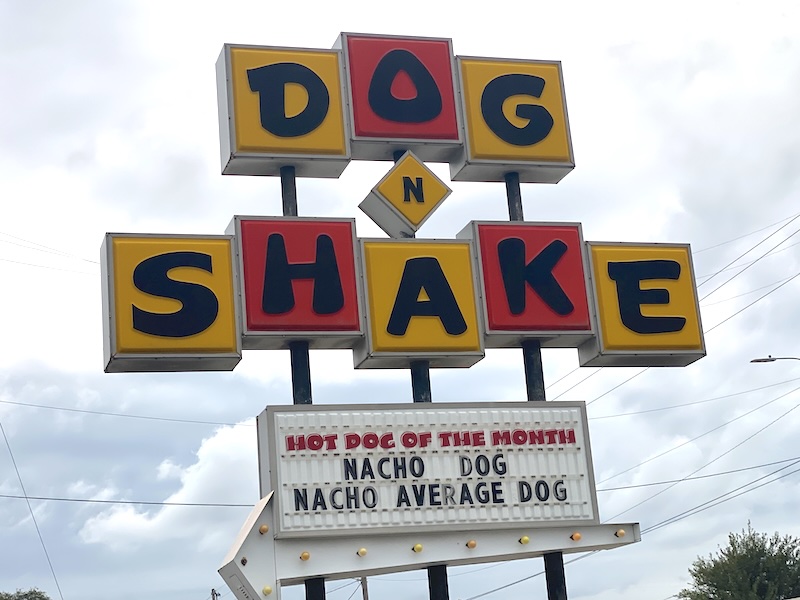
As far as cheeseburgers go, I went to one of my old favorites—Bionic Burger; when “Oklahoma onion burgers” became a thing here I scratched my head a little, because I think of near-smashburgers piled with onions as simply being “burgers”—that’s what I grew up on. (Not quite the lacey edge of a true smashburger, but one of my favorite memories of Bionic Burger was seeing balls of beef on a square of paper, lined up in a grid. When someone ordered a burger, the cook would grab one of the balls-on-paper and smack it down onto the griddle, flattening it with his hand, then peeling the paper away.) Alas, my 2025 Bionic Burger was fine but didn’t quite find the same nirvana of griddle precision. I also went to Dog N Shake, which has the best signage in town but I never quite loved for dogs and burgers; we went there for another Wichita favorite, the cherry limeade (Sprite, a couple of squirts of cherry juice and a couple of squeezed lime halves). When I moved to Chicago I just assumed cherry limeades were everywhere, but quickly learned otherwise. You can get them now in Chicago at Sonic, which is no coincidence—the expansion of Sonic in recent years was led by investors from Wichita (I went to school with the kids of one of them, Jamie Coulter).
Wichita also has a large Lebanese population and there’s always been pretty good middle eastern food there. My mom has half lived on tabbouleh since the 70s, so she took me to one of her favorite places—coincidentally in that same mall as Livingston’s—called Cafe Maurice. It was perfectly fine, but no more, for a plate of grilled chicken, onions and red peppers in hummus and a side of falafel to mop up the last of the hummus with. By the week’s end I was pretty done with burgers, and while the city has always had a certain amount of Asian food, my sisters both worked at a Korean-owned pancake house, but it has really seemed to boom lately. My mom had had a favorite banh mi place, but it had closed; I found a Vietnamese spot, Da Nang Bistro, just a couple of blocks from her house, so we went there. She and my son both had banh mi and liked them a lot—my question was, do they bake their own bread? I would have bet not, but Mom didn’t recognize the bread style from anywhere in town. Anyway, they liked their banh mi, I had a bowl of cellophane noodles with crispy pork and it was very satisfying.
Finally, my mom comes from a German Mennonite background, and she’s always been a fan of a place that has a low German buffet, The Breadbasket in Newton a half hour north of Wichita. (The thing in Planes, Trains, and Automobiles about having to get a ride from Wichita to “Stubbville” to catch the train? It’s true, and Newton is where you really catch it.) I decided I wanted to try it. It reminded me a bit of Old Warsaw in Broadview—a very hit or miss buffet, often as much comfort food for 80-year-olds as anything German or Mennonite; even Mom said the vareniki (Ukrainian pierogi) were always overcooked there. But several things nailed our German Mennonite tastebuds just right; I particularly liked a bowl of chicken borscht, and several desserts were excellent, like, surprisingly, bohnne beroggi, a Swiss dessert that’s like a cinnamon roll stuffed with mashed white beans. Sounds weird (and kind of Chinese, like red bean paste pastries), but it was a hit.
Growing up, I often thought of Wichita as the whitest, most ordinary place to eat in America—a town that has been a power in fast food chains as the home of White Castle, Pizza Hut (I went to school with their kids, too), Sonic and now Freddy’s Frozen Custard and Steakburgers (never heard of it? There’s more than 500 of them, including in the Chicago burbs). Hey, I worked at McDonald’s at the time, my worldview was pretty burger-based, though I couldn’t not eat some tabbouleh along the way. Returning after all these years—haven’t been there in almost a decade—it’s a diverse city with plenty of immigrant restaurants, and like many places in America, offering more than meets the eye, which at first glance is chains, chains, chains.