

1. WHAT WE CAN DO
I go away for a week and when I come back, the restaurant industry is in a crisis again—not COVID, but ICE. They’ve raided some restaurants, but more than that, they’ve made Latino neighborhoods seem scary places to go. When I got back on U.S. social media, I saw that many people had posted a message on their Instagram feeds or whatever, and it took a little poking around to track it down to Jason Hammel of Lula:
If you’re asking yourself, how can I respond? What can I do? I have a simple suggestion. Go out to eat.
Let’s think about the restaurants in our neighborhoods. Almost everyone I talk to says that this terror in our cities has caused slow nights, quiet days, which means that those in our communities who need the most are worried about their hours being cut, lower tips, about not having what they need for their families.
Just like in the pandemic it’s about the front line. It’s about the deep economic chain linking our food business to farms and florists and delivery drivers to every server, cook and dishwasher in your local restaurants. And my suggestion is about having you all out here, being present, showing up, letting them know we are behind you.
…I’m flipping the script on what I asked in 2020. Back then it was order takeout, support our local businesses. Today I’m saying come on in, go out tonight, pack every neighborhood.
Here’s a good piece at Block Club about the impact on Mexican restaurants in Belmont-Cragin.
A food Substack previously unknown to me, Mona’s Tongue, posted on Reddit that she was listing places to go on walking/eating tours of Latino neighborhoods; start here.
One in particular you could support: Katherine Anne Confections had put up an “ICE is not welcome” sign, among other things, got talked about in a Tribune piece—and soon was dealing with hate mail and online attacks. So go there and have some hot chocolate.
These don’t have anything to do with ICE, but two more you could make a point of supporting right now: much-loved Dear Margaret suffered a fire and will be closed for some weeks. They’ve almost raised the desired $25,000 to cover staff while they rebuild, so go here and maybe you’ll push them over the top.
I don’t know if you know Quick Bite, an old school dog and Italian beef joint at Western and Foster; back when I had little kids, I knew all such places. Anyway, they got plowed into by a driver, and also are raising money to support staff while they repair the building. Go here to help them out.
2. AND SO IT BEGINS
Year-end awards season, I mean. Michelin announced—well, honestly, I don’t know what it means that they announced that Creepies and the Chef’s Table at the Astor Club (the open-to-the-public part of that private club) are now both Recommended. Apparently that means they’ll both be in the book, but does it mean they’re up for stars? That they’re the only ones eligible for stars this year? Heck if I know, but one thing we do know is that Michelin likes to reward the people that it has already rewarded; Creepies is of course from David and Anna Posey of one-star Elske, and the chef at Astor Club is Trevor Teich, who previously had a star at Claudia.
Rather more comprehensively, the Banchet Awards announced their list of nominees; the list, and nice writeups, can be found at WTTW, and many other places. I like the list, which seems pretty strongly farm to table-y, not that everything isn’t these days (or claims to be), but Feld (nominated for Best New Restaurant and Best Hospitality) and Cellar Door Provisions, nominated for Restaurant of the Year and with a rising chef nomination for Alex Cochran, are two of the most serious about working simply with the ingredients of the midwest.
It’s also a strong list on international cuisine, with nods to immigrant cuisines from all over—Indienne is the first South Asian restaurant to be up for Restaurant of the Year, two African restaurants are up (also surely a first), Mahari in Hyde Park for Neighborhood restaurant and Tesfa Ethiopian Cuisine for Heritage restaurant, two Filipino (at least partly) spots with a pastry nom for wildly popular Del Sur Bakery and a nom to Kanin (Filipino-Hawaiian), the Hospitality category includes expensive steakhouse Asador Bastian, but also Minyoli, the Andersonville Taiwanese restaurant, and Korean Perilla Fare. Chef of the Year in particular seems a tribute to the diversity of influences on the Chicago scene, including John Manion’s South American influenced food at Brasero, Andrew Lim of the Perilla empire, two-time-winner Jennifer Kim (Passerotto) at Proxi, and Zubair Mohajir with his own mini-empire including South Asian the Coach House and Mexican-Indian Mirra.
Anyway, if there’s a name on there you haven’t been to, go check it out—and watch the videos of the nominees being informed (usually by host/majordomo Michael Muser) of their nominations on Instagram; they’re often quite affecting. The show is January 25, and tickets go quickly; go here to get yours.
3. 100 YEARS IN 60 MINUTES
That’s pretty much what you get in WTTW’s Iconic Foods, which debuted Friday night and will be rerun many times in the coming weeks, and can also be watched online here.
It does a surprisingly thorough job of covering all the major Chicago food groups, economically but basically accurately. I was one of the interviewees, and although I have one quote about Italian beef, I mostly turn up to talk about high end restaurants, which I find ironic (given my Chowhound/LTH origins as a cheap eats guy) but after writing my book for the last few years, I could hardly be better qualified to throw out soundbites on Banchet, Gordon Sinclair or Trotter. Where the old Mike turns up is in the section on South Side barbecue—nearly all the B roll of places like Lem’s, Uncle John’s or Honey 1 come from my documentary A Barbecue History of Chicago.
One curious note: in the section on hot dogs, there are several shots of people taking a bite out of the middle of a hot dog bun. Who are these people and how did they learn such a wrong way to eat a hot dog? Bizarre. Anyway, definitely watch it—it’s a thorough introduction to our food scene’s history. Then, if you want more, I know a book that’s coming out soon….
4. A TALE OF TWO PIZZAS
John Kessler’s piece on a couple of new pizza places starts out talking about how there are two kinds of pizza, one of them the thin crust/Neapolitan type that came from Italy to the east coast. Oh man, here it comes, deep dish isn’t pizza, it’s a casserole, the usual anti-Chicago pizza crap. I was afraid I was going to have to gather a mob to ring his doorbell and run.
Then he says this:
The second kind is a pleasure delivery system, an orgy of flavor, a textural marvel of crispness and goo, all designed to make your head explode. This is the pizza of the Midwest, invented by cheese lovers. It’s not precisely a satisfying meal because you always want more, even when you’re feeling green from eating too much.
Okay, he gets us. Very much in the spirit of when, years ago, I responded to the usual Chicago’s isn’t pizza bologna at LTHForum by posting a picture of Porter Wagoner in his pompadour and Nudie suit to demonstrate the excessive delights of Chicago pizza. (Not that kind of “nudie,” click the safe link.)
But enough about Porter and me. Here’s the two pizzas that Kessler likes:
The pizzerati is particularly enamored with Pizz’amici, a West Town restaurant that opened last November. It’s from Billy and Cecily Federighi, the young couple who have done more than anyone to refine this style and create excitement around it. They and housemate Brad Shorten began with a pop-up through their Instagram (@eatfreepizza). Soon fans could buy their crackery pies at Pizza Fried Chicken Ice Cream in Bridgeport. Next the trio decamped to suburban Westmont to open Kim’s Uncle Pizza. After a viral New York Times story got people around the country slavering, their pizza became the golden fleece of Chicago dining. Without the option of delivery or online ordering, patrons drove hours, waited patiently, and prayed just to try it.
and:
In comparison, the thin crust at Zarella Pizzeria & Taverna in River North, which opened in March, isn’t quite as tasty but is something I could eat on the regular. The tavern-style is thinner and drier than that of Pizz’amici, Novel, Dicey’s, and other party-cut newbies; a stubble of cornmeal on its undercarriage enhances the tug and crackle of the crust.
Chris Pandel’s innovation is using Italian 00 flour (the same required in Neapolitan crusts), which contributes to its unusually supple texture. Pandel (Swift & Sons) is one of two chefs at this Boka Restaurant Group joint. The other, Lee Wolen (Boka), contributes an “artisan” pizza, a version of the one he serves at Alla Vita. Take your pick, or order from the roster of Italian American dishes. Zarella aims to please.
6. BALLAD OF FRANK AND MARY
Frank and Mary’s Tavern was one of the homes for Mike Sula’s peripatetic Monday Night Foodball, and now that it’s been sold and Frank and Mary head into a well-deserved retirement, who better than Mike Sula to pen a paean to the old place:
Here’s what I do know: There would be no bar to sell or buy if not for general manager Tony Mata. A legend of Chicago hospitality, Mata—formerly of the Matchbox (where he once fed Anthony Bourdain) and the Silver Palm—was a longtime regular and is a connoisseur of the great American dive bar. He shepherded Frank and Mary’s out of the dark days of the pandemic, preserving its best qualities—like Mary Stark’s daily lunch menu, including her famous meatloaf, served every Wednesday for more than a half century.
7. CREEPY AND DIM
I go away for a week and Understanding Hospitality writes two long reviews. The first is for Creepies:
I was there at opening on August 22nd, and Creepies seemed to have immediately fulfilled its potential. Out of nowhere (despite many years of quiet planning), Chicago dining had been given a shot in the arm. It was the kind of restaurant—almost like our answer to The Four Horsemen—I had long dreamed of: intimate and warm, a bit zany, with a short but sweet (but intelligent, evolving) selection of beverages and a distinctive, playful, yet pinpoint execution (or maybe subversion) of familiar fare.
The next is for Bill Kim’s new place, Dimmi Dimmi:
Overall, I think Dimmi Dimmi succeeds at an aesthetic level: being small (but also comfortable) and fresh (but also classic-feeling) in a way that accords with an idealized corner, neighborhood spot. It’s refined (yet not precious) in a way that’s sure to earn a second look from locals who might not have thought to patronized Tarantino’s. It’s also equipped—maybe not in terms of grandeur but baseline detail—to satisfy those used to dining in Chicago’s glitzier neighborhoods.
8. A LARK IN ASPIC
I go away for a week and Michael Nagrant writes three reviews: of Little Lark, which is a pizza place from the owners of Lardon:
We kept the seasonal thing going with our choice of wood-fired Neapolitan-style pies, fluffy and blistered at the edges and crisp and sooty on the booty. First up was a combo of fresh and smoked mozz, sweet corn niblets, fermented tomato & chili, caramelized onion, sea salt, and Rachael Ray’s preferred culinary lube, aka EVOO.
A bite and I felt like I was out in the middle of a downstate farm pulling fresh ears of corn into my maw straight from the stalk.
And Midosuji, the Boka Group’s latest Japanese restaurant in the Milk Room space in the CAA Hotel:
The intimate counter service experience here is dubbed as omakase, and while there are enough handrolls on offer to justify that moniker, the meal is also inflected with pure Michelin-level French-inspired technique that would be at home at E.M.P. or The French Laundry (another spot [chef Brian] Lockwood worked) so that what you get is kind of a combo Japanese-influenced European pre-fixe.
(A weird note: I just went to Resy to see how much and how busy Midosuji is… and they won’t do reservations for one. At a counter? What in the Nick Kokonas…)
Finally, Nagrant proposes a form of DoorDash roulette where you get somebody else’s order from a different place. Try it, maybe you’ll like it! From there, somehow, we wind up in a concession from the Honey Butter people in a pickleball facility, Honey Butter Beach Club:
As soon as Josh Kulp who partners with Christina Cikowski started talking about HBBC’s lobster roll with Honey Butter on the Joiners podcast I knew I had to go here.
Sadly, the roll is only served on Fridays, and it was Saturday. But I’ll be back, because everything else I ate was fantastic.
Candied jalapeno pimento cheese dip is the right level of spicy, sweet, and savory. Served with a crudite and freshly fried corn-chip platter, it also invokes 1970s swinger parties in all the right culinary ways.
The fried shrimp, flaky, deeply mahogany colored and slathered with honey butter is a racquet smash down the middle.
9. IT’S A MIRRACLE
I go away for a week… okay, enough. I went to Mirra, Zubair Mohajir and Rishi Kumar’s Indian-Mex place (Kumar was previously at Bar Sotano) and I really liked it, but curiously other food writers I’ve talked to were not so enchanted. At least Titus Ruscitti liked it:
Rasul’s Roti Quesadillas is perhaps the most joining dish on the menu. Roast Mushrooms, Amul Cheese, and Chettinad Masala is stuffed into a house made roti before a trip to the griddle. It’s been a mainstay on the menu since day one. According to a blurb I read in Chicago Magazine this dish is “an homage to a signature dish at Rasul’s El Ranchero, a now-closed Northern California restaurant that broke new ground by bringing together the foodways of the area’s Punjabi and Mexican immigrant communities.” I love a dish with a fun backstory.
10. DE MINNAMIS
Dennis Lee at The Party Cut went to Minna’s, a great Mexican diner which I featured in this piece before COVID, but haven’t been to many years:
I’d been once years ago, and I remember absolutely loving it, specifically for the handmade tortillas. There’s a ton of counter seating facing the flattop grill, with some small booths alongside the wall. When I visited yesterday, every single seat was occupied except for the one tiny booth I managed to snag. I was relieved to see the place was packed.
Here’s the link. He also went to Ocean Grill and Bar, the Vietnamese mostly seafood place in Chinatown which was a Banchet nominee last year:
I’m a big fan of snails in any form, whether it’s in Korean snail salad or buttery escargot, so getting an order of the Canadian sea snails stir-fried with garlic butter ($14.95) was a no-brainer.
These are slightly tricky to eat, only because you have to really tug at the snails to get them out of their shell. But you have to do so gently so you don’t tear their flesh too much, otherwise those parts retreat back into their housing. When you get one out intact, make sure to drag it through the sweet garlic sauce for full effect. The thicker, more muscular part of the snail is chewy, while the vulnerable portion inside is soft and yielding.
If the idea of that garlic sauce doesn’t appeal to you, those same snails are also served with other types like tamarind, lemongrass, salted egg yolk, and more — so you can look around for something that’s up your alley.
11. TABOON FOR PRESIDENT
Nick Kindelsperger went to Seedo’s Levantine Bakery for a standout sandwich in the Loop:
Seedo’s reaches its true calling with the “sandweeshes”—creatively topped sandwiches that combine eastern Mediterranean flavors with Midwestern-sized portions. Each starts with a much thicker version of taboon bread that’s halved crosswise and placed in a sheet pan. Then a sandwich big enough for Garfield is constructed, before being cut into somewhat manageable slices. (The format reminds of the big sandwich you’ll find at Publican Quality Meats.)
He also seems to have a theme for his Loop food coverage: enough with the bowls already! A place called Imee’s Kitchen. Here’s the typical state of things:
Not only can you pick your protein, but you can load up with multiple kinds of bases, half a dozen vegetable sides, and sauces of nearly every color and spice level. This theoretically empowers each guest to craft their exact experience, but it can also lead to confusion and questionable combinations. (I wrote a whole article about this issue with Chipotle years ago.)
…Imee’s Mediterranean Kitchen, located inside Chicago’s Board of Trade building, doesn’t want to be Chipotle, and it’s all the better for it. Owner Nicole Nassif is from Lebanon, and unlike the anything-goes attitude of those other places, she’s particular about what she serves and how you eat it.
12. SPEAKING OF CHICAGO HISTORY
Les Nomades, one of the last living links to the Banchet era of Chicago’s culinary evolution, and a major topic in my upcoming book, has announced that they will close (no date given, at least at Instagram). Mary Beth Liccioni:
When we opened our doors 32 years ago, we never could have imagined the incredible journey ahead — the laughter shared over meals, the celebrations hosted at our tables, and the friendships that blossomed over the years. You welcomed us into your lives, and for that, we are forever grateful.
Les Nomades was originally founded as a private club by restarateur Jovan Troboyevic, mainly as a way to control his guest list. From my soon-to-be book:
MAGGIE TRBOYEVIC: Les Nomades came about because he wanted a restaurant where he didn’t have to deal with conventioneers. The problem was always that secretaries in those days, they’d book a lot of restaurants. The boss is coming into town for whatever reason, and they would give him a list—there’s six restaurants that you can choose from, where would you like to go tonight? And he would make his choices, and she would never cancel anything. This was infuriating to Jovan.
BERNARD GUINAND: He always knew if they were convention people, because they were [parties of] six, seven, eight.
MAGGIE TRBOYEVIC: Charging a dollar made it a club. And then he could just simply say to someone who was really miserable—you know, you’re not happy here, you’re always complaining about everything, and we want you to be happy. And we’re not happy with you, either. So we’re just going to remove your name from our list, and you don’t have to come here anymore. Just go somewhere else where you’ll be happy.
Eventually Jovan retired and Mary Beth and her then-husband Roland, who had mainly worked for Banchet, acquired it and took it over, believing the city was a better place to be by then. There’s lots more to the story, including a great tale of Trboyevic firing a customer for being too loud at dinner, in my book. As for Les Nomades under Mary Beth (and part of the time, Roland), I went there several years ago and it was old school lovely, the room was a little ghostly but I don’t think I’ve ever seen things brunoised as perfectly as what came out of Roland’s kitchen. It is a farewell to an era of Chicago dining, (H/t Susan Bush)
13. SOMETHING ELSE TO WATCH
Le Bouchon is the subject of the new episode of Ari Bendersky’s restaurant video series Family Meal. Go here to hang out with them.
14. LISTEN UP
Joiners talks to Heather Bublick of Soul and Smoke (I talked to her and husband D’Andre Carter about Moto), and to Joe Spretnjak of Apolonia (sister restaurant to S.K.Y. and Valhalla).
David Manilow on The Dining Table talks to local chefs about where they go to eat.
On The Chef’s Cut, they talk diner breakfast favorites, and the new World’s 50 Best list for North America.
After a couple of months off (looks like creator Mitch Gropman got married in the meantime), Another Round returns with a discussion of something Gropman did a deep dive into on Reddit, chicken sandwiches, with Ethan Lim (Hermosa), Henry Cai (3 Little Pigs) and Joe Fontana (Fry the Coop).
Dish From Chicago Magazine talks about places they’ve eaten lately, and also how trendy Tulum was on John’s recent trip. It’s a good roundup of all those new places that no one exists to write about any more.
Supper With Sylvia talks to a guy who set out to eat at every Michelin starred restaurant in Texas, and to the women behind October Cafe, where pumpkin spice doesn’t just come once a year—it’s their whole theme, year-round.
IN MEMORIAM
Tony Fitzpatrick wasn’t a restaurant guy per se, but like a lot of us, he liked the liveliness of restaurants—his last mention here was in regards to a Block Club piece about a frequent gathering at Peanut Park Trattoria. But as an artist, he was frequently restaurant world adjacent, his art turning up in places like Blackbird. Here’s an obit at Block Club, and here’s a piece by Shames about where to spot his art around town.
WHAT MIKE ATE
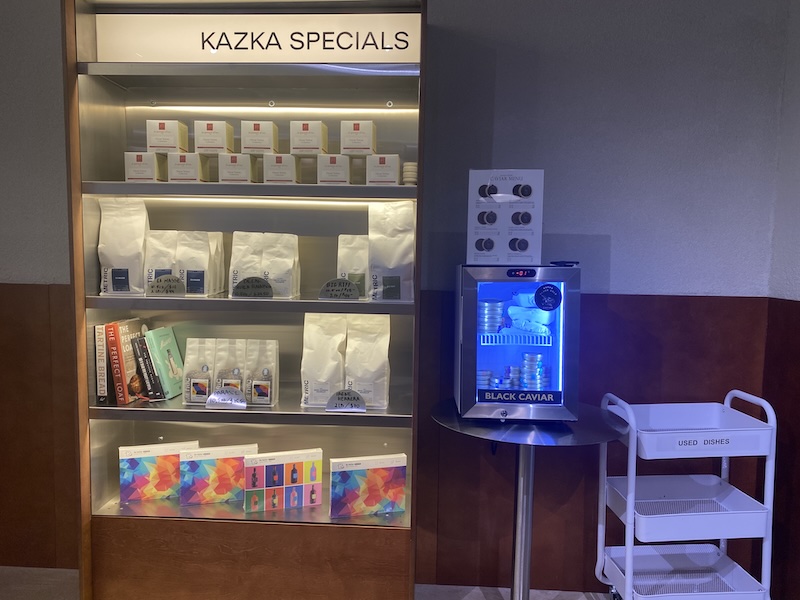
The curious picture this week, with the caviar fridge and all that, comes from a new breakfast spot on Lincoln south of Belmont called Kazka City Cafe, billed with the rather Soviet-sounding tagline “Daily People’s Place.” It clearly comes from somewhere in the former USSR, perhaps Ukraine, though I have yet to track it down precisely—I had syrnyky (pancakes stuffed with farmer cheese, with a cherry compote or pie filling or something), and the last time I had that it was at an Uzbek place on Lawrence. I liked the food but unfortunately the location—a cement-floored, long and narrow space—seems less than welcoming, and it badly needs the owner or somebody talking up the food and his homeland and charming guests. (Play some music, too.) There is, I think, a story about another land to be had here, but it’s not getting out.
I was invited (as a PR guest) to Tama, the latest restaurant in that Bucktown space that has been Glory, Scylla, Takashi, Dixie, Stone Flower and Claudia, among others (who’d I miss?) The chef is a Greek woman named Avgeria Stapaki, who came to Chicago to run Nisos, but that quickly failed and became a steakhouse, Nisos Prime. I was told to come on a night when she’d be in full personality flower at the counter on the first floor, but alas, she wasn’t there.
So I had some decent Greek food without the show. It started off well with trumpet mushrooms tossed in “miso cream cheese” (if you say so), which hit my middle eastern sweet spot for a vegetarian dish—like the labneh with chives at Cafe Ya-Ya. Some beef tenderloin skewers with a balsamic-truffle oil glaze were tasty, nicely cooked, if kind of a cheap date. Next they brought us a burger, not what I would have ordered on my own, but it was actually quite good—caramelized onions, a housebaked bun. A bowl of fall-apart short rib with orzo pasta tossed with white wine and mizithra cheese looked promising, soul-satisfying—but it didn’t have much flavor. After so much beef, seafood seemed a good way to close out—but a branzino was overcooked and had the taste of burnt spices, while the Chinese broccoli was doused in a puckeringly strong amount of lemon juice.
I think there are good things to be had here, but it seems like you should order around the obvious things for Americans who expect to eat steak or a burger, and look for the unexpected—like those mushrooms. I wish everything had been as good and as interesting as them.