

1. SNAP TO IT
The government shutdown may shut off SNAP benefits to families this week (there are a bunch of court cases pending, so who knows for sure). Nevertheless, while the ditherment governs, private enterprise—also known as “restaurants”—stepped into the gap. The first announcement I saw came from a restaurant with one of the greatest legacies in Chicago, Manny’s, who showed their importance to our city:
In light of recent events around SNAP benefits we want to keep our community fed and safe. For this first week, starting Monday, we are offering to anyone who comes in and shows us their SNAP card that we will ake you a family meal for you to eat here or to-go.
Others quickly followed suit. Here’s the Stop-Along; while here’s a piece at NBC 5 listing different restaurants making similar offers.
2. SURLY
This is a big newsletter for pastry, as you’ll see, and Del Sur Bakery feels like old news compared to a couple of newer ones I’ll mention—so here’s the Trib with a review:
Del Sur Bakery in Chicago makes extraordinary and eccentric pastries artfully layering the Philippines with the Midwest, but pastry chef and prodigy Justin Lerias doesn’t quite realize their edible works are comparable to the best in the world.
Lerias opened his hyperseasonal farm-to-pastry-box debut in the Lincoln Square neighborhood in March. If the bakery seems like a stunning, fully formed vision, he might share that it’s been his dream since high school. But he just graduated in 2020.
3. NOODLES WEAVER
Mike Sula wrote about Noodles Party, I mentioned The Infatuation rviewing it last week, and now comes Titus Ruscitti:
Diners can customize their bowls by choosing what type of noodles you want and there’s often the option of getting them with or without broth. In the case of the Boat Noodles they’re offered with pork or beef. I had plans to try a couple of different bowls thinking the very reasonable $10 price-tag would result in a smaller serving of noodles as is the case in Bangkok where customers often go thru multiple bowls of noodles mixed into a rich and dark and savory broth made with beef and or pork bones plus cubes of Mini Coagulated Pork Blood, which is how it gets its cloudy color. That said one bowl ended up being a complete meal when paired with a refreshing bowl of Thai Style Shaved Ice.
4. NEW TRINO
Chef Stephen Sandoval was supposed to open a Mexican restaurant called Entre Sueños, which had been a pop-up at Soho House. In the meantime he’s opened a street food bar called Diego, and now a Latin steak place called Trino. Michael Nagrant, on perhaps his best bite:
So, I dig in instead to the lobster mexicaine, a brandy cream spiked with guajillo chili enrobing a delicate dangle of juicy lobster tail. Talk about Champagne wishes and caviar dreams. This bad boy is the height of luxe. I kind of want to hover the tail over my mouth like a concubine hanging a set of grapes over some kind of pharaoh and swallow it whole.
The lobster is so addictively delicious that I instead savor it in many tiny little bites. When the lobster meat is gone I start dragging the picanha scrims through the remaining sauce to chase the buttery glow of Escoffier-level sauce work refined with Mexican glory.
5. LUNCHTIME AT THE OASIS
I wondered how long it would take for Nick Kindelsperger’s newsletter about places to eat in the Loop to get to Oasis Cafe, located in the back of a jewelry mall on Wabash. About three weeks, apparently:
Sure, Oasis Cafe is located inside a jewelry store. But why should you go?
First, there are all the obvious reasons. Oasis maintains a crucial homespun genuineness that sticks out in a sea of Mediterranean quick-service chains. Oasis feels lived in, a little worn around the edges, and real.
It’s also probably the oldest continuously running quick-service Mediterranean restaurant in the Loop, dishing out hummus before Naf Naf or Benjyehuda were even a twinkle in their owner’s eye. During the lunch rush, it swells with regulars who sometimes don’t even need to say their order before the cashier says, “Your usual?”
I even get a mention as someone who sold Nick on going there. Let me explain, because I don’t want to oversell the (minor but real) charms of this place. I don’t think it would be a standout for middle eastern food (or Moroccan, a definite influence, as Nick notes) in almost any other neighborhood.
But in the ’90s I worked in a couple of ad agencies in or near the Loop. And my lunch choices were dismal. Fast food, occasional Chicago things like Ricobene’s pizza and fried steak sandwiches, which could knock you out for the afternoon. A lot of sandwiches at Wall Street Deli (no memory of any of them). And then… there was this counter hidden in the back of a place to get your watch repaired, a homespun middle eastern cafe. It was the closest thing to real food to be had within walking distance of my jobs over the years. I went at least once a week, and I believe it remains probably the restaurant in Chicago I have been to more than any other. (I still go nostalgically once in a great while, after visiting my dentist with the view overlooking Millennium Park.) It’s not great, and I don’t think I’ve ever promised anyone that. But it’s good, and real food when little else near it was, and for most of a decade, that was enough to sustain a guy… working on the McDonald’s account.
6. CRAWL TO CREEPIES
The Infatuation went to Creepies—just in time for Halloween—and gave it 8.3:
Though Creepies might’ve started as a joke, their French food by way of the Midwest is seriously good. Like brie gougères drizzled in honey that could easily sub in for cream puffs at a Wisconsin supper club, or maitake-topped tartes that are like crispy tavern-style white pies fresh off a Parisian exchange program. For the non-cheeseheads, there are excellent plates of roast chicken in savory liver and wine sauce, or plump mussels in a tangy mix of giardiniera and Pernod foam. And like Elske, great desserts run in the family—the raspberry sherbet merengue cake is what every up-and-coming ice cream cake should look up to.
Though “merengue” is a style of dance music from the Dominican Republic; “meringue” is the dessert.
7. POLISHED
I’ve long thought that Polish food was the most overlooked semi-common cuisine in Chicago—though I think Ecuadoran may be giving it a run for its money these days. Anyway, always good to look through a survey of Polish in Chicago, just in time for cold weather when hearty food will feel good, and here’s one at WBEZ.
8. BÁNH MI MAYBE
Mona Tong tried 47 spots for bánh mi in Chicago and the burbs; here’s her report:
Although I wasn’t too surprised by the results, the journey was quite rewarding. I’ve deepened friendships through the project, inspired more people to appreciate bánh mì, and even introduced some to the sandwich for the first time. I also learned a lot along the way— about my preferences and non-negotiables in bánh mì (crispy, airy bread and ample, acidic veggies), and about Chicago’s Vietnamese diasporic communities, restaurants, and foodways.
9. FUSION REACTOR
The fusion of Asian flavors and classic pastry techniques is a hot thing (more about that below), and Chicago mag walks us through the Filipino-Indian-French offerings at Sarima Cafe, from Zubair Mohajir, Jacob Dela Cruz (both of Lilac Tiger and Coach House) and Reema Patel (Mariscos San Pedro).
Mike Sula also writes about (amusingly overwrites about) one of their specialties, the chai leche flan doughnut, at the Reader.
10. BRAT AUTUMN
Have you had a brat sandwich (or brat burger) in Sheboygan? I have… once. Anyway, if it didn’t win me over as a replacement for a typical burger, I am interested to read about its history at Sandwich Tribunal:
That’s a lot of German bratwursts! So you might be surprised to learn that the so-called Bratwurst Capital of the World is… Sheboygan, Wisconsin. The 19th Century saw political upheavals in German-speaking areas of Europe, and Germans accounted for more immigration to the US during that period than any other nationality or ethnicity. Most of those Germans settled in the Midwest. Wisconsin was admitted to the union as a state in 1848; in its first state census, 38,064 of its 305,391 inhabitants were German. By 1900 there were 268,384 German-born people living in Wisconsin. Sheboygan is the 13th largest community in Wisconsin, and not the most German–but Johnsonville Sausages started as a butcher shop in nearby Johnsonville, Wisconsin and is currently headquartered in adjacent Sheboygan Falls. In 1953, Sheboygan began holding an annual “Brat Days” festival to honor the town’s 100th anniversary since being founded by German settlers.
11. CONGRATS
To Steve Dolinsky, who won an Emmy five months after leaving food reporting. It was for an NBC5 special on Chicago food, which included a Dolinsky segment on a Peruvian dish liked by a Chicagoan named Robert Prevost… better known as Pope Leo XIV. Watch it here.
12. LISTEN UP
Joiners talks to Ryan Castellaz of Discourse Coffee and Agency Cocktail Lounge in Milwaukee.
The Chef’s Cut talks about that viral pancake recipe and the path to publication for cookbooks.
WHAT MIKE ATE
With its mixture of French pastry technique and Filipino flavors, Del Sur Bakery was an instant hit and soon had lines out the front door for months. Here’s another one, and it doesn’t really have lines—yet. It’s called Daeji Dough Company, on Belmont just east of Southport, and it mixes French pastry technique with, this time, Korean flavors.
I went and dropped a small fortune the other morning. Let’s start with breakfast—I got a hunk of what was termed “Blueberry-yuzu focaccia.” You may not think all those things quite go together but the blueberry and yuzu are very much like blueberry-lemon things, common enough, while the focaccia part was a dense, chewy bread with sourdough tang to it—and it was fantastic, one of the best pastries I’ve had in recent memory. I also had a coconut sesame croissant, a bit more conventional, but I liked it at least as well if not better than Del Sur’s toasted rice croissant for French-Asian pastry fusion.
Eight hours passed and I ate the remainder of my box of goodies for dinner. A tteokbokki croissant was an oddity, with spongy, rubbery tteokbokki, coated in a slightly spicy sauce or glaze on top of a puff pastry; I liked it reasonably well though there’s no such thing as taking a bite out of tteokbokki and not immediately pulling the whole thing off the pastry. More satisfying was the smoked brisket roll—puff pastry filled with smoked brisket from Green Street Meats, surrounded by “our signature jalapeno raspberry gochu-jam.” It was a little like eating a brisket and jelly sandwich, but once I got past that, I liked it a lot and would go back for it—though honestly, I think I will be back for breakfast more than savory meals. That focaccia is unforgettable.
Another breakfast item was less exciting. There’s a piece in Crain’s this week about all these bagel chains coming to Chicago, and a similar notn-pawalled one at WTTW. Well, one that’s already here is The Daly Bagel in Oak Park. I had to go to pick something up at the LaGrange Farmers Market, and after I did that, I poked around to see what else there was, and one of the was The Daly Bagel. So I bought some bagels and cream cheese with scallions, and picked up some nova lox on my way home. Sounded like a good breakfast for the next day—but alas, everything was just kind of bland. The bagel had little flavor, the cream cheese was fine but nothing that exciting. I suppose it’s nice that it wasn’t goofy-ass stuff like cacio e pepe bagels, which seems to be the thing now, but bland is not really that satisfying an answer in response.
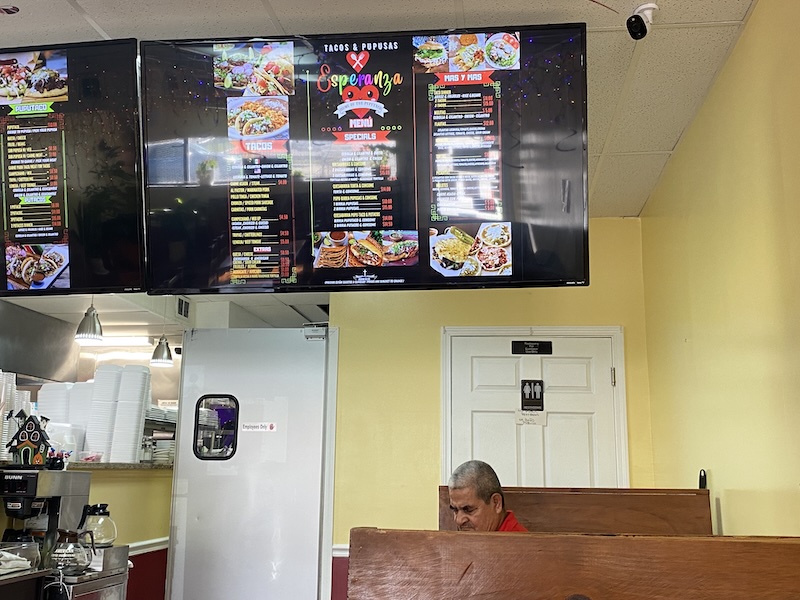
Finally, I felt like Mexican one day for lunch and decided to drive to the south side and find something new (and possibly ICE causing trouble). I found a place on 47th street called Tacos & Pupusas Esperanza. Had a new experience when I reached for the door handle—it was locked, presumably to keep ICE out, though one of the guys hurried over and let me in. Looking over the menu, I saw tacos, and pupusas, and then… Puputacos. Say it out loud and try not to laugh. I couldn’t resist, so I ordered one. It was a pupusa, topped with mushy refried beans and then a pile of carne asada, and finally a big glob of guacamole. It was tasty enough, though I can’t say it was an inspired combination—too much squishiness, which tended to kill the flavor of things like the carne asada. Still, a pretty good place, though I wish it had existed two decades ago, when my then-young kids could have delighted in having eaten Puputacos!