

1. THE TIRE COMPANY’S GAMBIT
I doubted that Michelin would do much other than taking a star from Alinea and giving one to Feld, which seemed a done deal (I knew that Chef Jake Potashnick had been invited to the ceremony, wherever it was). In the end, yes, Feld won a (perfectly well-deserved) red star—and then a second green one, joining Daisies as a place that gets noted for its sustainability practices. The only other move on stars besides that was a second star to one-star Kasama; if we buy the theory that part of what was behind promoting Smyth to three stars two years ago was to make room for docking Alinea a star but still leaving the city with at least one three star joint, this seems like the opening move in a similar gambit. So who knows—Kasama moves up to three? (Unlikely.) Oriole or Ever moves up to three, which would empty the two-star category if they both did it, so Kasama is moved up in anticipation of that move in a year or two? Maybe. Who knows, and more to the point, who really cares, but good for Kasama.
One other award to Chicago, which I am all for—they now give these special awards within several categories to one restaurant in the country for, say, service. And that went to Amy Cordell at Ever, who is an ace captain of the front of house crew, now that co-owner Michael Muser has moved on. Congrats to her.
And hey, we did better than Boston, which paid Michelin to come there for the next three years—and got exactly one star, total.
The Tribune talked to the three Chicago winners:
Potashnick, a 32-year-old Chicago native who cooked in the highest-caliber kitchens of Japan, Sweden, France and Germany before returning home in 2022, knows Feld’s farm-focused menu that evolves each day is worthy of the accolade. The surprising bit is that the Michelin inspectors recognized a kitchen that does things so differently, Potashnick told the Tribune Thursday, a day after he flew back from the Michelin Guide Northeast Cities ceremony.
“I don’t think we ever cooked with a star in mind,” he said. “I think there’s a certain formula to get a certain type of recognition in this type of restaurant. And I’m really proud of the fact that I think we got this recognition by breaking that formula.”
At Reddit, they posted a meme that appears to have originated with Chef Potashnick (though I haven’t confirmed that), sending up the grief he got a year-plus ago for one of Feld’s earliest dishes, three tastes of cheese from Uplands in Wisconsin. (If it wasn’t him, it’s still pretty funny—and true.)

2. TURKEY DAY
But enough about tire company dinner. The important meal is on Thursday and involves a large bird! At the Sun-Times. friend of Fooditor Lisa Shames talks to local chefs about side dishes:
When it comes to Chicago’s Mexican restaurant scene, chef Geno Bahena at Manchamanteles in Logan Square (2009 N. Western Ave.) has cred to spare. His moles are legendary, including at his newest spot, as is his commitment to sharing the culture and cuisine of his native country with the one he calls home.
That’s the approach he took with his unique take on this classic Thanksgiving dish. By swapping out those ubiquitous baby marshmallows for a smoky, deeply flavorful salsa macha, he takes sweet potato puree into savory territory. More layers of flavors come courtesy of toasted sesame seeds and peanuts. Bonus: The salsa macha can be made days ahead of the holiday and is shelf stable.
3. TUTTO DI FLAMM
Anthony Todd talks to Joe Flamm about his upcoming Bar Tutto:
Flamm is the chef behind a bunch of my favorite restaurants, including BLVD, Il Carciofo, and Rose Mary, so I’ll admit I didn’t expect to see him opening a coffee shop (or even, as Bar Tutto promises to be, a part-time coffee shop). But when the space became available in Fulton Market, he says, it was the obvious choice. “The West Loop needs this,” explains Flamm. “There are so many good restaurants, but not a good casual neighborhood hang spot. There’s not a lot of grown-up places to just hang out — every bar is either a serious cocktail bar or meant for 25-year-olds.”
4. AS GOD IS MY WITNESS I THOUGHT HOT DOGS COULD FLY
A couple of food-related stories in the Reader’s People Issue. One about Night Train Veeck, yes, that’s his given name (for a Detroit football player), you can probably guess which former White Sox owner his last name comes from, and, among other things, he attempted to set the record for… dropping hot dogs from a helicopter. The other, by Mike Sula, is about Justin E. Arnett-Graham, a server who also does the Terms of Service podcast, about issues faced by those in the industry.
5. STIFLE, EDITH
I knew a girl named Edith in high school; I think having a name mainly associated with Archie Bunker’s wife was not the best thing that could have happened to her as a teenager. So it’s surprising to me that we just got our second restaurant with Edith in its name (after Regards to Edith, which Eater probably killed by headlining its piece “Fulton Market’s Latest Serves a $19 Italian Beef.” Michael Nagrant does not seem to be trying to kill Jenner Tomaska’s Petite Edith with this preview piece:
Whether it’s creating a course where diners can create a table-side painting, carving scallops to look like marigolds, or serving peanut butter with caviar, Tomaska has impressed me so much over time that I could no longer be a dispassionate observer of his work.
As a subjective supporter I’m looking forward to him twisting bistro convention at Edith, whether it’s serving bone-in monkfish lollipops or fin-on fried and flayed seabream kissed with citrus and a side of smoked potatoes, aka “Fish and chips.”
In the meantime, Nagrant goes back to another familiar restaurant in a new incarnation: S.K.Y., from Stephen Gillanders, now in Lincoln Park:
S.K.Y. 2.0 is the same as 1.0 but also different. If 1.0 was the cute little caterpillar, then 2.0 is the bodacious butterfly. The staff has a “Michael Jordan is always taking the last shot” brashness.
I guess that’s because unlike say Avec River North, there is still only one S.K.Y., it’s not really a sequel as much as a reimagining. Like some kind of gourmet McDonald’s, the lobster dumpling wrappers are as consistently silky and luxe and buttery as they were when I last had them eight years ago.
Other old favorites like foie gras larded bibimbap or the fried chicken are on offer too.
I skipped them for some “new to me” numbers like a sizzle plate of sisig crowned with a constellation of chili ringlets. Served with crispy rice, toasted nori, and a jigger of chili vinaigrette, you swaddle and dab it all together to make your own Filipino/Korean/Japanese-inspired hand roll. At one point, the server offers more nori, but I decline it in favor of scooping the remaining juicy pork straight into my mouth.
6. THE POLISH MOMENT
Could Polish food, the working class staple rarely taken seriously by reviewers, be having a moment? The couple behind Pierogi Kitchen and Spoko are trying to give it one, and so is Maplewood brewery and distillery, says John Kessler (though he doesn’t mention the most notable previous sign of their ascendancy—their Banchet nomination for neighborhood restaurant):
When chef Joanna Janczurewicz (BiXi) was tapped to design a menu, she leaned into her heritage. “I said, ‘Guys, just trust me. Chicago has such a deep Polish history,’ ” she recalls. “It was a bit of a leap of faith.”
7. TEMPURA LOORA LOORA
Dennis Lee checks out a tempura place in the Mitsuwa Marketplace food court:
The main star is the Edomae tempura plate ($22.99), which is featured first on the menu. It has conger eel, two fried shrimp, squid and scallop kakiage (basically a medley fritter), seaweed, and shishito pepper. You can get it as the tendon version, which has the tempura on rice with sauce already poured on it, or the plate, which comes with the rice, tempura, and sauce plated separately.
…But first of all, a note about the dipping sauce — it’s absolutely delicious.
It’s served warm, and I’m certain it must be some sort of soy, mirin, and dashi blend, but the grated daikon radish in it gives it some great texture. And not only that, the radish soaks up the sauce and clings to your tempura, giving you that extra flavor with every little grain that sticks to your food.
8. PIZZA MOLE
Not a fan of weird combinations on pizzas—I feel like a great deal of field research has been done on this subject—but as soon as I heard mole on pizza (the Mexican sauce, not the rodent), I was intrigued by Sharpies, The Infatuation:
Each slice has a crispy bite followed by a pleasant chew. The surrounding frico fence crunches like brittle, contrasting to the melty fusion of brick cheese, mozzarella, and peppery sauce. And the funky toppings, like cheese fondue, sambal, or mole—which has vanished from the menu, so consider this our plea to bring it back—help Sharpies stand out when it comes to Detroit-style pies.
Wait, what? They got rid of it? Well, maybe I need to try this at home.
9. PUTTING THE IN IN EXPENSIVE
Back in my Grub Street days, the New York Times did one of its frequent “36 Hours in [City]” pieces about Chicago, and I ripped it for never seeming to leave a River North rooftop to actually visit the city. Well, they did another one, and Edward McClelland takes it down at Chicago mag; instead of spending an NYT budget, he visits cheap places to actually experience the city:
The New York Times’ “36 Hours in Chicago” recommended $25 martinis, a $30 architecture walking tour, and $44 miso black cod (its mid-level accommodation option has rooms starting at $204 per night), and never ventured more than a mile or two from the lakefront. In United Airlines’ Hemisphere magazine, “Three Perfect Days: A Trip to Chicago,” suggested the West Side consisted of Wicker Park, Logan Square, and Ukrainian Village.
As a cheaper, broader alternative, here’s our guide to seeing as many of our 77 neighborhoods as you can — on a budget. It’s Chicago for the rest of us.
10. HAIL CAESARONI
The Caesaroni is a sandwich with the toppings of a pepperoni pizza and some caesar salad to lighten it up, invented recently in Toronto. Sandwich Tribunal reports on its origins with one of the staff:
So I guess the origin story is, we’re part of a restaurant group. There are 4 restaurants: Bernhardt’s across the street, NL Ginzburg and Dreyfus. The head owner [Zach Kolomeir] is Jewish and his wife [Carmeline Imola] is Italian… and the Caesaroni is kind of a mixture of his Jewish history and his wife’s Italian [heritage]. How can we kind of mix the two? So the Caesaroni was born and, I mean, you can’t go wrong with a pepperoni pizza melt and a creamy Caesar salad. And you know, it’s been a staple on the menu, it’s our definitely number one bestseller.
11. LISTEN UP
A few months back I mentioned that the people behind Spinning J Bakery and Soda Fountain were doing a podcast in honor of their 10th anniversary. The first episode is up now—go here to listen.
Joiners has a big name guest this week: legendary chef, cookbook author and pal of Julia Child Jacques Pepin.
Supper With Sylvia has an impressive name this week too: Farmer Lee Jones of Chef’s Garden in Ohio.
What’s going on this week? The Chef’s Cut talks to its own big name: Eric Ripert of New York’s Le Bernardin.
David Manilow talks to Michelin star winners including Jake Potashnick of Feld, John Shields of Smyth, Sujan Sarkar of Indienne, and Genie Kwon and Tim Flores of Kasama.
WHAT MIKE ATE
I didn’t set out to eat three different omakase meals in two weeks. But I liked the wagyu-driven one last week at Bonyeon well enough that I wound up having two more, mostly seafood-driven, in a short time. And I didn’t mind it a bit—it was interesting for how two places of wildly different backgrounds arrived at quite similar results.
First up: Atsumeru. We have all these new tasting menu spots and I don’t know much about them—except for Feld, none of the reviewers review them. Chef Devon Denzer (who ran a private chef thing called Loon) opened this place in the former Temporis space, calling it Nordic-Japanese. That at least was a concept I could make sense of—too many of the new tasting menus don’t seem to have a clear one behind them.
After the fire that closed Temporis, the landlord apparently dug out the (very short) basement, and now Atsumeru begins your experience in the downstairs bar and lounge for a few bites and a welcome cocktail (it’s still awaiting a liquor license, so the current setup is subject to change). After a few courses you go upstairs for the rest of your meal. It’s a pleasantly relaxed way to start the meal (though the real reason for it may well be that it lets them do two seatings at 5:oo pm and 7:00 pm—the 7:00 pm crowd comes in and goes straight downstairs while the 5:00 crowd is finishing up.
It would be simplistic to say that the downstairs is Nordic and the upstairs is Japanese—the first course (downstairs) was raw amberjack in a rambutan (Filipino fruit) cup, with calamansi to squeeze over it—but a hot puff of gjetost leaned as far one way as anything did. Upstairs, we began with sturgeon surrounded by Thai flavors out of tom kha soup and puffed rice. Raw scallop in a luxurious kabocha squash sauce or puree was followed by a terrific chawanmushi course with skate wing and mushrooms. We’d had a taste of wagyu again downstairs, so I didn’t mind a bit that instead for a savory course we concluded with roast duck under kohlrabi and sea lettuce. The menu says we had six dessert courses after that, but mostly light so I didn’t feel sugared out, like “frozen milk” with pine oil underneath, or a financier with yuzu. A ginger ice cream with a speculoos snowflake cookie would have been a great course to end on, but it was followed by some kind of fish-based cream under papery dehydrated buttermilk—fishy dessert under Communion wafer, it seemed like to me, a miscalculation as a note to go out on.
Service was extremely friendly, even as they had to keep straightening my chopstick holder because I kept fiddling with it. I spoke to Denzer briefly at the end—he came by to ask how we’d heard of his two-month-old, only half busy restaurant. I fessed up to being myself (“You write for Fooditor?” Well, yes….) I liked that—in contrast to last year’s hot new tasting menu chef, Jake Potashnick of Feld—Denzer doesn’t seem all that up on the local food media scene, and to be focused on the food he makes and the people who work for him. (Not to suggest that Potashnick isn’t, but he came out of the box with a social media name, and had to work toward getting his cuisine taken seriously, which admittedly he did very quickly, as this week’s news suggests.) So I liked the feel of Atsumeru—relaxed, friendly, fun to explore course by course—and encourage other people to check out his well thought-out, handcrafted menu. I think it will only get better.
From this homemade, personal restaurant, we go to one that comes from a considerably more exalted background—it’s a Boka Group restaurant in the Pritzker-owned CAA Hotel. (I was invited as a guest by Victoria Kent when I saw her at the Banchet Awards noninee party.) Several years ago I was talking to Kevin Boehm about what might be next for them, and he said they wanted to open a small Japanese restaurant. Yeah right, I thought—the sushi bar at Momotaro seemed as close as they were likely to get to such a thing, as they definitely seemed to be in the big West Loop restaurant business. But sure enough, they did it with Gene Kato at Itoko and now comes Midosuji, in the little pocket bar in the CAA lobby that most of us will know as the Milk Room.
The chef is Brian Lockwood, who’s mostly worked in Denver and California; his main experience in Chicago before this was doing food for The Bear—if you saw Jeremy Alan White plating a dish, Lockwood probably taught him how to do it like a chef, and if you saw a tight closeup of plating, good chance those were actually Lockwood’s hands. Anyway, he’s cooked many different kinds of food, and says that Midosuji represents his experiences doing both Japanese and classic French food.
So we started with chawanmushi again, with caviar at one end, little chunks of cauliflower at the bottom and a “buttermilk mussel sauce.” Shiitake mushrooms were fried into a kind of tempura fritter, with a bonito cream sauce and a side cup of shiitake tea. Perhaps the best dish we had followed, hamachi with sunchoke and yuzu, and then, about as good, a plop of jonah crab salad with a miso egg yolk, covered in bread (panko?) crumbs.
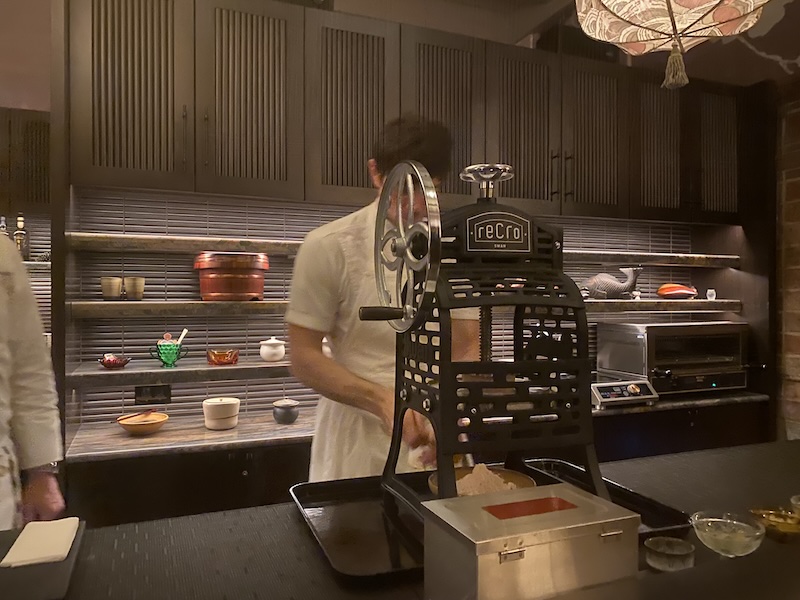
Next came a couple of handrolls, including one of deep-fried shrimp. They were followed by “parmesan risotto,” which Lockwood said was the leftover sushi rice, treated like risotto. Having had plenty of beef at Bonyeon the week before, I was happy when a roasted duck arrived from one of the other kitchens in the building, and led to a wedge of duck breast served with cranberries and a citrus jus. Dessert started with a palate cleanser of apple kakigori ice, ground before us—I didn’t remember the Milk Room having such a thing, but they said they found it there when they took the room over—and then a dish called Gold Chocolate, chocolate and honey together with sabocha, a pear-like fruit also known as zapote or sapodilla. Both of those were outstanding.
Lockwood is clearly more experienced with Japanese flavors than Denzer, and where part of the fun at Atsumeru is going on Denzer’s journey of discovery with him, at Midosuji it’s that Lockwood is an old pro. (Both ways have their pleasures.) With the lobby at the CAA full and noisy in the holiday season, it was a pleasure to be tucked into this little space, far from the madding crowd. Not that Michelin will ever know it—given their obliviousness to Japanese food in Chicago—but as my three, pretty similar but each distinctive omakase experiences showed, this is a very good moment for Chicago’s own takes on Japanese flavors, and on seafood from all over the world.
Buzz List will be off next week, but back on December 8. But my book will be for sale on Black Friday—beat the crowds! Click the ad above to order at 15% off.