

1. SELF-MADE MEDIA
I mentioned last week that Friend of Fooditor Maggie Hennessy hinted that she was going to keep reviewing (after her gig at Time Out ended)… somewhere. Well, we know where it is now: Dennis Lee’s Substack The Party Cut. Per Dannis:
Up until recently, she was the restaurant critic for Time Out Chicago, but just like many other food writing gigs, her role got snipped due to a shrinking budget. (That ol’ chestnut.)
I asked her if she wanted to write reviews for The Party Cut instead, and to my surprise, Maggie said yes. So she’s joining to pitch in with the same style of unbiased restaurant reviews she was previously writing, and I couldn’t be more excited.
As the number of reviewer positions at mainstream publications continue to dwindle, people take advantage of new tools to create places to write what they want (I might know a little about that). So it’s a good time to subscribe to The Party Cut—two writers for the price of one. More about Magge’s debut appearance below.
And on a strikingly similar topic, Ari Bendersky—who once did a podcast with one Maggie Hennessy—has his own new venture—a talk show, which he says”delivers real conversations from real people in the restaurant industry. This new YouTube-based docu-series spotlights the people, culture, and community that fuel restaurant life.”
It’s called Family Meal, and the first episode sits him down with John Manion and his crew at Brasero for a half-hour conversation. Go here to watch it.
2. HWE OUT
Louisa Chu talks to Andrew Zimmerman and Jennifer Kim about things changing at Proxi:
Proxi has gradually introduced changes but waited to unveil its most dramatic dish when it launched the new menu: a seafood platter with oysters, a scallop tartare and poached blue prawn. You can also add an uni shooter and king crab legs.
But half the hot line at Proxi is all live fire, said the chef [Kim], with a wood fire grill and a Josper charcoal oven.
“If we look at some of the coastal Asian countries, like, how do they utilize live fire? What is their practice with it? And what’s the significance?” Kim said. “Those are things that we want to be able to incorporate into the menu.”
3. FAR TORTUGA
At Chicago mag, Titus Ruscitti sings the praises of the tortas at Taquizas Valdez:
Chicago’s Mexican sandwich scene is strong, but Taquizas Valdez, which chef-owner Ivan Valdez opened in December, is raising the bar. Take the pambazo Valdez, which consists of bread dipped in chile sauce, toasted, then stuffed with sautéed mushrooms, refried black beans, crispy fries, lettuce, tomato, onion, avocado, lime crema, queso fresco, and salsa macha. It’s a beast that could feed two. And dare I say it’s the best Mexican sandwich in the city right now?
4. CRABBY PATTIES
Michael Nagrant salutes the old school panache of Shaw’s Crab House:
Shaw’s Crab House is younger than me, and frankly it looks and operates much better.
As sips of agua left my lips, my water glass was always refilled. Napkins were folded when my wife used the rest room.
The martinis are crisper than a head of fresh iceberg lettuce.
When we ordered beyond our stomach capacity, demolishing a huge salad, soup, and lots of bread (the gratis fluffy Parker House-style rolls here require a second round) our server coached us hard through our towering hot seafood platter. When we polished off dessert, she stood in for my mom, telling us how proud she was.
5. ENEMY MINE
At Understanding Hospitality, Grimod says that Warlord’s new popup tasting menu, Enemy, finally helped him get what Warlord was up to:
Warlord has always been loud and brash—“catering to artists and industry” as they say. This energy, so attuned to a late-night, à la carte concept, really shines when grafted over to luxury dining. For it captures more of the directness, the irreverence, and the essential romance that resonate with a newer, broader gastronomic audience. Here, the “experience” is not staged at countless, semi-private tables or even a single, august counter. Instead, Enemy plants guests at a busy restaurant’s nexus, awash in the orders placed by other diners, waiting to see what kind of rabbit the chefs pull out of their hat. In turn, Kraszyk, Lupton, and Fleming coolly lead the team, manage the flow of food, and then concentrate their attention on a range of preparations that stand totally apart from everything else going out.
6. GET YOUR YA-YA’S OUT
Steve Dolinsky visits Galit’s new all-day-cafe sibling, Cafe Ya-Ya:
This new café is almost a polar opposite of its predecessor. No tasting menu, no reservations and a renewed emphasis on its pastry program. In essence, lots of new ideas in a more casual environment, and a dual personality that changes throughout the day.
7. BURNING BRIGHT
Mister Tiger, a Korean spot in West Town, has apparently been jammed since it opened. Maggie Hennessy at The Party Cut says it’s no surprise to her that this food cooked with heart has taken off:
At the suggestion of our server, we started with pork-filled fried dumplings ($10): crescent-shaped mandu packed bursts of juicy, tender pork and cabbage beneath bubbly, crisp exteriors.
A colorful heap of sweet-spicy cabbage slaw flecked with briny dried seaweed was a crunchy, fresh revelation paired with the dumplings.
I also appreciated the restraint in the still-punchy spicy pork ($26), in which petals of gochujang-kissed meat were stir fried with cabbage and scallion till sweet and charred at the edges.
8. RACINE WITH THE DEVIL
At his own site, Titus Ruscitti has news I can use: where to eat in Racine, Wisconsin. Bendtsen’s Bakery I’ve been to many times, generally regarded as the champ among kringle spots; Kewpee I just took my mom to on our way to visiting son #2 in Appleton Wisconsin, and Wells Bros. I’ve tried twice to go to, failing both times. But there are others I don’t know, like La Tapatia:
Racine is a crispy taco town as evidenced in this post from 2016. But not the kind made of store bought shells, the type made crispy by frying them to order. There’s handfuls of spots around Racine making real deal tacos dorados but this family run convenience store with a restaurant in back was the first and is still the best. Get them with ground beef and be generous with the salsa. Since 1981.
9. GRRRR-EAT!
It worries me that the two latest reviews at The Infatuation both get called “great” in the blurb on the homepage. I believe in some economy in dubbing things great. Anyway, one is Noriko Handroll Bar, under Perilla Fare:
Despite its low profile, Noriko stands out in Chicago’s crowded sushi scene. Not just because Noriko is only one of three spots focused on handrolls, but because of the temaki craftsmanship happening behind its 21-seat bar. Any immaculately wrapped package of nori and well-seasoned rice that pops up on your personal ceramic handroll holder—delicate yellowtail, fatty tuna, or a surf and turf butter bomb of wagyu and uni—will be some of the best in the city.
While Nadu is a new Indian restaurant in Lincoln Park:
Nadu crams over ten distinct regions in India into one room with two giant glass chandeliers. This Lincoln Park spot focuses on dishes from specific areas, like crab milagu fry from Kerala or goat curry from Odisha. And it’s from the team behind tasting menu spot Indienne, but is more casual while still being nice enough to celebrate a birthday.
10. REGION SEASON
One of the longrunning debates at Chowhound was when we’d try to write about things just over the border in Indiana (aka “the Region”). You can’t talk about that on the Chicago board, we were told, it belongs on—I don’t remember if there was an Indiana board, or an “Other Midwest” board, but the idea that people in Indianapolis or Evansville were going to have a conversation about Three Floyds in Munster, let alone “bolshevik,” a form of bologna in the area, was obviously wrong to us. That’s not to say that Chicagoans ever paid much attention to the Region; here’s Nick Kleutsch, pitmaster of Sander’s BBQ Supply in Beverly, who previously had a BBQ stand in Lowell:
Lucy’s BBQ, now closed, did receive some attention from the Chicago press, but nowhere near the amount as Sanders BBQ Supply Co., the Chicago restaurant where Kleutsch now serves as pitmaster. Within the first six months of opening, Sanders had been featured in Chicago publications like Eater, NBC, and the Chicago Tribune. Kleutsch thinks that having a concept located in Chicago has helped him receive more press than when he was located in Indiana.
That’s in a piece at WTTW about dining in the Region.
11. GET IN LINE
I thought about going to Del Sur Bakery midweek recently, thinking I could beat the line. Well… it was only a block long, not two. Maggie Hennessy, at WBEZ, talks crazy long lines:
[Owner Justin] Lerias doesn’t love that the hype has overtaken any real identity the bakery might have formed (nut-free with interesting coffees and teas, for instance) if it had opened with less fanfare. Chalk lines on the sidewalk and signage on nearby buildings encourage customers to share the sidewalk. Inching forward, I struggled to keep my expectations in check, as my patience dwindled alongside the products in the case.
12. BYE PI
When I moved up here, there were certain deep dish pizza places that seemed immensely popular and eternal—Gino’s, Giordano’s, Malnati’s. How could a deep dish pizza place not last forever in Chicago? But some that seemed strong in the 80s and 90s have faded and dwindled as chains—Leona’s, Edwardo’s, Bacino’s, and My Pi, for example. Now comes word that My Pi—down to a single Bucktown location since 2008—is closing up as of late June. Eater:
Ownership broke the news on Instagram this morning, Thursday, May 1, touting My Pie’s role in introducing deep dish to customers scattered across 25 locations in nine states. The company also shipped pizza all over the country. The Bucktown location had been open since 2000, inside a small strip mall at 2010 W. Damen Avenue near Armitage. That location also debuted a sandwich spinoff called Lil Guys. “From our first location on Sheridan Road in 1971 to our Bucktown home since 2000, My Pi has been a labor of love,” the post reads.
When Steve Dolinsky’s first pizza book came out, we met up at My Pi to talk the finer philosophical points of Chicago pizza, and here’s what he said about why My Pi was an outstanding example of the not-too-overblown Chicago deep dish (the bolded part is me talking):
Pizza like this isn’t so huge that you want to just crawl off to sleep—you have that great line in your book, that deep dish is like “an afghan for your stomach.”
If you take away the ridge, this is not that thick a pizza. If it was square, it would be close to a Grandma or a Sicilian pizza. People in other cities make fun of how thick our pizza is, but they’ve never had this, they’ve never had Louisa’s in [south suburban] Crestwood.
I’ve ordered from there occasionally since that day—though I’m sure it’s overrun this week, given the news. You have until the middle of next month to give it a farewell order.
13. IN OTHER PIZZA NEWS
As one generation of deep dish pizzas fades from the scene, another rises. One of them, Milly’s Pizza in the Pan, announced that it was moving from Uptown (where it’s only been for three years) to a location on Ashland, near where Temporis used to be and Kimchi Pop is. The new location will have higher capacity, for a reason that instantly made my ears perk up. Eater:
The new restaurant’s Cutler oven (a brand previously and more widely known as Middleby Marshall) is often called the “Cadillac of pizza ovens,” coveted by pizzaiolos for its ability to deliver consistent and crispy results.
The space was once home to a location of Pizza Metro, the Roman-style pizza spot known for its late-night hours. But since their exit, the oven, which [owner Robert] Maleski estimates is 15 to 20 years old, has remained mostly dormant.
I became the historian of one Chicago brand of pizza oven, Faulds, when I wrote this article; I hear from Faulds oven owners a couple of times a year. But though I’d never heard of Middleby-Marshall ovens having a comparable cult, I knew of them and they do have a history. Middleby-Marshall was where Scottish immigrant John Faulds worked before launching his own company, and I’ve seen vintage Middleby-Marshall ovens a few times around town (check out the picture in this 2014 post about Phil’s Pizza in Oak Lawn).
Not sure about Cutler, apparently another defunct brand, but Middleby-Marshall still exists in Elgin, and mainly make conveyor belt ovens (the pizza moves along for exactly the right amount of time to bake), often seen in places like Pizza Hut locations inside stores like Target. I think, contrary to Eater, that it’s prized by owners because you don’t need a trained pizzaiolo monitoring all the pizzas as they cook. But if Maleski likes it, good for him, and good luck in the new location.
14. LISTEN, KID
When I talked to Jake Potashnick (Feld) he spoke about one of his seminal experiences on his path to being a chef:
…his mom had just read a review of a year-old restaurant called Alinea, saying they did “science-y food.”
“I sent them an email. Grant Achatz responded and was like yeah, come on in. And he gave me a personal tour of Alinea. I mean, I didn’t get to eat there, but he gave me little bites of things. He gave me a bag of maltodextrin”—the fat and flavor-absorbing powder ubiquitous on “molecular gastronomy” plates c. 2007—”for my project. But the science-y stuff wasn’t what was fascinating to me. It was the rows of, like, everybody in all white, and it’s so quiet. I was just like, why would anyone not do this for a career?”
He dug out a photo of 8th-grader Jake with Grant Achatz c. 2007, and posted it on Instagram here. Read the text, too.
WHAT MIKE ATE
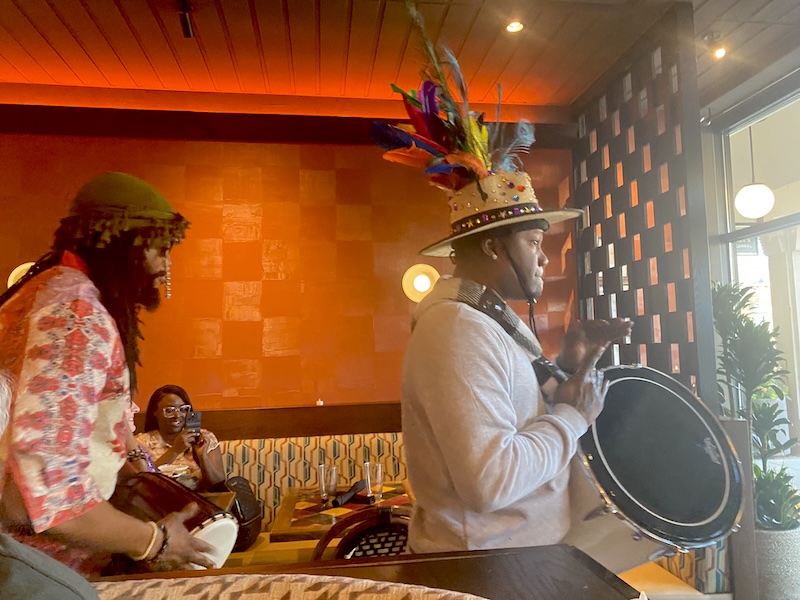
Mahari, in a Hyde Park mall, is said to be an African-Creole restaurant—but chef Rahim Muhammad was born in Chicago and grew up in Baton Rouge, and apart from a liberal use of berbere spice, I got a definite sense of Louisiana flavors and cooking styles, and even more than that, a warm and friendly laissez le bon temps rouler vibe (summed up by my picture of the musical birthday procession). Pineapple also figures prominently, decorating appetizers like the salmon cala (a rice fritter) and coconut-tamarind scallops, not to mention “pineapple wings,” though not the one I liked best—a trio of sambusas, the best being a vegetarian lentil sambusa.
For mains (or “large bites”), I was impressed by a stuffed plaintain with mushrooms and a tomatoey creole sauce, and a cazuela of seafood (again in a pineapple-coconut milk broth). I went with a good-sized party and there was some grumbling at the end that the flavors were kind of repetitive regardless of what the dish was, which I suppose is true—if you’re going to order half the menu, like we did. But I think normal people, sharing an app or two and ordering an entree, will find it an enjoyable mix of flavors from Africa and the Caribbean, and the very welcoming service led by “Director of Community and Culture” Magic Johnson (not that one, needless to say).
In further south side adventures—not the same day: I ordered from 3 Little Pigs some years ago, when you had to meet owner Henry Cai’s car somewhere in Chinatown to try his Chinese-American comfort food. It has a couple of locations now so I drove down to Bridgeport, where it occupies the old Pleasant House space next to Maria’s Bar and Kimski. I decided to go with the Salt and Pepper Chicken sandwich and a side of “Chicago’s best crab rangoon,” as well as an order of fried rice with Chinese sausage and BBQ pork, to take home for the next night. Honestly, I got a little hint of salt and pepper dishes in Chinatown from the sandwich, crab rangoon were crab rangoon, and the fried rice was scarfable but did not at any point particularly say “Chinese food” to me. (On the other hand, my wife loved it and took the leftovers to work the next day.) I think this is just aimed at fans of Chinese-American food who are younger than me—or higher than me.