


1. ANOTHER ONE BITES THE DUST
I was at an event at Hawksmoor, the London steakhouse, and Steve Dolinsky was there. At one point he had something to tell Rob Levitt (the guest chef for the event), but asked me to stay out of earshot. But we’ve talked enough about the state of food media in Chicago that I could guess what it was, in outline at least, and the details followed on Monday—Dolinsky is leaving food media, including his current gig as the Food Guy on NBC5, to join the Levy restaurant group:
I’ve known the management team @levy.restaurants for decades, and have always admired how they creatively feed and entertain thousands of people every day at venues all over the country, elevating the guest experience by surpassing expectations. In this new role – reporting to CEO Andy Lansing – I’ll be a culinary connector and collaborator. My focus will be on trendspotting, relationship building and creative execution across Levy’s industry-leading network of venues spanning restaurants, sports, entertainment, convention centers, cultural attractions, festivals and more. I still get to explore and discover places, but now that zone has significantly expanded across the country.
Dolinsky has always been a bit of a target among other food media, with his well-coiffed ABC7 glamour shots all over town coming in for frequent mocking (the best was at Kith and Kin, which erected a Dolinsky shrine with theirs). To me all that meant was that he was on TV and was savvy about playing the TV name and fame game, to my mind almost entirely for good—calling attention to interesting restaurants, most of all the Asian restaurants in strip malls all over the area that he loves; if you’re going to fault him for that, who was doing it better?
With little food media left to react to his news, I looked to Reddit’s r/chicagofood to see what the reaction was, and it was, perhaps unsurprisingly, nasty, with people saying he stole ideas from Redditors (don’t flatter yourselves, kids; he did plenty of his own field work, but in any case—as I often said to people on LTHForum who would make the same complaint—if you love a little mom and pop place, don’t you want people with bigger media audiences to find out about it and share it?) The most interesting comments in the thread came from Jason Vincent of Giant and Chef’s Special:
Steve is a good guy. Everyone on this planet has shortcomings. He, and you, are no different.
He was highlighting the small, mom and pop, immigrant and less glitzy places years before it became trendy to do it. He sees those places as much more interesting than another Italian mega-restaurant in Fulton market. So, whatever you think of him, he deserves a huge amount of credit for the decades of work that he has put into this city and its food scene.
…I don’t know if he reached out to others [during Covid] but yeah, he reached out to me and I thought that it was an incredibly kind gesture. [The Tribune] running lists of Covid closures was for you, not me. We were going under as an industry and many folks in the restaurant ecosystem (media, publicists, influencers) were ok doing just that, commenting. Steve and Nagrant are the only ones that I know who were trying to help us
I’m not saying he shined a light on us. I’m not sure that he ever reviewed giant or chefs. And no, I don’t think we’re a small restaurant but I do know lots of immigrant owners who credit him with helping their bottom line (same as Alpana and Manilow).
Can’t argue with that. My main piece involving Dolinsky is the same one I linked to when My Pi announced it was closing, this two-men-and-a-pizza symposium. (He also played a significant role in this one.) But two amusing stories that tell you a little about him as I encountered him and his work:
A decade-plus ago I was at a soul food restaurant deep on the south side, and I snapped a picture of my food. Immediately the staff was in my face, borderline hostile, wondering if I was a health inspector, why would you take a picture of food? I kind of stammered half an answer and then I spotted Dolinsky’s head shot on the wall. “That guy! I know that guy! I do what he does, sort of!” Suddenly they were all friendly, and asked, “Do you think you could get him to come back and do another story on us?”
Before I wrote this story about a Bridgeview middle eastern restaurant, I took John Kessler to try it and to get to know the offerings in the city’s best middle eastern food area. We get there and there are only a few other people there—but two of them, also checking it out together, were Dolinsky and Titus Ruscitti, making the restaurant’s population that lunch approximately 50% explorers in north side food media.
Note that both of my stories took place far off the food media and PR beaten path, on the South Side. And that though Oozi Corner is long gone, Dolinsky has since done a story on its replacement in that space, M’daKhan.
Dolinsky’s last piece for NBC5 will air May 29th.
2. REAL MANA EAT KEESH
Speaking of Bridgeview and its Arab population (and what they eat), Mike Sula has a piece on a place called Al-Manakeesh, making manakeesh (think flat pita you can put toppings on), ka’ak bread and other things not entirely unknown before—ka’ak is one of the things you can get a sandwich on at Ragadan, and Taza on Devon has long baked things similar to manakeesh in-house—but they certainly found a crowd:
You should’ve seen the lines after sundown this past Ramadan at Al Manakeesh. “We were slammed from midnight to around 5 AM,” says Mohammad Atieh. “We were at max capacity. It was a great time.”
Atieh, the general manager at the nine-month-old Bridgeview restaurant, figures that between February 28 and March 29 during each iftar—the breaking of the daily daylong fast—they sold close to five hundred “Arabic pizzas” and one hundred “bagels.” Double that on the weekends.
3. KYO LA TENGO
Grimod regards it as a personal mission to sing the praises of Kyoten:
I continue to cover this restaurant not only due to my own enjoyment of the food but, also, what I feel is a responsibility to provide the public with a peek behind this gilded curtain. Not every reader will necessarily be induced to take the leap of faith that plunking down this sum, without the sanction certain honors provide, demands. However, I hope each piece gives some idea of the dynamism and peaks of pleasure that make Kyōten, even in comparison to the dining scene’s most hallowed names, a singular experience.
In other words, here’s why to spend the bucks, even without a tire company star.
4. CHEEZEBANGER
Louisa Chu reviews Parachute Hi-Fi, but devotes a lot of it to a burger:
“It was kind of ridiculous that we would put a burger on our menu, I mean, for us anyways, it’s something we said we’d never do,” said [co-owner Johnny] Clark, especially since their last incarnation leaned more Korean. “I’ll never say ‘never’ again.”
The burger was just supposed to be playful and not serious, said the chef, and he didn’t think it would become the best-selling item.
“Just because we’re a Korean American restaurant,” said Clark, who drew from contemporary Asian influences. “I’ve noticed in Japan, there’s some places serving burgers in a pool of cheese.”
His cheeseburger gets cut in half, placed cut side down in its own pool of cheese, a cheddar beer sauce to be precise, plus a pour of bordelaise, the classic French red wine sauce typically reserved for steak.
“It’s kind of a wet mess, but since we do like fully dipped Chicago Italian beefs here, I figured it was something that was acceptable,” said Clark. “If you can eat a Chicago Italian beef, you can eat this burger.”
Speaking of places that spin discs, Chicago mag has a piece on the listening bar trend, including Parachute Hi-Fi.
5. WHERE THE ELITE GALIT
Titus Ruscitti returns to Galit, which he says has a tasting menu now:
I’m not sure exactly when Galit made the switch to a full fledged tasting menu but it’s been that way for a little while now. It’s currently among the five finalists for ‘Outstanding Restaurant’ at the 2025 James Beard Awards. They describe the tasting menu as a four course “choose your own adventure” as it lets you choose from a handful of options for three of the courses. The ‘Salatim’ is the same for every diner as it’s a general term in Israeli cuisine for a variety of spreads, dips, and salads that are commonly served at the opening of a meal. Salatim at Galit includes labneh, wood roasted snap peas, ezme and pickles. They were all refreshing and came served alongside the second course which is your choice of a few different hummus preps. My waiter said the one with brisket was his favorite which made it an easy choice as that’s what I was leaning towards. Hunks of smoky brisket are cooked down with tomatoes and carrots and served over an extremely smooth blend of hummus and wood roasted pita to go with it.
I’m pretty sure I had all of those things the first time I went to Galit—the four courses which let you choose among them was there from the beginning. So I’m not sure what, if anything, is different.
6. MAUI WOWIE
In his penultimate piece for NBC5, Steve Dolinsky talks about Hawaiian food in Chicago, and compares it to Hawaiian food on, well, Hawaii:
Just five minutes from the Kahului Airport on Maui, you’ll spot a food cart pod with several vendors, selling all manner of plate lunches, featuring rice, macaroni salad and heaping plates of teriyaki chicken or slow-roasted pork. The menu is eerily similar at Aloha Wagon, in the Heart of Chicago neighborhood on the Southwest Side near the CTA station.
“Hawaiian food it’s catch of the day. From the ocean to your plate; everything is fresh,” said co-owner Richard Manongdo.
7. KANIN ABLE
And speaking of Hawaiian food… The Party Cut has another guest reviewer—John Carruthers (ManBQue, Crust Fund Pizza), who went to Kanin:
As a longtime Ravenswood resident I’m not overly used to hyped restaurant openings. I love this neighborhood, but it’s much more of a Big-Ten-hoodies and wings-at-the-bar sort of scene. Lincoln Square is like if you turned a brewery with children allowed in it into an entire Aldermanic ward. So imagine everyone’s surprise when a several-block-long line appeared for Kanin’s soft opening back in March. And the seemingly endless parade of foodie and influencer photos and videos followed those hundreds of people, and just kept going. I can tell you it was the talk of school drop off that following Monday. We didn’t know what to do with ourselves. We’re simple folk up here.
8. ART IMITATES DINNER
LIA is an upscale restaurant opening in River North where the food is themed to the art. Anthony Todd tells more:
The restaurant’s name stands for Life Imitates Art, and the first thing that a diner will see when they walk into the restaurant is what [owner Justin] Vaiciunas describes as “the biggest painting in the city that weighs over 1,000 pounds — it starts the energy off right.” The restaurant is full of art and the current focus is on the artist behind the Guest Check series at Laundry Room Studios (other artists will be similarly highlighted in the future).
9. DEEP DISH HISTORY
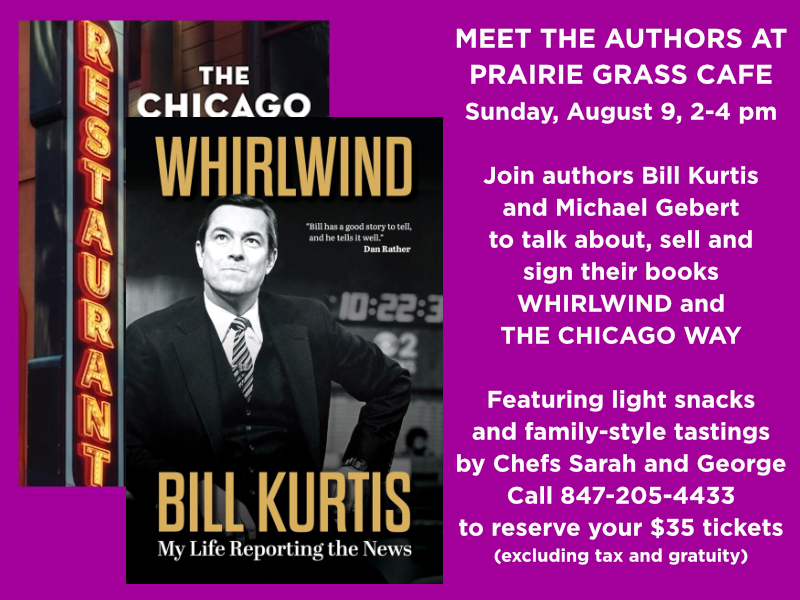
There’s a book by Marc Malnati about his family’s pizza business, and Rick Kogan has an in-depth piece about it and the family at the Trib:
I met him on the 200-some pages of his book titled “Deep Dish: Inside the First 50 Years of Lou Malnati’s Pizza” (Agate Publishing). It is a surprising book in that it has a welcome lack of recipes but also because it is self-aware and, frankly, occasionally chilling, as Malnati writes, “Too often, my little brother and I would end up falling asleep in a booth in the bar while (Dad) told (Mom) he was going to have just one more.”
That dad, Lou, was the big-dreaming patriarch of the family enterprise that now offers pizzas in places across the country, a rather remarkable business success, especially given its modest roots. That mom, Jean, is the person responsible for holding the business together when Lou died at 48.
The story is ultimately an entertaining one. As Malnati’s younger brother, Rick, puts it in a short preface, “This is not a story about great pizza, although we do serve the best pizza in the world. This is the story about how a somewhat dysfunctional family led to the growth of a more functional family.”
10. MA SWEET LORT
The New Chicagoan talks about Josh Noel’s book on Malort, “the city’s best worst drink”:
The Malört we have today is almost certainly the unchanged mid-19th century recipe of Jeppson himself. As the book explores in fascinating depth, Malört is a type of besk, or Swedish herbal bitter. Noel didn’t publish the exact recipe but he might as well have: a neutral spirit (vodka) is distilled and aged with pounds of imported wormwood. Then it’s bottled. Malört.
How has this niche immigrant drink survived to the present? The book provides two answers. One is the practical way: Malört is a business. As Noel traces, Jeppson sold the Malört brand and recipe to a certain George Brode in 1934. At the time, Brode was a lawyer and local liquor purveyor and added Malört to his portfolio of spirits, more as a passion project than a serious business proposition.
11. DE MINIMUS
Good piece at the Sun-Times about the effects of the elimination of the sub-minimum wage for tipped workers, which went into effect last year:
Restaurant owner Dave Bonomi said he’s been forced to eliminate jobs at his three restaurants after Chicago’s ordinance to phase out the subminimum wage for tipped workers took effect last year.
“We eliminated almost 20 positions between our three restaurants. We had 64 and now are down to 45, mostly because of it,” said Bonomi, who owns Peanut Park Trattoria on Taylor Street and Coalfire, which has two locations.
Now, Bonomi and other Chicago restaurant owners, along with the Illinois Restaurant Association, are pushing to have the law repealed. They’re following the lead of Washington, D.C., Mayor Muriel Bowser, who earlier this month introduced a budget agenda that included plans to repeal a similar law that took effect in 2023.
12. WHAT’S GOOD?
At Bon Appetit, Maggie Hennessy on the thing we’ve all done, and often regretted: asking a server what we should order:
“I can use the guise of ‘my favorites’ as an opportunity to suggest a dish or two that I believe would complete their order,” [Maggie] Cook [of Philadelphia’s Little Water says. “For example, if the guest names two rich, indulgent dishes for their main course, I would recommend the bitter green salad using the segue of it being ‘one of my favorites,’ but bolstering the claim with how the acidity and crisp texture of the salad will enhance the two other plates.” In other words, maybe the better question to ask is: “What am I missing?”
This is roughly what I do, order some things and then ask what’s great that I should also try. Having some things down is better than being a blank slate.
13. LISTEN UP
Joiners: Talks to Dylan Trotter, of you-know-where.
The Dining Table: Talks to Dario Monni about making pasta at Tortello.
Dish From Chicago Magazine: Talks about the recent review of Thalaiva’s Indian Kitchen.