

1. BOOK NEWS
I’ll be live in Milwaukee this Friday at Boswell Book Company, hosted by Kyle Johnson Cherek—go here for details—and my appearance on Cherek’s podcast Classic Eats is now up, though I think the blurb on Apple Podcasts under “The Restaurant Critic” is for a different episode. Anyway, start playing it and you’ll soon hear about me and my book.
And I hope to be able to announce the next of our live events at a local restaurant by next week, so check back then!
2. IKO IKO
Louisa Chu in The Trib profiles Kumiko‘s Julia Momose, who is now both bartender and chef:
Momosé stepped into the kitchen as chef in the final days of 2024. And Kumiko won the James Beard Award for Outstanding Bar just last year.
“I’ve been involved with the food since Kumiko opened,” said Momosé, who’s soft-spoken yet clear. “Kumiko is very much me.”
The chef wants to bring her sense of nostalgia growing up with Japanese food, but excitement too.
That’s evident with their mainstay truffle milk toast, which she credits to a collaboration. It was based on toast from her time working at a little cafe when she was in high school in Japan.
3. YOO-HOO!
People love Yooyee, a hot new Chinese restaurant in Uptown, though when I went the popcorn chicken was so heavy with Sichuan peppercorn that it basically blasted out my taste buds for anything else; I didn’t recover until after when we went to Lickity Split up the street and let ice cream wash it away. So I can’t tell you what everybody sees in it, but anyway, here’s Michael Nagrant:
I haven’t seen this kind of Chicago yen for Sichuan cuisine since Lao Sze Chuan was at its apex just before owner Tony Hu went to the hoosegow for wire fraud and money laundering.
Which is to say maybe local chefs need to move beyond the bagels, donuts, fried chicken sandos, steakhouse, Middle-eastern, and Italian fare and zag toward regional Chinese food if they want to make a buck.
4. SMYTH, THE ANTI-THREE STAR
That at least seems to be Grimod’s view of Smyth on his zillionth visit:
I speak of the polarization that informs every piece I write about this concept: an acknowledgment that, while I’ve been convinced by what I taste here, others (rather vocally) have not. The nature of personal preference dooms any business charging this amount of money to a certain number of detractors. But Smyth, relative to its peers in Chicago and beyond, has long rejected the trappings of “fine dining.” Structurally, it lacks the kind of world building and flourishes that resonate more widely and memorably than any intricacy of texture or flavor. To reference one critique I read recently, the environment feels like a one-Michelin-star restaurant because, truly, it has changed little from the time it held that more modest rating.
Discounting the quality of the service and beverage program (which, being considerable, helps to enliven a space that may otherwise seem plain), Smyth really seems like a test case for Bibendum’s increasing affirmation that the Guide is “focused only on the quality of the food.” This does not accord with how the organization (as claimed by at least one famous chef) was said to operate in the past.
5. DA LOOPAL BOY
I liked Da Local Boy, the Hawaiian spot in Highwood. Would I put it on a list of the 25 best restaurants in Chicago, as Kevin Pang recently did in the Times? Not by a good little ways, but I’d check out the new one in the Loop next time I’m there. Here’s Nick Kindelsperger:
For your first visit, start with Da OG Plate, a gargantuan platter of grilled pork belly, huli-huli chicken, white rice, and creamy macaroni salad. The grilled pork belly is the star. Marinated in aromatic calamansi juice and salty soy sauce, each slice balances tender pork with the occasional burst of unctuous, gooey fat. It’s undeniable.
Not that the huli-huli is lacking. These sweet and tangy marinated chicken thighs are jaw-droppingly juicy and tinged with charred aroma from the grill.
6. PERFIDIOUS ALBANY
Titus Ruscitti suggests five places to check out in Chicago’s United Nations neighborhood, Albany Park. I’ve seen a couple of them, and I’m a little surprised that he doesn’t suggest either of the hot new places I’d name, Nubar (Kurdish coffee/pastry spot) or Amandes, of most excellent Basque cheesecake fame. But the five he finds prove you could do worse than just roaming the neighborhood and trying what you see, like:
First stop is a very new spot at 4749 N Pulaski. It’s so new that Xotikka doesn’t have a sign up yet (Mahi’s Kitchen [on the sign] was the previous tenant). This is an efficient one man operation making some fantastic Indian sandwiches. The first menu item listed is Vada Pav, a Mumbai favorite that spread across India and has really started to take the States by storm too. Vada Pav is a spiced potato patty in a fluffy bun, accompanied by chutneys and sometimes cheese if you please. The potato patty, or vada, is mashed potatoes, herbs, and chickpea flour batter, and deep-fried until golden brown. It’s placed in a pav, a soft, savory bun similar to a kaiser roll. I had to get one of these on my first visit as it’s the most mentioned menu item in the few online reviews and I always like a Vada Pav when I get one. This was bigger than any other I tried but still a very good deal at $8 with Amul cheese. The potato fritter was perfectly fried to where the exposed part was crunchy while the inside was soft and super flavorful with a nice and spicy profile. Mint chutney and the option to add cheese plus a well roasted sesame seeded bun round it all out. This was a very good version that filled me up right. I chose to add cheese but it’s shredded and not melted and didn’t really give off any clues that it was being used so I’d skip it. I’ll be going back for one of their Indian chicken sandwiches made in a variety of ways.
7. LAODERMILK
Dennis Lee goes to Lao Der, the Lao restaurant on Elston:
Davida picked today’s restaurant based off a recommendation from her course advisor at school. When she mentioned the name, I already knew we’d have a fondness for what was coming, because we have a tremendous love for Southeast Asian flavors. There’s just something about a style of cooking that’s heavy on the acid and fermented flavors that gives our moods a big boost. It could be our four-season Midwestern living, but I think food born of tropical weather helps whisk our imaginations to far-flung places.
8. POPE-RAH CHEF
Kevin Pang talks to former Oprah chef Art Smith about the getaway he and Phil Stefani are helping open in Pope Leo’s summer getaway, Borgo Laudato Si.
9. LIVE FROM PILSEN
I mentioned a few weeks ago that the Bayless Family Foundation was giving a million dollars to the National Museum of Mexican Fine Art in Pilsen. The Trib has a piece telling the story:
The revitalized venue will be renamed the Foro de Artes Bayless, a nod to the Mexican tradition of dynamic performance spaces known as foros, where communities gather not just to watch but to connect.
Rick Bayless, the James Beard Award-winning chef whose family foundation made the gift, said the project fills a glaring gap in Chicago’s cultural landscape.
“One of the things that we are really lacking here is a good Latino performance space done in a really solidly professional way,” Bayless said. “We’ve come to something that I think is just spectacular, and I’m really, really proud to be part of this project because I think it will bring something both needed and unique to Chicago.”
A better space is needed; a couple of years ago I was helping plan a meeting of my wife’s legal society in the South Loop, and I wanted to include the Mexican Fine Arts museum as one of our venues, but its only event space sort of looked like a high school gym. A better one—with genuine Mexican flavor—will be a definite enhancement to the area.
10. BITTER GREENS
One of the currents running in my book is the collaboration (struggle might be a more apt word) between chefs and farmers to get the former to cook what farmers grow, and the farmers to grow what chefs want to cook. Lisa Futterman has a piece at WTTW about this:
Dario Monni grew up eating seasonal, locally grown produce like tardivo, a sweeter, curlier relative of radicchio, and puntarelle, a delicate but bitter chicory, in Veneto, Italy. To source those vegetables for Tortello, the bustling Wicker Park restaurant and pastificio he owns, he had to import them from Italy, a tiresome and expensive process. Until he met Adam Pollack.
Pollack runs Closed Loop Farms, which grows greens, flowers, herbs, and more in outdoor plots, a hoop house, and indoor growing trays at The Plant, a food incubator located inside an old meatpacking facility in Back of the Yards. Monni asked Pollack to grow him bitter greens, and Closed Loop set about getting the Italian crop to survive in the Midwest.
11. BAD WEEK FOR OUR HERITAGE
Two places that sum up a certain old school Chicago-ness are facing, well, not closure, but significant change: first is Jim’s Original, a classic late night hot dog and Polish sausage joint, which is apparently being forced out of its location near UIC by the rapacious expansion of the university, and will relocate to Pilsen. The Sun-Times has a story here.
Less noticed—though there was a story on Reddit I can’t seem to find now—is that the older Greek couple who ran Mr. D’s Shish-Kabob, widely loved for its steak sandwich, pork kebab sandwich, and the fresh-cut fries Nick Kindelsperger judged the best in Chicago—have sold it and they’re off to a well-deserved retirement (and their grown son, no longer having to work alongside his parents every day). Here’s a tweet confirming it, and it looks like the new owners are going to keep it going in the same vein, but it was already a slice of 1973 somehow surviving into the 2020s, so I hope you went and appreciated it while it was still what it was. Here’s a Tweet that confirms it happened.
12. HI MOM
For Mother’s Day, a sweet piece by Mark Mendez about inviting his mom to eat where he was working, Spiaggia:
When my mom and I walked into Spiaggia, with all that marble, brass, leather and a whole floor to ceiling window overlooking Lake Michigan, she grabbed my arm, “This is where you work?”
“Yes mom, but in the kitchen.”
The maitre d made a big show for my mom and took her hand and led her through the dining room and down to the front, neat the giant window overlooking Michigan Avenue, Oak Street Beach, and Lake Michigan. All the cooks waved as I walked by the open kitchen, a couple flipping me off, because that’s how cooks are. We had a 10 course tasting menu paired with wine. To be honest I don’t remember most of the food except my mom got gnocchi for the pasta course and lost her mind, asking me how to pronounce it and if I knew how to make it. She sent back the single lamb chop and asked for it well done which was embarrassing, but the server was gracious and the executive sous chef brought the well done lamb to the table with a wink to me saying “Mom’s always right “.
13. THE MAGGIE HENNESSY ISSUE
Talking with other food writers about food writing often leads to extended kvetching about the state of things (no comment if that happened in the interview shown below). Friend of Fooditor Maggie Hennessy figures in two pieces this week on this topic—at Slate (behind paywall) there’s a piece on bad writing from influencers, and at a site called Bureau, she’s interviewed about her craft:
What does good food writing require now that it didn’t ten years ago?
This is a hard question for me, because “good” is connected to a reward system that’s complicated and agenda-riddled. I do think there’s a focus now in the oh-so-trendy food newsletter space on acerbic, voicey reporting—like to be relevant, one must be in the know and talk shit about the top brass over glacial (maybe N/A?) martinis at the Chelsea Hotel.
The contrarian, new-look, jaggedy fonted “gourmet” comes to mind. I bought a subscription right away. I love aspects of it, that it’s ballsy and writer-owned, that it calls out its own missteps almost in real time. It’s publishing great writers and writing. But I’m still not sure I’m the audience for it. Maybe I’m aging out, but I miss subtlety. I’d like to see more archness, more winks, more … slowness. Everything punches us in the face, kind of like overly designed restaurants with flavormaxxing food.
What’s fascinating is the relentless tension of food (a.k.a. lifestyle) content that keeps butting up against genuinely complex, systemic, and increasingly unavoidable issues that people still really don’t want to talk (or read) much about: income inequality, worker abuse, climate change and displacement, and mass deportation of workers on whom much of this system depends. Can we just get Ina Garten’s go-to roast chicken recipe?
14. LISTEN UP
As noted above, start playing Classic Eats and you’ll hear me talking about my book.
Joiners talks to Megan Marshall of Edible Chicago.
The Chef’s Table talks about Sysco’s acquisition of Restaurant Depot.
* * *
BOOK REPORT
Maggie with Bible
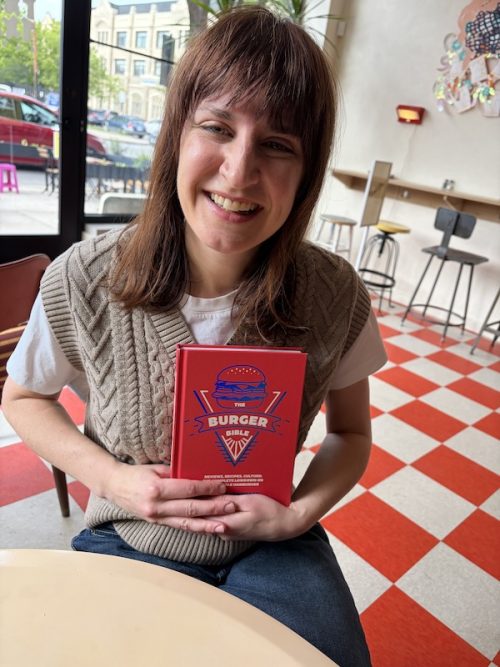
I suggested to friend of Fooditor Maggie Hennessy that we talk about her book, The Burger Bible (Welbeck, $19.95, published April 2, 2026). Having read me making fun of Txa Txa Club last week, she immediately suggested that as a place to meet up, figuring that however the conversation went, there was a chance of a great story (for her) about me getting thrown out. (I just had one pastry, both sweet and savory which seems to suggest the little-bit-of-everything approach of the place, but it was skillfully made and I’ll be back.) Anyway, they never figured out I was that awful person who made fun of them last week, so, live from Txa Txa Club, here’s burgers according to Maggie:
FOODITOR: Tell me how this book came to be.
MAGGIE HENNESSY: So a British publisher, Hachette, reached out to me. It was for an imprint called Welbeck that focuses a lot on food, music, sports, sort of the lighter side of things. They said, Are you theoretically interested in writing a book about a very, very commercial topic that’s food related?
And you said Hell no. I’m against making money.
I’m an anti-capitalist. I only eat fallen fruits. But no, he said it was about burgers. My mind immediately went to John T. Edge and George Motz and, you know, Kenji Lopez, all covering every way you could possibly cook a burger to perfection. And I thought, what do they need one more voice for?
But then I said, this actually suits me very well. It’s a mainstream topic. It’s very approachable. It’s kind of like where the rubber meets the road in terms of development of this country. It’s a topic I find fascinating. It’s about the immigrant experience. I just thought for a second it would be so much fun to dive into that and learn all about it. The gist was, eighty-some profiles of burgers around the world.
So you took off in the corporate Gulfstream and started eating burgers.
Absolutely! It became a lot of like, you know, digging through the vast ecosystem of what’s been covered, and cross-referencing among city publications and alt-weeklies and like, what’s actually good out there and would make for compelling profile stories. The history part was really fun as well, because there’s just, like I said, so much kind of aligns with the way America has developed, the development of highways and our love of cars, drive-thrus. So it was just a few months of nervously putting together a list that felt representative of kind of where we are and where we’ve come from, where we’re hopefully going.
I feel like we pretty much solved the mystery of what to put on a burger 100 years ago—ketchup, mustard, cheese, pickles, onions. So if you’re going to profile 80 burgers, you have to pretty much find the places putting wacky stuff on burgers.
You need some of those. There’s a place in Pensacola, Florida, Maguire’s Irish Pub. They have something called the terrible garbage burger. They put, I think, almost every condiment and every topping on their entire menu on this burger—pineapple, hot fudge. And there’s the $700 burger in Philadelphia [at DBG]. If you think about the shock jock-like, food shows that came along, it’s fun to dig into these places that sort of proudly do these things that are absolutely disgusting.
But it’s a time when everything is on fire, and it ended up kind of pulling me back to the things about the US that I am proud of to some extent. The food industry remains a low barrier to entry business. Someone can come here and find a way to take a cuisine that’s that is relatively unknown by the population they find themselves living amidst, and create something that is an entry point for their country, like the Laotian burger in the book [at Ox Burger in Seattle].
The thing that might be the most interesting picture of the state of the burger in 2026 is the Burgerpedia section where you get into all the different styles that are hot now, like smashburgers—
Oklahoma onion burgers—
I grew up in Kansas and you know what we called an Oklahoma onion burger? A burger. Lot of Okies working in diners and burger stands in Kansas, and that’s pretty much what we had.
I love the way the onions cook into the patty, and then you get the sweetness. I find that really delicious. I love Ragadan’s [maker of Oklahoma onion burgers, in Uptown].
Let’s talk about the history. I feel like some of the earliest burgers aren’t what we would recognize as burgers now—like Louis’ Lunch in New Haven. It’s ground beef on toast. Or a chopped cheese sandwich.
Or loosemeat burgers, or the patty melt. Are those burgers, or are they burger-adjacent? It’s like the whole is a hot dog a sandwich thing. Do you get into those?
Not really. Yes, it’s meat between bread. No, it’s not what we think of when we say we want a sandwich. Kind of a pointless discussion.
Yeah, it’s like, is chili a sandwich? Is chicken soup a sandwich?
What do you think about the idea that Chicago food culture has a problem conflating nostalgia with food more than other places?
Probably, though I wouldn’t say that’s unique to us. Have you ever had an egg cream in New York? Fizzy chocolate seltzer, it’s kind of gross. But they grew up on it.
Nostalgia can take up a lot of oxygen in the room. But it should be part of the conversation. Because I think that happens a lot, when you run into people who are opinionated and who get mad at you about what you think is good. A guy attacked me on Instagram for including the original Billy Goat in my favorite burgers to eat in Chicago. And I said, Well, why don’t you try reading it and see why I included it? And he goes, Nope, you’ve lost all credibility. Okay, goodbye.
Well, let’s talk about burgers in Chicago. My feeling when I moved here from Kansas was that in Kansas you didn’t seek out a famous burger place, you just, whatever small town you were in, you went to the drive-in place where all the high school kids go after the game on Friday night, and it’ll be somewhere between pretty good and damn. But if you think of the burgers we had in Chicago twenty years ago—basically what you’d get at a place like Hub’s—it was a frozen hockey puck patty.
Yeah, I was going to say the frozen patty was the main thing.
But I also think the buns were too sturdy. Too bready.
Interesting. I was thinking about the eras of the bun, like when Kuma’s Corner opened, and it was like the gastropub era, and they started popularizing the pretzel bun, which is dense and bready. And you have the kaiser roll at old school places, also bready.
Then suddenly we had freshly ground meat at Edzo’s—
The Bad Apple, and The Loyalist burger. And then the bar is suddenly up here, and it feels like very quickly it happens that way. I think the next iteration of that is the pop up joint doing a smash burger, and it’s becoming harder to differentiate between them. I mean, people would DM me and say, How could you leave out…? For me, the burger that changed my viewpoint, made me more of a burger person than I thought I was, was the Owen & Engine burger. That’s like the sort of apex of what you’re talking about, where they’re you see them bringing in the side of beef in the back And then it’s probably been established by now, I am a fan of onions on a burger. And that was just so simple, caramelized onions on top. Really great soft bun.
It also kind of was the era of the pub burger. A half pound. That’s kind of now been dispatched, more affordable for the restaurant, less beef used. You don’t need to be scarfing down 10 ounces of beef, with bacon. But it was interesting, sort of going back in time, to when Instagram was new. It was 2011, 2012 and revisiting kind of Au Cheval and the early virality of the burger and the people lining up for two plus hours. I think it was fun to think about the contributions of Chicago to the conversation, the virality piece, the the chef driven burgers that we you know, the Loyalist burger that was another one. It had its own Instagram. I enjoyed that moment a lot. But I think right now we’re a little bit dominated by the smashburger.
Okay, so you wrote about all these different burgers around the world, what did you talk about that you really want to try?
Without question, this one in Tokyo—the Shima Saba burger. But it’s inside this sprawling fish market, and they only can make this burger, I think, for like a month or two out of the year. It’s like a seared, pickled mackerel burger.
Is that a burger, though?
I’m gonna say yes, because the thing is, at a point you’ve had the burger in every possible guise, you’ve had the steakhouse burger, the pub burger, the smashburger, the onion burger. But this is a genuinely novel way to approach making one. The guy, the whole point was he, he wanted to challenge the idea of mass produced, greasy junk. So he’s sourcing this fish from the market every day. Bread is made by a baker in Akita using natural wild yeast, tomato and tartar. The sauces are made in house. It’s inspired by the mackerel futomaki, so there’s the omelet on it, shiso leaf, cucumber. It’s only available in September, October. So that’s like a bucket list life goal, yeah, which probably is wrapped up in some of my own other issues.