

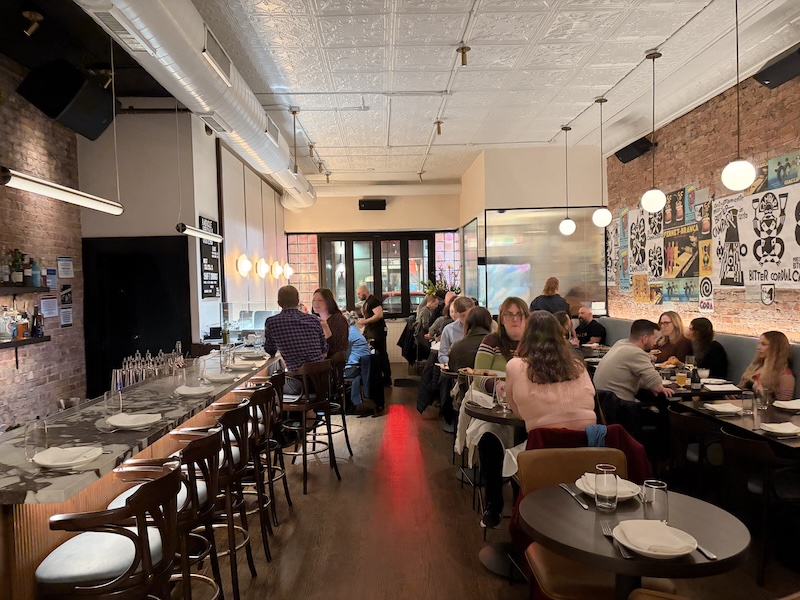
1. GIVING US THE CREEPIES
The Tribune has been on such a tear of reviewing South Side African-American and Latino places that it’s a surprise this week to find Louisa Chu reviewing a restaurant with known chefs in a stereotypically hot foodie neighborhood (the West Loop), Creepies from Anna and David Posey. It’s fine to focus on whatever aspect of the food scene you want to, I’m certainly not saying everyone needs to review the same places, but it does mean that when you review the kind of place being talked about a lot elsewhere, for the first time in a long while, we don’t really have the context for evaluating your opinion on this one versus other restaurants of the same sort. Anyway, here’s Chu on the much-admired roast chicken at Creepies:
The roasted chicken with liver and wine sauce at dinner has already become their bestseller. It appears to be a classically rendered dish. A slender drumstick and drumette extend enticingly above a half chicken with sliced breast, prized thigh and a pool of fatty, flecked sauce below.
…it takes three days to make. They cure it lightly, then poach it, dry it and pan fry it, all before roasting.
Crisp-skinned and tender-fleshed, their chicken is then ready for its lovely sauce, herbaceous from tarragon and bright from white wine. That sauce is lush and savory. Not too livery, for better if you’re not a big fan of offal, or a bit wanting, if you’re like me and expected more intensity.

2. ORE-IDA
Grimod returns to Oriole, and I can’t say I knew what he could say about it that would be new, but at least this summation seems dead on:
Oriole deserves credit for crafting a memorable space, leading diners on a journey throughout its confines, and wrapping the whole voyage with warm, seemingly effortless interactions. There’s a charm to the evening’s sequence—stepping through the elevator door, greeting one’s guests in the lounge, marveling at the kitchen ceiling together, settling into the finely appointed dining room, lingering over coffee, then retracing the same steps home—that never gets old. Form begets function in a manner that leaves Alinea feeling cramped, Ever feeling cold, and Smyth as if interior design was discounted altogether.
3. ERIE-LASALLE-DEKALB
A long story at Michael Nagrant’s site that includes the fate of the Erie-Lasalle Body Shop neon sign, and an Indian restaurant in Dekalb, winds up with Kanin, the Filipino-Hawaiian snack spot:
So to Kanin it was and all of its musubi glory. I tried them all including the spicy loganisa, but the hit was the Spam and egg musubi, a salty ham and rice number with a custardy tamago-like capper. Kanini does another musubi where they add in some bacon jam and hash brown. I have no doubts this one would win above all, but as things go at Kanin, they were already sold out.
4. POLITOELY
The Party Cut has a guest reviewer in Lauren Polito, who “runs a communications business called House Trained, and also performs stand-up comedy on the side.” She goes to a Bucktown coffee place called Thrd Coffee (that’s not a typo):
Drinks come in pretty handmade ceramic mugs made in Pilsen by Ariadna Ginez (@ariadnaginez). There’s a surprisingly wide variety of sweet and savory snacking options, too. The matcha and coffee are delicious, and the seasonal drinks make a typical coffee stop feel like a treat — twists on familiar favorites alongside completely new ideas are one of the highlights of every visit.
5. SHO BOAT
The Infatuation goes to SHO Omakase, fresh from making Chicago mag’s best new restaurant list, and uncovers a hitherto unknown omakase epidemic:
Thanks to Chicago’s great omakase boom of the 2010s, we now have a bunch of places for multi-course raw fish tastings. But over a decade later, most new sushi spots tend to feel like one predictable parade of nigiri after another. That’s definitely not the case with Shō, which brings a music-themed swagger and refreshing omakase remix to Old Town.
I had to think: were the 2010s really a heyday of omakase dining? The last couple of years of the decade, maybe, when Omakase Yume, Omakase Takeya (now gone), Mako, and Kyoten all appeared within a year or two; but I wouldn’t say we had much of it before that—when I needed a hot sushi chef for this Chicago mag piece in 2018, I talked to the chef of decidedly mid-priced Raisu.
6. ASTOR PIAZZA
Rick Kogan in the Trib on the reborn Astor Club in the Gold Coast spawning a spinoff a few doors down:
On Monday, they offered many of the details and dreams for their new operation, which will be called the Astor Club Clubhouse. They showed off an old and heavy and sadly empty safe. They showed the high ceilings, modernized bathrooms, the eight or was it nine or 10 fireplaces? The windows gave you water and sky.
The building is in the process of renovation, workmen wandering about its floors on projects the Bilters estimate will run well into the seven figures.
As of now, plans are for the clubhouse to be open from 6 a.m. to 6 p.m. and offer coffee service, light breakfast and light lunch throughout the day; have meeting rooms for members and small gatherings; and have seven or so overnight guest suites.
7. RICHLAND, POORLAND
My pieces about the Richland food court, now called Heung Seng, remain among the most popular on this site, even though they’re all years old and almost certainly mostly inaccurate now. Whoever’s in the space now, they’re about to pay more for it. The Reader:
Beginning in the summer of 2025, the staff of Richland Center landlord Heung Seng Corporation began telling tenants they would nearly double the rent in their next leases. According to six Richland Center tenants, the landlord said they would raise the price from $1,800 per stall to $3,000—a $1,200 increase that multiplies to $2,400 and $3,600 for double- and triple-wide businesses. Increases would be implemented at different dates depending on the end of leases, but could lead at least three of the six tenants the Reader spoke with to close or relocate their businesses entirely.
I suspect—and the article suggests this is true—that as Chinatown has attracted hot pot chains from China and such, there’s been a trickle-down effect to the mom and pops that started on the cheap in spaces like the basement food court. Many businesses that started in the food court have moved on to more traditional street-level spaces, like Yummy Yummy Noodles (now at 23rd and Wentworth) or QXY Dumplings (which will soon open a new location in Wicker Park). And at these new jacked-up prices, why not?
8. BOQUERIA BOCADILLO
Although there’s a restaurant chain called Boqueria, to me it’s the market in Barcelona, a zoo of exotic Spanish eats, jamon legs hanging everywhere. Lisa Shames talks about the new weekend communal table dinners at the revived Bocadillo Market, now in West Town:
[Chef/co-owner James] Martin is not of Spanish heritage but feels a deep love for the country. He sees similarities between Spanish cuisine and the food he ate growing up in South Carolina. Take his garlicky lima bean and sausage stew: It’s part ode to his mother and part reference to fabada Asturiana, the signature dish of northern Spain. Martin changes the menu seasonally, but dishes have included classics like patatas bravas, Spain’s favorite drinking snack, and golf-ball-size croquetas filled with roasted chicken and jamón. He also offers Spanish-inspired cheffy bites, like tuna crudo with citrus-harissa dressing nestled in the center of a large rice cracker.
9. PEPPERY
At WTTW, Daniel Hautzinger talks about a spice importer who got into the business in an unexpected way:
Scott Eirinberg, The Reluctant Trading Experiment’s founder, was in a different business altogether years ago; he founded the children’s furnishings company The Land of Nod in 1996 and sold it to Crate & Barrel in 2010. He had traveled the world sourcing fabrics and other materials for the brand, meeting a supplier in southern India named Divakar in that work.
“He started talking to me about spices that grew near his home in Kerala,” a historical center of the spice trade, says Eirinberg of Divakar. “I really didn’t have any background in spices or food, and I was very reluctant – which is how we came up with the name Reluctant Trading – but because he’s a friend of mine and he was very excited about this pepper that was growing near his home, I eventually said, ‘Go ahead, send me some samples.’”
10. PIE FOR EVERY MEAL
A piece at WBEZ about making savory pies, with people like Hoosier Mama’s Paula Haney and Rajee Ariya of Chiya Chai:
“We’re thinking about street foods in India, Nepal and South Asia in general, and just things we enjoyed eating with chai,” co-owner Rajee Aryal said about creating the menu at the tea shop. “I also knew about these savory pies that were very popular in other parts of the world where there’s a big Indian diaspora. So for example, in England, they have a lot of curry pies. The things that we put on the menu were all things that are very South Asian that speak to our heritage, but also very approachable.”
11. LISTEN UP
Speaking of Creepies, chef Taylor Ploshehanski is on Joiners.
The Chef’s Cut continues its hospitality series with Drew Nieporent of New York’s Tribeca Grill, Nobu. etc.
IN MEMORIAM
Paul LoDuca owned Adobo Grill, an early upscale Mexican restaurant which has had a couple of locations over the years, and Vinci, a longrunning Italian restaurant in Lincoln Park. I have not seen anything confirming his passing, but (h/t Ina Pinkney) that’s the report, and Vinci is listed as “temporarily closed” and its website is down; Penny Pollack also told Ina that she had seen on NextDoor that LoDuca’s family does not want to continue the business.
WHAT MIKE ATE
I often like restaurants I visit for the first time—what’s not to like? It’s a restaurant!—but when you truly feel the charm of a place upon entering, it’s rare and it’s magical. Last week I talked about one such experience—Noodles Party, which effectively captures the feel of Bangkok street food—and then just a couple of days later, I had another: Chomp Pizza, the little pizza slice stand inside a Pink Line at 18th street. (Think right about where 5 Rabanitos is.) When I got there—the entryway of the CTA station—there were two other customers already waiting there, a young black woman with a bunch of boxes on a cart (apparently she had just retrieved them from a storage space) and a police officer (I think Hispanic). They talked about how good the pizza here was, about the special that day which was cheese with a non-tomato sauce of onions and chicken stock (!) Proprietor Travis Hezel was working steadily making pies and reheating slices admirably puffy New York style, and occasionally contributing to the conversation, especially as the cop got to talking about the pizzas he makes on his grill at home (since I’ve done the same, this is where I entered the conversation at this point, though these days I make Grandma-style pizzas rather than mess with the grill). Once we all had our slices and were chomping happily, a white couple showed up with their baby in a carriage and ordered a couple of slices, curious about whether or not pizza with chicken stock worked—it does, we all assured them.
It was a great little Chicago moment, people of different backgrounds united by pizza fresh out of the oven. Pilsen has a lot of protest signs up—anti-ICE, of course, but also anti-gentrification, which I always find ironic when it involves Mexican activists trying to keep other groups out… of a neighborhood still named for Czechoslovakia, where its original, 19th century residents came from. But there was none of that hostility and exclusion happening today; pizza was serving as a great uniter, and as the other customers left, the police officer gave the woman with the boxes a ride to wherever she was going. A slice of Chicago life, at its friendliest. (If you want to know more about Chomp, Dennis Lee wrote about it here some months back.)
The Radicle is the new place from the Daisies crew, located in the old Daisies space on Milwaukee. Owner Joe Frillman was talking to my dining companion when I came in, and explained the basics of the menu—they make a variety of Neapolitan-leaning pizzas, so they have somwthing Italian to offer that isn’t pasta, and thus doesn’t repeat or compete with Daisies, but the bulk of the food is seafood-based or vegetable-driven. Then there are the cocktails, which aim to keep the prices down at $10 per—not at all surprising that it was packed on a Tuesday night.
We ordered the most basic pizza—with fennel sausage and tomato sauce; it seemed like a good baseline before venturing into more unusual things, like the clam pizza the people next to us ordered. I was not enamored of my one cocktail, called a Posca; the apple-honey shrub, I thouht, threw the vermouth-based cocktail off. Still, at $10, you couldn’t complain too much. But I really liked the other dishes we tried—of the vegetable-based ones, a plate of tender baby beets with crunchy bits of some kind of puffed grain was terrific; a plate of diced salmon tartare and Saltines to spread it on was nice, but I was more impressed by a couple of slices of toasted bread topped with tuna, olive oil, and, I think, big Christmas lima beans, a great bread-with-stuff-on-it nosh. It made me think of something Koren Grieveson of avec said about the philosophy they got from dining in Europe, in my book:
You go there and have, like, a bowl of sardines with crackers. Of course you do, and why not?
Exactly. You don’t have to make—or eat—a whole concepted dish, you can just take a really nice ingredient, maybe dress it slightly but definitely minimally, and—voila, you have something good to eat. The Radicle gets that, and carries it off very well. I will be back a lot, I suspect.