

1. LUCKY THIRTEEN
Looking at the few remaining mainstream food publications in town, listicles seem to be the bulk of what we get—and precisely because we get so many from what’s left of Eater, Time Out, etc., no one particularly notices them. Certainly no one races to announce on social media “Hey, great news, we ranked #11 on The Infatuation’s 25 Best Places to Get A Bag of Chips With Your Sandwich!”
But there used to be annual lists that people actually waited for. I would always pore over, say, Time Out’s 100 Best Things We Ate This Year, just to see what I didn’t know about. There’s only one left like that, that people actually seek out when it comes out—Chicago mag’s annual Best New Restaurants issue. (The Trib might beg to differ, that they do a whole set of awards and have for many years—but the fact is, it’s completely unpredictable; the last time they did it, it was after a hiatus of a couple of years, and the things they give them for are pretty arbitrarily chosen. Consistency matters, guys; Chicago mag’s list does the exact same thing at the exact same time of year, every year.)
That’s not to say that I always thought it was a perfect set of choices. For decades it’s consistently acted like the only meal that matters is dinner; you’ve looked in vain on the list for a breakfast joint or a sandwich stand or a pie shop, for instance. But I’ve noted when they’ve broadened their horizons and gotten better (i.e., more to Mike’s taste), and this year’s list answers two of my long-running complaints. To dig into dusty archives like Gandalf looking for clues about the ring, I’ve mentioned before how 2006’s list had a lot of upscale joints, but ignored a restaurant that proved to have real influence and staying power—Spacca Napoli. (Admittedly, two of those upscale joints were named Alinea and Schwa, so it’s not like they got it all wrong.) So what does this year’s list have? Two pizza places, Zarella’s and Pizz’Amici. ‘Za lives!
And the big geographic blind spot, to me, was always Chinatown—maybe too big and varied for a reviewer to spend time seeking out what’s new and best there (the last time I did a listicle of new spots in Chinatown, it had 27 entries under a few years old). But Kessler likes his Asian flavors—follow him on Facebook and you’ll see a lot of Asian-tinged stuff he makes at home—and he includes Nine Garden, which he reviewed in June. Chinatown has been discovered!
Beyond those two, to my mind genuine advances, it’s an entirely respectable and reliable list of what’s good (for dinner), right now. The top spot goes, not terribly surprisingly, to Anna and David Posey’s Creepies, which practically everyone likes a lot for its midwestern-slash-French-ish comfort food:
The well-versed servers are people you look forward to seeing again, and the weirdly shaped room — two storefronts connected by a back corridor — has its creepy charms, like a basement rec room in a 1960s ranch house. The natural wine list connects well with the offbeat food, and the few cocktails are all bangers. More than anything, Creepies is a pure original, a restaurant that taps into the soul of Chicago.
Other places fitting that same bill of high end comfort food follow, including Cafe Ya-Ya and Petite Edith (I was regretting the absence of Ox Bar and Hearth, but Kessler mentions it in the latest Dish podcast as a place that was too new to include, but which he thought about). There is, unsurprisingly given his tastes (but also, I think, fairly representing what stood out this year) a strong Asian presence, with three omakase-ish places including this year’s hot indie tasting menu spot, Japan-meets-Scandinavia Atsumeru, Crying Tiger for upscale Vietnamese, Noodles Party for gleefully downscale Thai and Nadu for regional Indian.
Anyway, don’t mean to give everything away, but I think it’s entirely solid as a representation of what stood out this year. I wish they could see their way to including, say, Del Sur Bakery or some other recognition that there are meals besides dinner, but oh well.
Michael Nagrant feels otherwise in his newsletter.
2. MORE DECAI
I went to a preview of Mordecai when it opened and thought it way better than it had to be for a bar opposite Wrigley Field, but that location is exactly why I’ve never been back. Anyway, Matthias Merges’ bar and restaurant has gotten a reconcept, says Anthony Todd:
A two-month renovation and a new menu have moved Mordecai toward becoming the neighborhood bistro that it probably always should have been. The redesign was focused on making the spot more intimate, adding booths, separating the bar from the dining room, and adding more artwork. The upstairs space, which has served a few different roles over the years, is now only open for private parties, further calming down the area.
3. KYOTOT
Grimod has breaking news at Kyoten:
a fateful phone call just three hours before service. Phan’s wife was in labor. The chef had a flight to catch. He’d have to entrust the evening’s meal to Jorge Villa, a longstanding deputy who has led Kyoten Next Door to considerable success since its opening nearly three years ago.
So how is it under Otto Phan’s protegé, as he prepares to welcome another student into the world:
When it comes to the nature of the sushi itself, Villa’s omakase preserves Kyōten’s emblematic style: one center on larger-grained Inochi no Ichi rice and a clear imprint of aged red vinegar. The chosen ingredients include a smaller selection of the wild-caught fish that Phan exclusively sources for the flagship; however, these headlining items (still included despite the cut-rate price) punctuate an array of farmed specimens that (as someone who never eats at Next Door) I rarely get to try.
I do note that a greater proportion of the fish has been portioned out right before the start of the meal, which typically helps to facilitate the sister restaurant’s faster pacing. Nonetheless, Villa does end up slicing the majority of the product as it is needed, and, ultimately, he preserves the essential flow of service (i.e., only one piece of nigiri made and served at a time) that distinguishes Kyōten from much of its competition.
4. SUBMARINER
I recall that Fontano’s, a sub shop from Little Italy, had one on Lake or somewhere when I worked down there, but I think it wound up changing its name and, apparently, being erased from history. Nick Kindelsperger went for a south side treat at the new one, on Michigan Ave.:
Fontano’s is probably best known for the Blockbuster, a monster sub stuffed with ham, Genoa salami, capicola, provolone, and Swiss cheese. While very good, I’m partial to the Wise Guy, which features capicola, Genoa salami, provolone, and a little-known meat called proscuittini. It’s a salty, peppery ham-like product, which isn’t aged as long as prosciutto, but still manages to pack a punch. Combined with the capicola and salami, it creates an extra savory bite that’s balanced by the crunchy shredded lettuce, juicy sliced tomatoes, and a zesty oil and vinegar dressing.
Mayonnaise, unfortunately, is standard, but you can easily ask for it to be left off. Which you should.
5. KOUKLAS PANG AND JIMMY
As long as there’s publcity for the Bannos’ new Kouklas in Niles, I’m going to strain to make Kukla Fran & Ollie references, because I can. Anyway, NBC 5’s Kevin Pang went to the new Greek restaurant from the father-son duo behind Heaven on Seven and the Purple Pig:
There’s plenty of solid Greek options around Chicagoland. Many of those restaurants have been reliably serving their classic dishes for decades. What I appreciate about Kouklas is that while the dishes are undeniably of Greek provenance, they’re prepared by chefs who’ve worked in modern kitchens.
6. BACI DI TUTTO BACI
The Infatuation gives a pretty strong 8.5 to Bar Tutto, the new all-day cafe from Joe Flamm:
in the morning, this place is soaked in light from the floor-to-ceiling windows, making it a soothing place to face the Google doc of your nightmares. At lunch and dinner, the dining room doubles in size as they open up another part of the space, but it doesn’t lose its intimate charm. It’s soundproofed enough that you can hear everyone at your table, while still feeling like you’re part of a busy scene. Think of it as a large cafe with the spirit of a living room.
7. SHOE, JIM
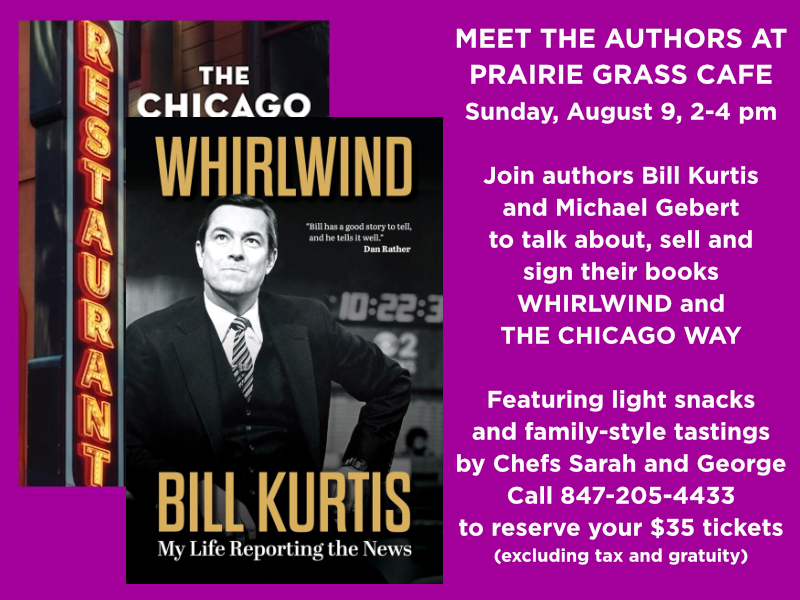
If my hyping my promotional appearances for my books for a few weeks made you feel like I was just promoting myself, please note that I appeared in a piece which I completely failed to hype last week! But there’s still time: friend of Fooditor Lisa Shames did a piece at Block Club on local Chicago specialties, and I’m good for a few quotes in it:
“The most interesting thing to me about a Jim Shoe is that they’re basically halal,” Gebert said. “The sub shops on the South Side where they originated were all run by Palestinians, so they don’t have ham, bacon or any other pork products. The customers mostly aren’t Muslim, but the owners are.”
8. G.O.A.T.
Not sure why we needed this just this moment, but the Trib has a profile of longtime Billy Goat owner Sam Sianis. The most interesting thing is this prefacing note:
The following interview [was] conducted in Greek with assistance from his son and Billy Goat co-owner and CEO Bill Sianis.
9. NO NO NOMA
No major followup on the Noma story. But we all know how nasty London restaurant critics are, and this is delightfully nasty—Giles Coren in the Times of London taking down Rene Redzepi for attacking him some years ago:
Someone, possibly Julius Caesar, feasibly Sun Tzu — who knows, maybe it was Zsa Zsa Gabor — once said, “If you stand by the river long enough, the bodies of your enemies will float past.” So it was nice, after a decade and a half, finally to see the bloated, waxen corpse of the former “Best Chef in the World” René Redzepi come eddying by last week, turning and rolling in the current, eventually washing up on the muddy bank of the international press to be prodded with sticks by curious children, sniffed at by cats and nibbled by stray dogs.
…he told the world I was a really nasty bastard when in fact (as it so often turns out) the really nasty bastard was him. As were the editors at Eater who goaded him into it. But Eater’s UK office was closed in 2023 due to lack of (really nasty) readers, and the editor’s body came floating by ages ago, so that’s all fine now too.
10. COMING… EVENTUALLY
At WTTW, a highly efficient checklist of new things opening soon.
11. UP WITH PIBIL
The photo of cochinita pibil at Sandwich Tribunal—orange sauce, green avocado, purple onions—makes it look like a Christmas treat. Anyway:
Puerco Pibil is a newer and probably more accurate name for the traditional Yucatecan dish Cochinita Pibil. Cochinita is an archaic Spanish word for suckling pig, though it might more literally translate as “small kitchen.” Pibil derives from a Yucatec Maya word for a cooking pit, piib, and refers to the food cooked in this way. A piib or pib is essentially a hole in the ground, dug square, large and deep enough to accommodate the intended meal. The hole is lined with stones and a hot wood fire is built atop those stones. Once the stones have been heated to the point where they are mildly glowing a the food–in a metal container or simply wrapped in banana leaves–is placed into the pit, topped with more banana leaves and wood, and then the hole is covered with dirt until the meal finishes cooking, which may take hours depending on its size.
12. LISTEN UP
As noted above, Dish from Chicago magazine talks about the Best New Restaurants list. By the way, there was one mention of a resaurant—sounded like “R.A.”—that I couldn’t figure out where it referred to. (Roka Akor? Seemed unlikely.) I asked John Kessler and he too was stumped at first, but eventually he figured out that it was Nettare, missing a syllable or two.
Restaurant design isn’t talked about enough; David Manilow at the Dining Table talks to Aida Napolis, who did the fancy new Carnitas Uruapan in Little Village.
The Chef’s Cut interrupts its series on hospitality to talk about the Noma brouhaha.
Here’s a name I remember (shot a Key Ingredient with her) but haven’t heard in a while: pastry chef Amanda Rockman, on Joiners.
WHAT MIKE ATE
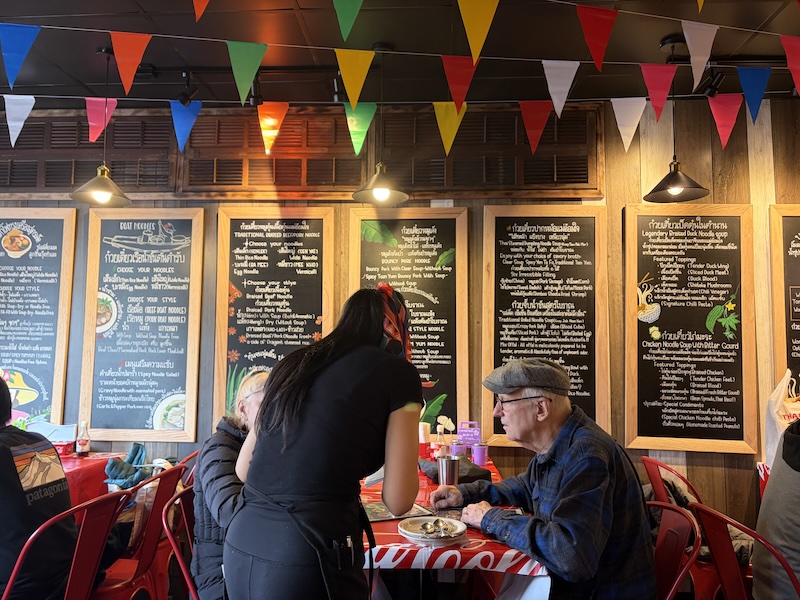
I was charmed by Noodles Party the moment I walked in—and even after placing my order at one table and then being moved to another (I recognized that seating one person at a four-top was not going to work for a place which quickly filled up). The benefit of the move was that I was soon sharing a table with a member of the family—or two, a parent feeding noodle soup to his three-year-old son, who advised me a little on what to order and fetched me a small bowl of just the right sauce to dial up my noodle dish (no idea what it was, exactly).
Anyway, I’m not totally convinced it captures the Bangkok street food experience—I wasn’t seated with my knees up to my chin on a plastic chair from the kids’ section at Ikea—but it gets it pretty well on a sensory overload level, between the lengthy text on the wall, the explosion of colorful decorations, and the owner in her trademark floral hat, that could rival Carmen Miranda.
I went in prepared with John Kessler’s suggestions of what to order, but of course almost none of that was on today’s menu. It’s a place for going with the flow and not worrying about ordering the perfect thing. (The borderline-incomprehensible menu—aided, partly, by a chalkboard list which is half in English—makes it nearly impossible to order exactly.) John Kessler had mentioned crispy pork:
Crispy pork with nam jim jaew dip is a marvel of texture
So I ordered the only thing with crispy pork, and got slices of crisply fried pork with white rice—and, unfortunately, a gloppy sweet brown sauce. I’m not saying I didn’t eat it all, but it didn’t sell me on the joint and I regretted the crispness quickly vanishing under the goo. The other thing I ordered, noodles in a soup with housemade wontons among other things, made up for it and more—it revealed new tastes and textures with every bite, especially the wontons which are wonderful, a deep sausage-y taste inside that went beautifully with the hearty broth. Crinkly noodles, some kind of greens, slices of—rutabaga? Hard to tell, but softened in the broth, they too were full of flavor.
So, ordering fairly blindly, I still had one of the best things I’ll eat this year. Going there is plunging into ordering chaos, and more chaos when you’re examining the caddy of seasonings and wondering which is right for what you’re eating (the guy at my table suggested the vinegar with chilis for my soup—I gave it a little sprinkle). But I urge you to take the plunge. It’s a place full of Thai flavors you may or may not recognize, served with warmth and friendliness by a family hustling in a crowded room. It’s exactly the kind of place we all look and hope for.