

1. A.I. THE EXTRACHEFFIAL
I have little interest in A.I.; first it was crappy art, 2025’s six-fingered answer to the cheesy CD-ROM with 10,000 FREE! images that came with your new Windows computer in 1995. Now it answers your searches that Google has gotten steadily worse at, but you don’t dare trust it without doublechecking your answer (I saw a pretty funny post about querying for pasta recipes using gasoline as an ingredient, and of course it very helpfully told you how to use it in Italian food, in the old authentic way).
So, you know, until they outlaw books and websites written by actual humans, I won’t be doing much with it. My pro-carbon-based-life-forms prejudices aside, the NY Times has an interesting piece on chefs playing around with A.I. to explore new worlds, including one Chef Grant Achatz at Next:
For four months in 2026, the Chicago restaurant Next will serve a nine-course menu with each course contributed by a different chef. One of them is a 33-year-old woman from Wisconsin who cooked under the pathbreaking modernist Ferran Adrià, the purist sushi master Jiro Ono and the great codifier and systematizer of French haute cuisine, Auguste Escoffier.
Her glittering résumé is all the more impressive when you recall that Escoffier has been dead since 1935.
Where did Grant Achatz, the chef and an owner of Next, find this prodigy? In conversations with ChatGPT, Mr. Achatz supplied the chatbot with this chef’s name, Jill, along with her work history and family background, all of which he invented. Then he asked it to suggest dishes that would reflect her personal and professional influences.
Of course the reassuring thing is knowing that the fictitious Chef Jill’s food will be supervised and refined by Chef Achatz—and indeed may well resemble his food pretty closely in the end. I immediately thought of when one of my sons would try to conjure up things to bake, and I would, on the fly, make his ingredients into something that would actually work (“Yeah, we need an egg in this to hold it together, is that okay?”). Still. my first thought when I saw people making fun of this idea was—where better, than the built-to-be-experimental Next? If Achatz wanted to pick ingredients by dartboard, or hire a Chicago novelist to conjure up a false chef and their backstory, or whatever, it’s just the place that should do it. Is it the future of dining? I doubt it, but is it good showbiz, such as Next has often been? Sure.
2. 42’S GRIM
I have nothing snarky to say about this, not least because I feel some responsibility for helping raise the profile of the chef involved (you can hear my voice in the first of the two—two!—documentaries about him): Jake Bickelhaupt, whose Michelin-starred 42 Grams shut down when he assaulted his then-wife Alexa Welsh in 2017, leading to a conviction for battery, has been arrested in Florida, where his restaurant Konro won the only Michelin star in Palm Beach County, for assaulting his second wife. The Miami New Times:
Bickelhaupt, who was previously arrested for attacking his ex-wife and business partner, was taken into custody by West Palm Beach Police on June 2 on felony charges of aggravated battery causing bodily harm and domestic battery. According to an arrest report, staff at St. Mary’s Medical Center had notified police that fire-rescue workers had brought an injured woman into the intensive care unit from Palm Beach International Airport, where she’d apparently had a seizure at a ticket counter while trying to purchase a ticket to Denver, her hometown.
According to the arrest report, the woman told police she’d been in a car accident. But medical staff quickly realized that her injuries weren’t consistent with that scenario. Police were dispatched to Bickelhaupt’s West Palm Beach home to conduct a welfare check, where they detained him for their investigation. The arrest report indicates that police observed that the woman had two blackened eyes, multiple bruises across her face, dried blood under her nostrils, and swelling around her face. Her arms, shoulders, wrists, and hands were also bruised.
Bickelhaupt and his second wife were the subjects of a second documentary, 86ed, which attempted to build sympathy for him as a victim of cancel culture:
The tagline on the documentary’s since-deleted website, 86edfilm.com, describes the film as “a story about a two-Michelin-star chef hitting rock bottom with cancel culture and finding redemption.” The summary reads, “After being canceled in Chicago following a violent incident with his ex-wife/business partner, 42 Grams chef Jake Bickelhaupt moved to Denver in the midst of COVID-19 for a fresh start. However, his past continues to haunt him as the cloud of cancel culture and online bullying renders him nearly paralyzed in his search for redemption. During these times of uncertainty and change, watch as Jake fights against all odds to rebuild his life.”
The site may be down, but as of this writing both of the Bickelhaupt documentaries can be watched on Tubi for free. Not a lot of comment so far, it’s not like there’s two sides to this awful story, but Wilson Bauer (who was at Schwa when Bickelhaupt worked there—another chef told me they were all afraid of him) has been skewering Bickelhaupt—and Michelin for praising him—on social media.

3. NAFSOFAST
It took Phil Vettel 13 years to produce a second review of Blackbird. Louisa Chu has now written up Nafsi, the restaurant in the South Shore Cultural Center, twice in nine months, first in September 2024 and now this week:
But it’s executive chef Dondee Robinson, last at Bronzeville Winery, who sets the standard of excellence from the kitchen.
His catfish and grits is an homage to Nafsi owner Donnell Digby’s family, founders of the once-thriving Black-owned business Catfish Digby’s.
Robinson transforms the traditional dish into an elegant offering rivaling the rarest catch from the deep blue sea. A golden and crackling creole-spiced crust hides a delicate and delicious filet, presented on glimmering and buttery grits. A side of bright arrabbiata sauce imparts tomato, garlic, chile and the warmth of the sun.
I liked it fine when I went some months back—I liked dessert the best—but I still have to ask: why so much attention in such a short time for one restaurant?
4. AURORA TACOALIS
If you asked me to suggest where I think there might be untold riches in Mexican food in the Chicago area, I’d tell you to start checking out places somewhere in the Elgin-to-Aurora axis. Admittedly, that’s a big territory, so I’m hedging the hell out of that bet, but still, when I’ve been out there for whatever reason, a quick look on Yelp for the highest rated places nearby has never been less than pretty good. Same for Michael Nagrant, whose son is in basketball now, meaning he finds himself in places like Aurora for games a lot:
I upped my game too a couple weeks ago by identifying a strip mall taco joint in Aurora that, if you dropped it in to Chicago, would be one of the better taquerias in town.
The spot is called Jefa Tacos, as in “boss” tacos
I wasn’t sure about it. This wasn’t a Chicago strip mall, but a fancy brick suburban one, the kind usually anchored by a modern dental office with a name like Boundless Smiles.
The taqueria was filled with the all requisite icons: skulls, Frida Kahlo, and flaming corazons. But the burnished reclaimed-looking wood tables and shiny lacquered modern chairs had a strong modern Instagram aesthetic.
And there were free chips and salsa.
Oh, no.
The salsa was served warm. And yet it was bright with a solid spice hit.
5. KOUKLAS, BANN’ AND OLIVES
I follow Jimmy Bannos Sr. on Instagram, so I’ve been following the construction progress of a new restaurant, Kouklas, in a space in Niles I recognized from zipping up and down Milwaukeee Avenue. Anthony Todd has a piece in Chicago mag announcing the place under the direction of Jimmy Bannos… Junior (The Purple Pig):
Bannos’s goal with Kouklas is not to reinvent Greek food, but to take classic Greek dishes and elevate them. He also wants to introduce diners to less common or regional Greek dishes they haven’t had before. Bannos equates his approach at Kouklas to that at the Purple Pig. “Let’s think about chicken souvlaki; simple as it comes, right? But how do we make it taste 10 times better than everyone else’s?” After the classics are taken care of, he plans to do more adventurous dishes, just like at the Purple Pig, and hopes customers will trust him and try anything he puts out.
6. CONGREEK
And speaking Greek, Dennis Lee talks about the venerable Central Gyros, an old school Greek place on Central Ave. For me there’s not a lot new to say about this old place, a onetime LTHForum fave, but Dennis finds something—comparing avgolemono soup to congee:
Of course we’d go for the avgolemono, the egg lemon soup, with chicken and rice floating in it. This one has a relatively light body to it, and both Davida and I noticed that it’s almost like Korean rice porridge (jook) or congee. But where jook is enjoyed for its gentle flavor, avgolemono hits you up front with the chicken and lemon.
7. LONDON CALLING
Titus Ruscitti has an epic post on where to eat in London—not a place I’ve been this millennium, but my wife has reason to go there once a year or so, so I’ll bookmark it for her:
I’m at a point in life where I’m trying to visit as many countries as I can but I also want to return to the places I loved and London is up there among my favorite cities anywhere. It may even be at the very top as I loved our second trip every bit as much as the first and I still feel like I haven’t seen even half of it. Two trips in and I’m sticking with my claim that it’s one of the five best food cities in the world and probably the best in all of Europe. It’s amazing how fast it all happened too as this would’ve been a crazy statement just 10 years ago. But it’s more than just the food – I love the history, the culture, and all the exploring one can do on the back of the Tube. I used this quote in my last post about London but it’s every bit as true after my second visit – “When a man is tired of London, he is tired of life” – Samuel Johnson
8. CITY IN A GIARDINIERA
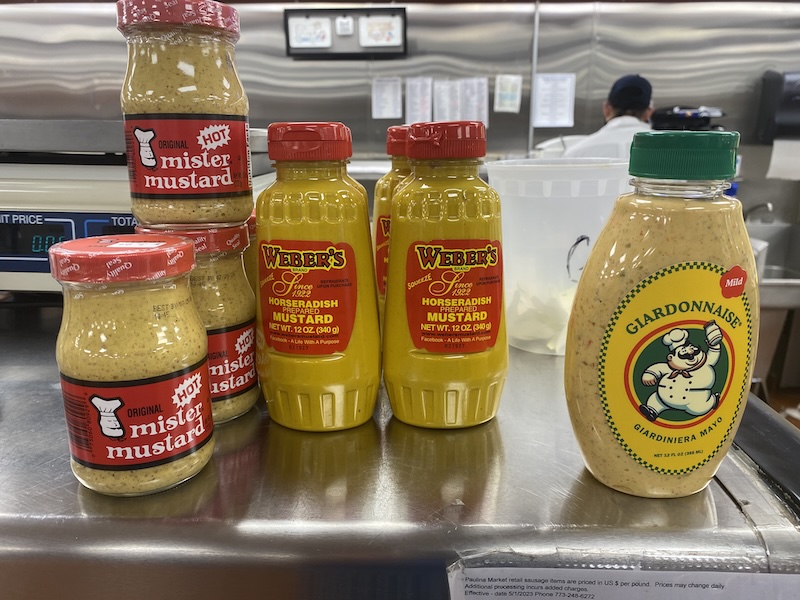
Chicago mag has a package (as magazines call it) on Chicago’s most distinctive condiment, including a taste test of different jarred versions by John Kessler, tips from chefs on how to make it and a recipe for same from Sarah Grueneberg. Amy Cavanaugh explains why all the love for spicy pickled veggies:
Chicago giardiniera features the same vegetables [as the Italian version], but chopped up and with chile peppers like serranos. Because of that and jarring it in oil, our giard has more verve. Unlike Italian giardiniera, created to preserve vegetables for winter and served as antipasto, Chicago’s works as a versatile condiment with seemingly endless possibilities. While its most famous use is on Italian beef sandwiches, it can zhuzh up many different foods. At home, I mix it into mayonnaise for my turkey sandwich. Friends swear by putting it into tuna salad.
9. LAO NOW
Last week we were talking about Lao food being rare; this week we have another Lao cook in the Reader, Alvis Huynh, who has a pop-up called Về lại—and a complicated saga involving being gay, dancing, having parents who wanted him to go into medical research, and a cross-country saga from the D.C. area to Madison to California, and finally Chicago:
“High school was really good up to a point, but it felt like my queer identity took it all away from me,” he says. “Not to an extreme, but that’s how it felt.” (In response to condolences about the situation, Huynh quipped, “It’s OK. It’s part of the lore at this point.”)
He was ready for a clean slate. It was still his ambition to become a chef, but his parents would not have endorsed culinary school. “They didn’t say no, but they didn’t say yes,” he says. He found a compromise in the field of food science, which includes food analysis, microbiology, chemistry, quality assurance, processing, and more.
“I forgot about it—the dream of becoming a chef. It wasn’t laid out for me.”
10. GYRO GEARLOOSE
More Greek: David Hammond takes a look at gyros for WTTW:
If you’ve never had a gyros (and if not, you really should rectify that immediately), here’s the breakdown. The word “gyros” comes from the Greek for “turn,” and it refers to seasoned lamb and beef (sometimes pork or chicken), shaped into a vertical cone, roasted slowly on a spit, and shaved into ribbons of sizzling, savory glory. It’s typically stuffed into warm pita bread, topped with tomato, onion, and a cooling dollop of tzatziki, a cucumber-yogurt sauce that tastes like ranch dressing’s Mediterranean cousin.
Today, gyros are practically everywhere, including small storefronts and white tablecloth restaurants. What many don’t realize is that Chicago is the city that gave gyros their American glow-up.
11. STEVEN MERCADO
Pilsen is the Latino neighborhood we gringos all know; Little Village/La Villita is bigger and culturally more important (it’s the second busiest retail district in Chicago, after the Mag Mile). I tried to make it a little less unknown a few years ago, and Block Club tells us about a new event on summer weekends that could be a reason to check it out: the Mercado de Colores, offering “a wide range of accessible, locally sourced fruits and vegetables” as well as crafts and local organizations, every Saturday through October 7th.
12. FORGET IT, GRUBHUB, IT’S CHINATOWN
Chinat0wn feels the most like another world as any food-related part of town, and one of the things you notice there are the delivery services that seem to exist only in Chinatown—Chowbus, Fantuan, etc. Here’s a piece about the alternate universe of Asian delivery services, at CNBC:
Fantuan’s strategy looks different than that of bigger food platforms given its focus on Asian businesses, according to co-founder Yaofei Feng.
The 11-year-old company sends representatives to talk to store owners in person about getting on the platform rather than trying to reach them online, Feng said. These conversations will often take place in Chinese, given that he said many of these entrepreneurs speak English as a second language.
“The way we gain their trust is very unique,” Feng said.
Having options besides English for the app is appealing for business owners who find it easier to communicate in their first language. The app design is also more reminiscent of Chinese platforms like Alibaba than American alternatives, Feng said, which can provide a sense of familiarity.
13. OLD MAN COMPLAINS
It’s an old man complaint, but I’m hearing it from people well before AARP age: why’s it too dark in many restaurants to read the menu. Maggie Hennessy in Bon Appetit:
Lighting has to serve multiple purposes. There’s general lighting to set the tone, brighter task lighting to help chefs and servers carry out their jobs, and accent lighting to draw attention to certain areas of the restaurant or up the ambiance. A soft spotlight over a table, drippy wax tabletop candles, or a spindly chandelier above the bar might draw diners’ attention to unique design elements or submerge them in a sexy dining room.
Accent lights are great for establishing a vibe, but deployed haphazardly, things can go from alluring to blackout-dark.
Two places in Chicago that were smart about this. One, the previous version of the Cherry Circle Room which gave every table tiny flashlights with a blue tint—so you could see your menu but not look like you’d flipped on the high-beams at the table next to you.
Two, I went to Le Perroquet once, don’t actually remember the lighting, but the description of it (from Maggie Trboyevic, Jovan’s widow) in my someday-coming book makes me wish I did:
We had these wonderful lamps that we had made out of millefiori vases… It looked like a little mushroom cap. It had a wonderful glow to it, it made the guests look great. It wasn’t dim. Some places were very dim, and they had red shades and so on—but these just made women look beautiful. You didn’t see a wrinkle on anybody.
14. PEACH TRUCK’S A-COMIN’
Your annual reminder that it’s soon to be time for the Tree-Ripe Citrus peach truck, bringing Georgia freestone peaches and, usually, things like Michigan blueberries and Georgia pecans which you can buy in bulk. I drive out to some parking lot in a suburb like Gurnee or Morton Grove every year to get a 25-lb, box of these fantastic peaches, lay them out on a table to ripen and about four days later, start eating one of the glories of summer. (Well, more than one, that’s for sure.) Go here to see the schedule and start planning your trek to wherever’s most convenient for you.
15. LAO FOOD BEAT
Speaking of Lao food, last week I linked to Titus Ruscitti talking about Lao Der, and saying “it’s rather surprising that Lao Der is the city’s first true Lao restaurant.” I kind of thought there was one twenty years ago or so, around Uptown or Edgewater, that we talked about on LTHForum, but I wasn’t positive it wasn’t Cambodian (when that was unique, too). In any case, no idea what the name was, or how to find it.
Well, an old LTH friend, Dave Gordon, wrote me:
Titus Ruscitti apparently does not remember the small Lao place next to Golden Pacific Market back in the 2000s, Sabai-dee. In fact, there is an entire (if short) thread on LTH to which I posted back in 2007. Very nice folks, wonderful food.
I responded that I couldn’t remember if it was Lao or Cambodian and he responded:
You may have confused it with a tiny hole-in-the-wall Cambodian place vaguely kitty-kornerish from where Carino now sits. The name escapes me (it may not even have had a name), but it was directly under the el tracks, maybe two or three doors east of Broadway on Leland.
Anyway, the old LTH link is here.
16. LISTEN UP
Joiners talks to Carlos Gaytan of Tzuco, which I’ve wondered about—one of those places that opened right before COVID, and its most ambitious plan, a tasting menu called Tales of Carlos Gaytan, so far as I know never happened. Haven’t heard much about it since.
The Dining Table looks at places for a lunch meeting downtown
Supper With Sylvia talks to Sam Toia of the Illinois Restaurant Association about the Beards and such things.
Dish from Chicago magazine talks about their giardiniera package.