

1. BOOK AND A SUB
Okay, the Brindille event is Monday afternoon, and there are a few tickets left, so if you want to go, you still can—go here to get yours.
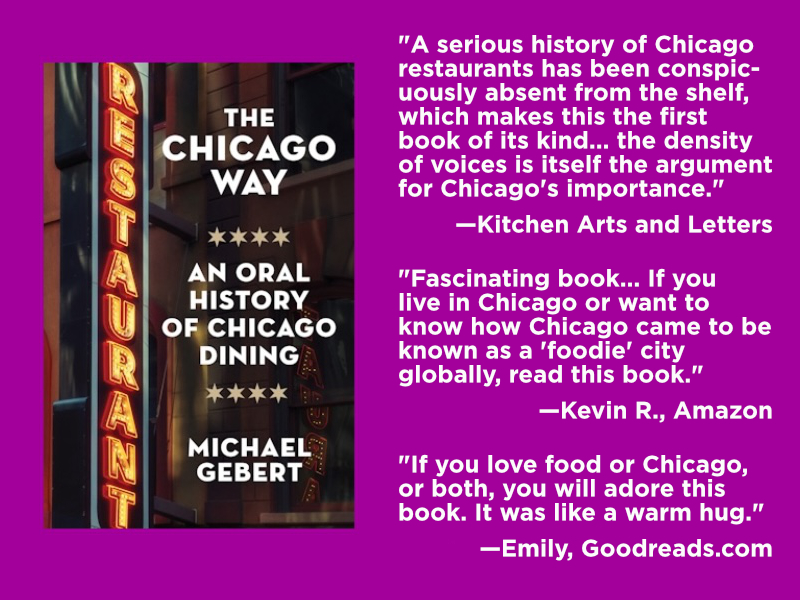
Here’s another piece about the book from about a month ago, just saw it, in the Northwest (Indiana) Times:
It’s a dense book, 587 pages long, but highly readable, a page turner in fact. It starts with The Bakery, which opened in 1963 in the food era of steaks. Continental cuisine was less well-known, and the restaurant was tiny, just 25 seats. But it was a game changer, and in deciding which restaurants to highlight, that’s exactly what Gebert wanted.
In other news, if you want an autographed copy of The Chicago Way, Friend of Fooditor and Giardiniera Supplier to the Papacy Jim Graziano (who’s all over the chapter on the West Loop, talking about what it used to be like) has laid in a supply of them at J.P. Graziano’s. So get yours and a Mr. G sub at the same time, could there possibly be a better combination?
2. SUN TAP
Uptown’s Sun Wah is a good choice for a story about a multigenerational family restaurant (I did a video on precisely that subject). So is Tufano’s Vernon Park Tap. What isn’t so clear to me is why they needed to be the same story, as they are this week in the Trib:
Nestled in Little Italy, Joey DiBuono, 69, runs Tufano’s Vernon Park Tap, a traditional Italian joint that has been in his family since before he was born. As the third-generation owner, he works closely with his sister, JoAnn DiBuono, 74, and his daughter, Darci Pinello, 38, nearly every day.
On the North Side, the scene is different, but the rhythm is the same. At Sun Wah BBQ, the air is heavy with the smell of roasting meat and five-spice. Whole cooked ducks hang from hooks in the front windows, catching the attention of pedestrians.
Inside, the energy is immediate. Servers with food carts zoom between tables, large and small. Overlapping conversations in Cantonese, Mandarin, English, Spanish and more fill the open dining room as a regular walks through the door.
…Though both restaurants are in different parts of the city and serve cuisines from different parts of the world, their stories are surprisingly similar. Both began with immigrant families who wanted to share the food they grew up with while building a life in Chicago. Their children were raised inside the restaurants, busing tables, greeting customers and working long hours in the kitchen.
Them and many, many others, I would think.
3. MARIELA BOATLIFT
Anthony Todd on the latest restaurant from Zubair Mohajir, David Mor and Rishi Kumar (Mirra, Lilac Tiger, etc.), Mariela:
The space has been totally transformed from the eclectic and hard-to-navigate Atwood Café to a much more luxe, relaxed vibe. “We wanted to make the space feel like a getaway; if we are saying ‘global coastal cuisine,’ people need to feel like they are being transported,” Mor explains. The group had to do a complete flip of the space in just a few months, but the result speaks for itself.
4. KYOTEN AGAIN
Grimod wrestles with what more there is to say about Otto Phan’s Kyoten (this is his fifth writeup since December):
This might mean a certain degree of redundancy. However, showcasing meals that stand merely two (rather than three or four) weeks apart could also offer a chance to demonstrate just how dynamic the restaurant’s arsenal of seafood really is.
Likewise, while Phan’s consistency will certainly come under sharper scrutiny now that my closest reference point is comparably recent, his capacity for fine-tuning and bonafide growth (quickly mastering the more challenging ingredients before they disappear for the season) may also be emphasized.
5. TEMPURA RULES
The actual historical Grimod (Alexandre Balthazar Laurent Grimod de La Reynière, 1758-1837) gets a mention from Michael Nagrant as he ponders, tongue in cheek, the history of restaurant writing:
My newest principle is known officially as food critic rule #1273 which states: There is a direct relationship between investment in branding and the quality of a restaurant experience.
This is supported specifically by Corollary 3.2: The more your restaurant logo looks like a Stan Lee comic imagined by AI, the more likely your restaurant sucks.
Somehow this all leads to Tempura Man, a new restaurant in Schaumburg from the owner of Chicago Ramen in Park Ridge:
The thing about tempura is it doesn’t brook any
food influencer videography or photographybullshit. Japanese tempura has an optimal shelf life of a minute max, so maybe I’d advise the kitchen to cut this bad boy up into a few smaller pieces. There’s too much potential the tea goes cold and some Schaumburg Stan might do some bad shit, like post passive racism in the form of a Yelp review.I then honed in on the udon a sweet dark tea of righteous broth and springy noodle coiffed with a nest of chopped scallion. Because I’m white and the move is always more fried-food-on-fried-food violence, I ordered the tempura udon.
6. TEMPURA RULES!
Compare-and-contrast for places serving a similar kind of thing is a common enough format, but I’m not sure I’ve ever seen anyone do it for shrimp tempura, as Titus Ruscitti does this week:
After going to Japan back in 2019 I fell in love with tempura in general and I’ve been trying to find a suitable spot in Chicago to feed those temptations. Tempura has a fascinating cross-cultural history tracing back to Iberian Catholic fasting practices taken to the streets of Edo-era Japan via Jesuits and traders from Portugal who introduced the Japanese to batter and deep frying techniques. In Japan tempura can come in more ways than I can name. It can be a humble dish served over rice (Ten Don) or it can come with a show in the form of an omakase. I’ve long thought Chicago would be a perfect spot to open a tempura omakase experience as people in the Midwest love fried foods but it hasn’t happened yet. When it does I’ll be one of the first people there but for now here’s five spots I’ve visited in search of good tempura.
7. RIVER, WALK
The Riverwalk downtown is one of the things you can’t argue with—it’s a great use of a panorama of the city visitors are always wowed by. Nick Kindelsperger looks at what’s worth eating there, like Haire’s Gulf Shrimp:
What makes the shrimp so great? Each jumbo Gulf shrimp is astonishingly plump and juicy — there’s no rubberiness here. Each one is dipped in a delicate coating that adds crispness without getting in the way, while also miraculously holding tight to each shrimp, refusing to fall off if you look at it funny. I also appreciate that each shrimp has been properly deveined.
8. DENNIS IN QUEST OF HIS YOUTH
Charlie Trotter’s family used to go to Hackney‘s on the north shore, says so in my book, and so did Dennis Lee in his youth:
The restaurant has been around for over 85 years, and you can feel it in its bones. The place is perfectly set up for patio season, and I remember visiting its various locations multiple times, including the now-shuttered shop on Printer’s Row. Everyone pretty much comes here for the big burgers, along with one other thing.
The other thing, as everyone who grew up on the north shore knows, is the onion loaf:
These frizzle-fried onion strings come smashed into a brick, and they’re the kind of thing your group will pick at right away.
9. I AM MOOT
I still haven’t been to Meat Moot, the Turkish meat-palooza in Burbank, but people have—enough that they’ve opened a new location in Mount Prospect, per Kevin Pang:
It’s a singular concept: Part counter-service barbecue, where you order meats by the pound, but also the type of sit-down place to bring a family on a Saturday night.
The halal restaurant (no pork) is inspired by the popularity of American-Texas barbecue, through the lens of Middle Eastern flavors. The meat is smoked for 12-14 hours, and emerges from the cooker fork-tender, closer to the texture of meat that’s been braised. A blend of spices is dramatically added to the meats, alongside salt, pepper, and a drizzle of honey. Sides include rice, potatoes and coleslaw, and it’s all-you-can-eat.
10. THE EIGHT KINGDOMS
I learned a while back that nearly all of Chicago’s older Chinese businesses came not just from the same region but the same county or town, Taishan in Guangdong, and only in recent years have we started to have broader diversity of regional cuisines in Chinese food. Here’s a very useful piece at WTTW by Mona Tong laying out the eight major regions and where to taste their food in Chicago. Bookmark this one!
11. FOOD AND WHINE
At Food & Wine, John Kessler talks about one way to find good food on vacation—phone it in. He was in Aruba surrounded by tourist traps, and found a local food delivery app:
Thirty minutes later, Chupa Dede Snacks had delivered a full array of local dishes I didn’t know I craved until I unboxed them. We had dedito (miniature turnovers filled with gooey cheese) and pastechi (empanadas stuffed with lamb). We had a quart of sopi di galina (a light and aromatic broth filled with stewed bone-in chicken, rounds of corn still on the cob, carrots, and hunks of starchy root vegetables). It reminded me of an Antilles pot au feu or corned beef and cabbage, with the broth a transport medium for a boiled meal. We drizzled it with a wickedly good hot sauce and dunked fat slices of cornmeal funchi, the local analog of polenta.
I am of two minds about this. If I’m somewhere, I want to sample the local culture, which includes not just food but hospitality. Generally, I don’t want to eat in my room. But I understand that sometimes you’re just boxed in by chains and restaurants aimed at hidebound Americans. (For me most recently it wasn’t Aruba, it was Phoenix, surrounded by malls and construction sites.) If I’m going somewhere interesting, I do my research ahead of time to avoid this sort of thing. But I think his point is worth remembering—there’s more ways to get food than what you can walk to. And it might be letting it come to you.
12. RELATIONSHIP TO LISTICLE
You know you’ve made it as a Chicago chef when you’re asked to name your favorites in an article. Jake Potashnick of Feld is a native Chicagoan, but he got most of his training outside of Chicago, so good to see him telling Lisa Futterman at WTTW where to get what he likes best:
Favorite dish
Fried dried beef with sticky rice at Siam Noodle and Rice (4142 N. Broadway). This would be my death row last meal. It’s perfection. What really makes the dish is the homemade hot sauce that’s the perfect level of spicy with comical amounts of chopped garlic mixed in. The Seoul sassy fried chicken at Crisp is a close runner-up.
13. MOLTO SCUMBAGGIO
Eddie Lakin takes a chef’s look back at the Mario Batali scandal:
As a post-script to the solemnly-delivered right-note-striking apology letter regarding the many female fans and employees he drunkenly groped and assaulted sexually, Batali signed off with “In case you’re searching for a holiday-inspired breakfast, these Pizza Dough Cinnamon Rolls are a fan favorite,” linking to a recipe.
He really thought he could just continue on. A week later, just say the right combination of words, come off as sounding contrite, then with a wink and that impish smirk, toss off another recipe and keep the whole celebrity money train a-rollin’. That’s what Mario the serial groping masher thought.
14. LISTEN UP
Joiners talks to Stephen Sandoval (Trino, Entre Suenos).
Joe Flamm of The Chef’s Cut is a judge on Top Chef, and talks about it on his podcast.
WHAT MIKE ATE
My son and his girlfriend had to do something at my house, and then they were trying to figure out where to go for lunch. I’d been holding onto Titus’s recent post about new things in Albany Park, and I’d only been to one, My Doner, so I quickly plucked another from the list and we found ourselves at a place called KatKout, a bright little shop with meat and chicken doner cones behind the counter. (There are other things—rotisserie chicken and specials like mansef—but the place clearly communicated that you want the doner the first time.) We ordered and the woman behind the counter quickly sliced some meat, rolled it up in a tortilla-like flatbread, and then crisped it up on the grill. It was that finishing touch that lifted this above the average doner place; chicken doner can be dry, but they squirted it with garlic tahini sauce and that also lifted it above average. We also tried a kind of sandwich made with nabulsi, a rubbery cheese similar to halloumi; it was fine, but we all agreed that it would have benefited from a splash of the garlic tahini sauce as well.
I was sorely tempted to try it again a few days later, but that seemed unimaginative, so I thought of another place I’d been meaning to try—a central Asian restaurant called Arzan Cafe, in a strip mall on Kimball across from the end of the Brown line. (It has a market a couple of doors over.) Specifically it’s from Kyrgystan and/or Turkmenistan, but the menu had the things you’d expect to find from anywhere in Central Asia—skewers of grilled chicken and lamb, lagman (noodles) with meat, cheburek, etc. I thought it was pretty good, the meat was nicely grilled, but I have to admit that I was less excited by it, maybe because everything was familiar, than I was by KatKout, which was more humble street food but really handled well.
Buzz List will be off next week and return on June 22.