

1. BOOK NEWS: BRINDILLE
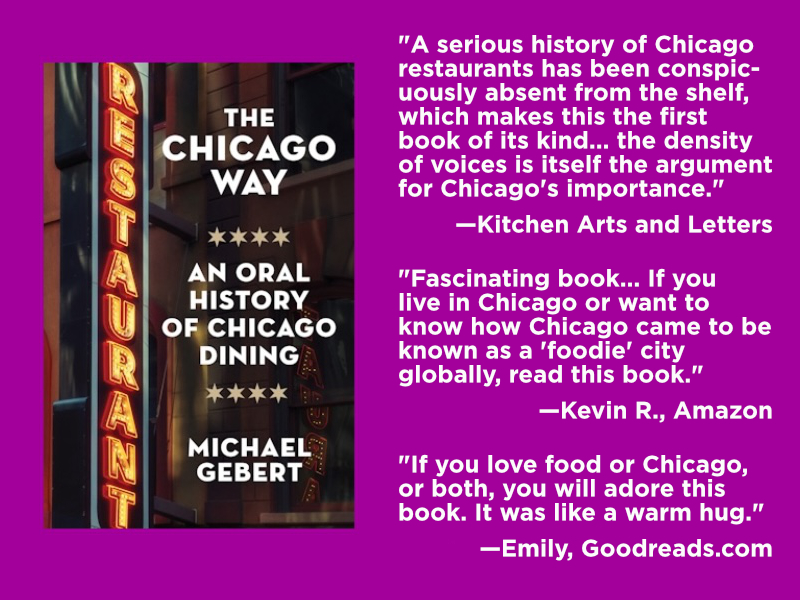
Okay, we’ve sold about 80% of the tickets to the upcoming The Chicago Way event at Brindille, with Monica Eng leading a Q&A with me, things to eat by Brindille and things to drink by Peter Vestinos. $50 gets you all that plus a copy of the book, which I will happily autograph. Go here to get yours before they’re all gone!
2. CONGRATS TO SMYTH
They won Restaurant of the Year at the Jean Banchet Awards. They won a third Michelin star—making them the only three-star in Chicago when Alinea was knocked down to two. And now Smyth has been named the best restaurant in America by the World’s 50 Best Restaurants—right as they hit their 10th anniversary in business. Here’s a piece about it at the Trib.
3. ATELIER GETS MESSY
I had my thoughts on the closing of Michelin-starred Atelier last week. Now the Trib has a story on the finances behind the closing, which include “nearly a half million dollars in small business bonds [raised] through online crowdfunding platform SMBX”; if Atelier owner Tim Lacey files for bankruptcy, bondholders may lose it all:
Atelier’s parent company, Iryna LLC, raised $485,340 through its bond offering, which closed in April 2025, according to the SMBX website. The terms promised investors 10.75% interest payable over five years. The restaurant planned to use 80% of the money for working capital and relocation, 14% to refinance debt and 6% to pay SMBX’s capital raise fee, according to the prospectus.
A total of 206 investors put up an average of about $2,356 each, according to the SMBX website, which lists most of the bondholders anonymously. Investments ranged from $10 to $50,000 in the unsecured bonds, all of which may be at risk.
Well, restaurants are like tech stocks and playing the horses—don’t invest what you can’t afford to lose. Who knows how this will all play out, but Lacey’s explanation for what happened is pretty obvious and mundane:
“The longer I tried to push staying open, the bigger the debt grew and the harder it got to meet payroll and to pay our vendors,” Lacey said. “It became obvious that every day we were open only deepened the problem, and that the financial issues had become insurmountable.”
A chef commented on my suggestion last week that they could have generated more publicity to let people know what they were doing there, finding it risible that I suggested they follow Grant Achatz’s example:
But acting like “just write on Substack” is the answer ignores the obvious: people are reading Grant because he’s Grant Achatz, not because he discovered a blogging platform.
Fair enough. Put that way, it does sound naive. I don’t mean that you’ll instantly be as widely followed as Grant Achatz. But one, writing about yourself is one of the few ways that you can attract an audience without spending a bunch of money on publicity—or influencers promising it. And you don’t need to have an audience as big as that of one of the most famous chefs in America—if you get ten more people in a small restaurant on Saturday night, it’s better than not having them, no? Anyway, there are rarely magic cures to business problems, but it’s just as rare when not doing anything beats doing something—that’s basically free.
Christian Hunter, the opening chef of Atelier, says something similar at WBEZ:
“You have to win your neighborhood over,” he said. “If you have a really big-name person or group, you’re ahead of the game, but no matter what restaurant you open, your neighborhood has to support you first. Otherwise, nobody’s going to know where to travel to come see you.”
4. ELIMINATE ALL FREE RADICLES
Amy Cavanaugh at Chicago mag tells you what to order at The Radicle. I really liked the seafoody stuff, like:
SMOKED MACKEREL
Curls of the fish, accompanied by radishes and mustard seeds, are placed on a slice of pumpernickel toast that’s slathered with tonnato. This dish tastes as good as it looks. $14.
5. BARSKE AT ELSKE
Understanding Hospitality returns to Elske not just for food, but to see what’s up with a new bar manager:
On the cocktail side, Stephan Jurgovan (whose wildcraft pairings impressed me during Warlord’s “Enemy” tasting menus last year) has stepped into the role of bar manager, replacing Monica Casillas-Rios.
…Of the new creations, a “Milk Punch” ($16)—made with fino sherry, green chartreuse, green apple, and coconut—tempts me. In fact, given the small change I perceive in the martini, this clarified tipple immediately takes the crown as my new favorite. Thoroughly chilled, the recipe blends a sense of weight and rounded sweetness with an electrifying oxidative tang: one that teases out the depth of fruit, earth, and spice that lurks in the background yet never detracts from a quaffable kind of enjoyment. Overall, I’d put this milk punch up against any in Chicago, and, if it’s a testament to Jurgovan’s work, I think the program is in great hands.
6. A-BOKA-Y!
Michael Nagrant checks out Boka for the zillionth time:
The savory parts of the meal make me realize, that though he has retained a Michelin star at Boka since the Nixon administration, [chef Lee] Wolen is woefully underrated in our city. So too is his team, culinary director Jonathan Dockter, and chef de cuisine Wood Jameson.
Although even on a Tuesday night the dining room all these years later is still packed, so Wolen is only underrated in the media, not by the people who pay the bills. And really, except when TGI Fridays was really successful, butts in seats, and not critics or writers, are what matter most.
7. BUT CERES-LY FOLKS
Nick Kindelsperger looks at happy hour deals in the Loop. This would be of pretty minimal interest to me, except for one place: Ceres Cafe, the post-trading hangout for guys in flimsy gold-colored jackets, which specializes in very stiff drinks, enough to knock a police superintendent into retirement. But maybe all you need to know is that Ceres’ happy hour is, hilariously, from 1:30 to 3:30, because as Jonah Goldberg says, you can’t be drunk all day if you don’t start early:
Few places offer such an adulterated experience of freewheeling, debauched drinking. Don’t expect karaoke or board games. The alcohol does all the work here. If it’s your first time, know you’ll laugh at the gargantuan pours, which are seriously “filled four fingers high.” The audaciousness is as mesmerizing as it is disturbing.
8. THE PURPLE PANG
Kevin Pang checks out the new incarnation of the Purple Pig in Oak Brook:
It was only a matter of time that The Purple Pig expanded. For its second location, it headed west to Oak Brook Center, and this new location at 15 Oak Brook Center in west suburban Oak Brook represents a more grown-up version of its raucous downtown location.
For one, the Oak Brook location is at least three times larger than the original, with an all-day cafe, a bakery, a fresh pasta station—and most notable of all—the ability to cook over live wood fire, unlike the confines of a Michigan Avenue office high-rise.
9. ROAD TRIP!
Nice to see Jan Parr, ex of Crain’s, with a piece at WBEZ about where to go just over the Indiana side of the border. A sample:
Neighboring Michigan City has seen an explosion of new restaurants, including The Heron (522 Franklin St.) which thankfully has strayed from the usual New American/Italian playbook and instead focuses on French food. A great happy hour from 4-6 p.m. (even Fridays!) features $10 martinis and deeply discounted wine and beer.
Up the street is Rocco’s Tavern (827 Franklin St.) from the family who owns Cafe Farina next door and Farina’s Supper Club in Michiana. Rocco’s makes you feel like you’re in a Rush Street steakhouse.
10. IS A FISH CAKE A SANDWICH?
Well, Sandwich Tribunal thinks it’s worth talking about fish cakes on bread cakes, beginning with the British “tea cake” as the bread:
The terms may not be entirely interchangeable. The Platonic ideal of a Scottish morning roll may not look much like a stottie or a tea cake. But in much the way that an American might use the word “bun” to describe a sticky bun or a cinnamon roll, a hot cross bun or a steamed Chinese bao (not to mention bread rolls of various shapes designed to accommodate hot dogs or hamburgers or bratwursts) someone in Western Yorkshire might use the phrase “tea cake” to describe a sweet roll with dried fruits baked into it–or it could mean a simple round bread roll to be split in half, buttered, and filled with bacon and brown sauce.
11. FRIENDS OF FOODITOR
The mayoral visit to the Pope was mostly a clunky pseudo-event, but we cannot be more delighted that the swag bag gift to the Chicago-area Pope included a jar of Friend of Fooditor Jim Graziano‘s house giardiniera (actually two, hot and mild, apparently).
In other Friends of Fooditor news, publicist Dave Andrews, who has fanily roots in Pittsburgh, will be doing his take on Yinzer Italian-American food this Monday at the Reader’s Monday Night Foodball at Thattu. Go here for more info.
And Paul Fehribach of Big Jones is in contention for “Favorite Chef” of the year at Taste of Home (a very large circulation food magazine, oddly little known to hardcore foodies). Go here starting Monday to vote for him for the honor, including: “Winner will take home $25,000, appear in Taste of Home magazine, and cook with celebrity chef Carla Hall!”
12. LISTEN UP
One of the smartest, most thoughtful interviews I did while at Grub Street a decade ago was a two-parter with Andrew Zimmerman (not Zimmern), ex of Sepia, Proxi, etc. See why I feel that way this week when he’s on Joiners.
The Chef’s Cut promises three subjects this week, only one of which is The Future of Hospitality.
Which restaurant group is an up-and-comer with the best shot of joining the Bokas and Hogsalts of the world? One strong candidate would be Ballyhoo, known in the city for places like DeNucci’s and Gemini Bistro, plus several in the burbs. The Dining Table talks with the group’s Ryan O’Donnell.