

1. BOOK NEWS
My long-awaited oral history of Chicago restaurants, The Chicago Way: An Oral History of Chicago Dining, is finally at a point where book news can become a semi-regular feature in this newsletter. For instance, there’s a publication date: February 3, 2026. And there’s almost a cover—we’ve had a couple of rounds of designs and I’m very happy with where it is, so expect to see that in the not too distant future. I posted a little more about it here, at the Facebook page for the book project, which will get renamed shortly. More to come, watch this space…
2. BURB BLURBS
One of the questions I had going into the book project was, when did the suburbs cease being where you went for fine dining? I soon realized that question was missing a key point—when did they first become where you went for fine dining? By the late 60s the city was still where you went for upscale food, French restaurant cookery. I wouldn’t say Le Francais opening in Wheeling was the thing that changed it all, but it was a big part of it.
By the time that Great Chefs of Chicago series was produced in 1985—the most vivid picture of Chicago dining just before Trotter—it was about half suburban chefs, including Jean Banchet, Roland Liccioni at Carlos’ in Highland Park, Pierre Pollin at Le Titi de Paris in Arlington Heights, Bernard Cretier at Le Vichyssois in Lakemoor (McHenry county), Thierry Lefevre at Froggy’s in Highwood (the last one from the series that still exists), and Carolyn Buster at The Cottage in southeast suburban Calumet City. When Henry Adaniya opened Trio in Evanston with Gale Gand and Rick Tramonto, the suburbs were still where you went, and when Tramonto and Gand left it they opened Brasserie T in Northfield; but by the time Grant Achatz was there c. 2001:
We’re in Evanston, which I didn’t even know what that meant. Oh, it’s close to Chicago. But it’s a pain to get up there. Trio was dying a fast death at that point.
So I guess there was maybe a 25-year span of suburban prominence.
But I think suburban dining is at something of a relative high point right now, maybe just because it’s happening in so much of America—people see food on TV and ask, why can’t we have that here? Chicago magazine has a big package on things to eat in the suburbs—the index is here, and the stories range from city chefs who’ve made a place for themselves in the burbs, like Chris Curren at (the very good) The Graceful Ordinary in St. Charles, to the ethnic foods that have concentrations in the suburbs, like Japanese around O’Hare and middle eastern in the southwestern suburbs, and, well, this one in Lake Forest that speaks for its suburban self: Best Farm to Table Cafe Where You Can Pet Baby Goats.

3. MAHARI VALENTINE
I liked what I had at Mahari, but what I really like was how Hyde Parkers have embraced the Afro-Caribbean spot as their place—not least because somebody else having a birthday meant that we got to see the musical procession through the room. Manager/”community engagement director” Magic Johnson (yes, he’s really called that) seemed to be the MVP here, acting as an emcee for the whole room. Louisa Chu reviews it at the Tribune:
The restaurant has become an escape from the everyday, where “people feel like they’re on a retreat somewhere,” [chef-owner Rahim] Muhammad said.
A woven grass ceiling over the main dining room with warm-hued tiled tables enhances that feeling.
“It’s a very homey place,” said the chef, who was raised in Baton Rouge, Louisiana. “Because a lot of us have a strong representation in Southern hospitality.”
It feels very exotic, he added, and communal too.
4. ITSA MINTZA
Slowly we’re getting regional Indian cuisine. Mike Sula reports on Mintza, a northern Keralan place on Devon:
The neighboring restaurants are “majority Hyderabad cuisine,” says [owner Sajadmon] Nechiyan, who opened the storefront Mintza in January. “But they don’t have any unique, different cuisine. So that’s why we say, ‘OK, let’s do it on Devon.’ There is a high demand for Keralan, or South Indian.”
Sula rattles off how many Keralan places we have now and it’s a lot—Thattu, Trilokah, parts of the menu at Nadu, Banchet nominee Thalaiva in Park Ridge.
5. MAXWELL SMART
Grimod at Understanding Hospitality takes a look at Maxwells Trading, with a particular focus on its wine list:
Structurally, I must praise the list for how it communicates style: white, rosé, and orange selections are grouped under the categories “refreshing & mineral,” “aromatic & centered,” and “rich & substantial” while red wines are labelled “chillable & smooth,” “subtle & focused,” “lively & engaging,” or “bold & intoxicating.” Short of appending annotations to each bottle (close to an impossibility for a program of this size), I can’t think of a better way to gently guide customers. In fact, by forming an initial signpost (toward a section, then maybe a price point), this system helps to encourage a more thoughtful conversation with the staff—one that need not start from zero (and all the trouble consumers might have in describing what they want) but can focus more on fine-tuning.
6. TO THE S’MORES OF TRIVOLI
I vaguely knew that Trivoli Tavern existed and was located in that building with a courtyard on Randolph and Green. I did not particularly know that it was a Hogsalt restaurant or that it was one of Chicago’s hardest to get reservations, but Michael Nagrant got a 4:30 reservation and explains, basically, why Hogsalt is such a hit factory:
I can’t explain how it is Trivoli Tavern can be all things to all people but it somehow achieves that. I think part of it is we are living in relatively dark times. We need escape more than we ever have. Most restaurants today, even the good ones, are a little too lean, a little too cool. A lot of dining rooms don’t look much different than the kitchen or living room reno of a rich person whose designer is just repping boring Pinterest trends.
Trivoli Tavern’s mishmash though is Harry Potteresque, a layered whimsical thing you never saw before, a thing you never needed, but now that it exists consumes and mesmerizes anyone who dares to come to near it.
7. BLUE PLATE
Dennis Lee goes to Chef’s Special:
The egg rolls with pork and shrimp ($10.50 for two) may actually be some of the best egg rolls I’ve ever eaten.
I think it’s because egg rolls are generally filled with cheap basic ingredients, like lots of shredded cabbage with only tiny scattered bits of protein like shrimp or pork. The ones at Chef’s Special are generously packed with big chunks of both shrimp and fatty pork, relying much less on filler material like cabbage and glass noodles.
These aren’t made with peanut butter like some egg rolls around Chicagoland are, which Davida missed, but I was so enthralled with these things I was secretly kind of bummed we didn’t order another round of them. We may have to come back for a happy hour, which happens between 5 and 6 p.m. daily, because the egg rolls go for $6 then.
8. SUSHI IN ANDERSONVILLE
Andersonville isn’t far from me, so I’ve been to Ora Sushi a few times in both its old and new locations. Here’s Titus Ruscitti on it:
Ora is stationed on the corner of Clark and Hollywood. I was tipped off by a friend in the food world who eats lots of sushi at different price-points and Ora is one of his favorite places in town. He’s also a big wine guy and lives north and Ora is BYOB and located further north so those two factors play a role in his love for Ora but first and foremost is the sushi. First thing I liked when peeping Ora’s menu was it’s tight – meaning it’s not over the place. It’s a single page with no more than 20 options listed among appetizers, nigiri, and rolls. I avoid sushi spots that get packed with groups due to the fact they’re cheap and have other stuff, choosing to leave those places to recent college grads in need of a spot to celebrate a group birthday or the likes. Ora is more personal than those places as it’s fairly small and only open for dinner so no lunch deals, no ramen or Thai food, or any of that other stuff.
Pretty sure I know who the friend is—an old LTHer who has long been an Ora fan. Hi Frank!
9. FILIPINO ROW
Chicago mag gives you the skinny on the concentration of Filipino food in Ravenswood—you can think about the others while you’re waiting in line at Del Sur Bakery.
10. IT’S YEEROS TO ME
The Tribune has a long piece by Charlie Kolodziej on the history of gyros cones, and their future in a world where gyros are becoming rare as a fast food choice:
In 1974 and 1975… two Chicago-based companies, Grecian Delights and Kronos Foods, began mass-producing the world’s first hydraulically pressed gyro cones. This modern marvel of rotisserie meat allowed for a more consistent, and therefore easier-to-sell, product. Eventually, the two companies merged in 2020, but in the years prior, they helped turn an ancient dish (some estimate the cooking techniques behind the gyro could be at least 2,000 years old) into a fast-casual staple, one that launched as many Dengeos-style Greek eateries as Helen launched ships from Troy.
Now, over 50 years later, the popularity of the gyro has waned, as the classic Greek spots that once covered Chicago’s North and West sides have dwindled, replaced by taquerías and shawarma joints as new waves of immigration have changed the city’s culinary landscape. With fast-casual options out, Greek food in Chicago has moved in a more upscale direction, entering a new era of Greek fine dining that looks like it is here to stay.
11. SUSHI THEATER
On the intimate second floor of Chicago’s oldest sushi spot, guests sit at tables positioned in front of a foam-matted stage. From a corner in the back, DJ Charlie spins tracks by Slayyyter, Charli xcx and bbno$. Rhythmic, colorful lights paint the room as smoke machines blanket the floor with a mystic fog. As guests arrive, employees move throughout the space dressed as warriors, enthusiastically shouting “Irasshaimase!”—a common Japanese welcome traditionally heard when entering a restaurant or convenience store.
Yes, somehow it’s sushi theater, at Old Town’s Kamehachi:
Chicago’s Batsu! is a gameshow dining experience that combines improv comedy with Japanese cuisine.
12. THE CUSTOMER SUCKS
Lisa Shames has a piece at Eater about bakeries dealing with customers who are a pain—an example being at line-down-the-block Del Sur, where some complain that the good stuff is all gone—and others complain that it has a one-of-each-type-per-customer rule designed so it doesn’t run out so quickly.
13. WBEZBQ
WBEZ talks to five pitmasters at the Windy City Smokeout, asking them what Chicago barbecue is. They all kind of say what they’re doing is Chicago BBQ. I don’t disagree with anybody!
14. MICHELIN BEGINS
The endlessly protracted Michelin process has begun for this year with the addition of five more restaurants to the guide. So they’re Bib Gourmands? No, they just could be Bib Gourmands, later this year—basically it just means they’re entries in the book. Anyway, the five are Mirra, Tama, Nadu, Taqueria Chingon, and Oliver’s. Glad to see Mirra on the list—I liked its Mexican-Indian fusion a lot, but for some reason few of the other kids on my block seem to. Here’s a story at NBC5.
15. BUDLONG FOUNDER CHARGED
A few years ago Jared Leonard owned Rub BBQ and The Budlong Nashville hot chicken. He closed or sold most of his Chicago businesses and moved to Denver. Now Denver’s Westword reports:
Leonard will definitely be back in Chicago soon, and indefinitely: Last week he was arrested in Denver after an Illinois-based grand jury indicted him on federal wire fraud charges, accused of applying for more than $1.6 million in pandemic relief loans under the Paycheck Protection Program and Coronavirus Aid, Relief and Economic Security Act. But most of that money never made it to any of his restaurants, not in Chicago or in Colorado, where he’d gone on to start several other spots, including the Michelin-recommended AJ’s Pit Bar-B-Q.That place closed in late February, when the staff quit, accusing him of failing to make health-care contributions or pay taxes; the eatery was seized by the state.
16. LISTEN UP
The Dining Table talks to Tony Mantuano about his time in Nashville and his return to Chicago for The Purple Pig.
Joiners talks to Jake Potashnick of Feld. Some of his stories I knew from my piece about Feld, some are more extreme than I heard.
The Dish from Chicago magazine talks about their cover story on the burbs.
The Chef’s Cut talks life on food TV, with “celebrity chef Erik Adjepong.”
Supper With Sylvia talks beer hikes, with the authors of Beer Hiking Chicago and Beyond.
WHAT MIKE ATE
Cellar Door Provisions opened in 2014, but it was basically a coffee shop doing pastries and very farm to table-y lunch for its first few years. Dinner got more serious over time, and the last time I went, not too long before COVID, it had a very nice, very reasonable prix fixe to which you could bring your own bottle.
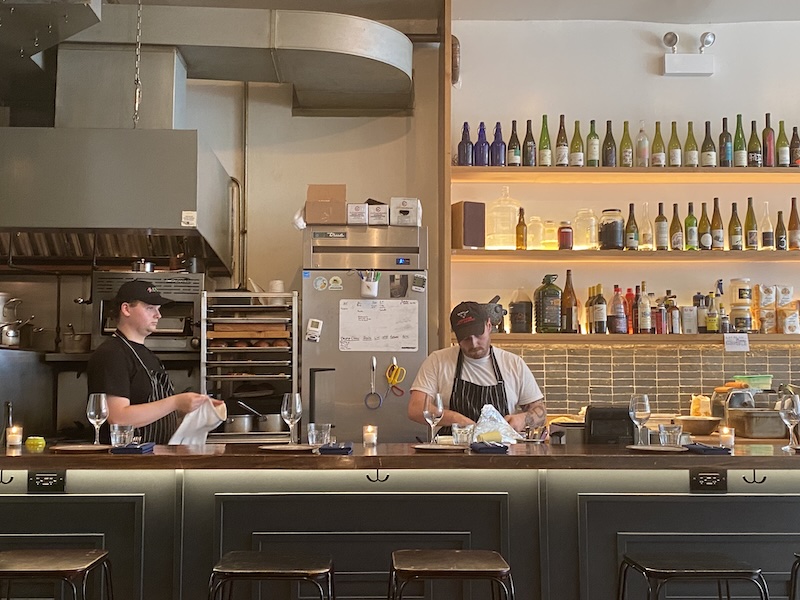
At some point in the intervening half decade, they completely redesigned the place—it now has a full kitchen line with a bar overlooking it, and individual two-tops and four-tops. And they’ve added a chef—Ethan Pikas is still the owner, but Alex Cochran is the chef de cuisine, and if anything it’s even more farm to table now—very simple, very fresh dishes that show real care for products and keep ingredients relatively few and simple. (A friend immediately suggested “deceptively simple,” but honestly, if you do five different things to the sauce the protein is perched on, it still comes off as a simple, unfussy dish.)
The first gave me doubts—a minimal dish of baby carrots, hakurei turnips and green strawberries in a vinaigrette just seemed like they were showing off that they can get trendy (in 2016) things like green strawberries. The next was better but still simple as could be—golden beets, trimmed like apple quarters, with blackberries. I love good beets, the sweetness of the blackberries complemented them nicely, so I was fine with this one, but it still didn’t seem like there was a lot of cooking going on here.
Then came the next dish, which I think could only have come from this restaurant—because its foundation was the housemade Danish seeded bread. That was topped with a schmear of Sauce Gribiche, a hunk of shaved lamb carpaccio and some braised sea lettuce. So still not exactly cooking, an open-faced sandwich—but it wowed me with the base of the thick, crumbly bread, the meat with the cheese or butter-like schmear, and the cooked greens-like sea lettuce.
Finally actual cooking. I had slightly smoky kampachi with a few wild mushrooms and a sauce rouille as a dip. My wife had gnocchi in a taleggio cream sauce, and we finished up with a peach galette, attributed to Rebecca Firkser, a Brooklyn-based baker and author who was just at CDP for a signing (her books were on the counter). Anyway, it was terrific, blending the fresh fruit with some frangipane for a creamy flavor underneath.
I still stand by simple as a descriptor, and that’s what I liked about it—as Sarah Grueneberg says in my book about the simplicity of Italian food, there’s nowhere to hide; either green strawberries or lamb capaccio on dark bread work, or they don’t. Not everything worked, but the simplicity and the honesty of the ingredients and the way they were treated made it a very pleasing meal, one of my best farm-to-table meals in recent times. In fact, except for the fact that a restaurant of that name has existed for a decade, I’d call this version of Cellar Door Provisions one of 2025’s most exciting new restaurants.