

1. PUBLICAN QUALITY CHEF
A few years ago I was getting rid of cable for streaming, and I had to answer my own security questions. One was “What’s your favorite restaurant?” They told me it had four letters. Easy, I said, assuming it was something I liked five years earlier. Vera! Nope. No? Now I had to think, what could it be that had four letters? Boka? Avec? Lula? Okno? Seemed unlikely. Finally I thought to ask how long ago I had established the account. About 2009 they said—almost 15 years earlier at that point.
Oh. Mado!
It was long gone by that point—Rob Levitt had had The Butcher and Larder and then gone on to Local Foods and Publican Quality Meats. But Mado was an important restaurant for me, the first one where I really got farm to table and nose to tail. I mean, I appreciated the concepts, but Mado was the place where they were living it and I understood why. I made a couple of Sky Full of Bacon videos about Rob Levitt handling meat—this one at Mado and this one at Butcher and Larder. But another thing that I got from him was an appreciation for good vegetables and what to do with them—I always remembered Rob saying that Mado, despite being known as a very meat-focused restaurant, nevertheless had a notable vegetarian clientele, because they knew they wouldn’t just get pasta primavera with cut vegetables from a bag, but actual vegetable-based dishes.
Rob going to Publican Quality Meats was a natural fit, hard to think of many who knew their way around a whole animal better, but it also seemed a bit of a missed opportunity if he was just providing ingredients for other chefs to make into something delicious. I went to a couple of dinners that he put on at PQM in the past year, and they were always very good, but made me think about what we were still missing. So this week’s news in Eater is both a natural evolution and the fulfillment of his promise: from PQM he’s moving to P, that is, taking over The Publican as executive chef:
While living in New York as a line cook, Rob Levitt remembers the buzz surrounding the Publican when it opened 18 years ago, reading about Paul Kahan’s ethos in Food & Wine, learning about the chef’s dedication to sourcing the best ingredients and allowing them to shine through via simple preparation. Now, nearly two decades later, Levitt finds himself in charge of the fabled restaurant’s kitchen as the Publican’s new executive chef.
…“What made the Publican so great from the beginning is that the focus has always been on finding the best possible products and cooking them simply and adding some kind of little twist that makes it interesting,” Levitt says. “And I know that that’s a bit of a trope at this point, but it’s a trope partially because the Publican did it at a time when nobody else was doing it.”
2. MASSIMO OVERDRIVE
Maggie Hennessy, at WTTW, talks to Grant Achatz about the latest chef whose work is being featured at Next: Massimo Bottura.
One of the most famous dishes Italian modernist chef Massimo Bottura ever created at his three-Michelin-starred restaurant Osteria Francescana in Modena, Italy, is called “Five Ages of Parmigiano in Different Textures and Temperatures.” The dish not only put the Emilia-Romagna region and its gregarious culinary ambassador on the map, it was pivotal to evolving how we think about fine-dining ingredients and dish composition in the modern era.
So, naturally, when chef Grant Achatz began envisioning a Massimo Bottura tribute menu as the summer theme at Next, his shapeshifting, Michelin-starred tasting menu restaurant, Five Ages of Parm counted among the 10 iconic courses he planned to replicate exactly as patrons would have experienced it at Osteria Francescana, which opened in 1995.
3. YAYA, WHATEVER
I was talking with a food writer about liking a certain place—opened last year, got decent reviews and seems to be doing all right, but didn’t quite make it into the hot ranks of Maxwells Trading or Johns Food and Wine—and I said what I liked about it was that there was no pressure in going there. There would be seating, there would be pleasant things on the menu to try, I could just dine with my wife and talk about things and didn’t feel like I had to order the right things and have deep thoughts about them all.
That’s a lot like how John Kessler talks about Cafe Yaya, the new all-day place from the owners of Galit:
I’ve been going … and going … and going. I’ve had everything from coffee and a pastry to a blowout dinner with cocktails and wine — seven meals total. I’ve tried to experience this place in all its moods and make sense of the mish-mosh menu that reflects Engel’s unique background: a rabbi’s son from the American South who’d make trips to Israel with his parents and became a cook in New Orleans, specializing in the Levantine cuisine of Palestine and Israel.
After all those meals, though, I still consider Cafe Yaya a work in progress. If you’re a fan of Engel’s cooking at Galit (many people, myself included, consider him one of Chicago’s best chefs) and want to try everything at his sophomore project, you’ll find it promising but uneven. Nonetheless, if you’re contemplating a spontaneous meal and Cafe Yaya pops into mind, go. The menu is all about meeting your appetite and hankerings, and becoming a place to rely on when flashier restaurants don’t appeal.
4. PIZZA BOY
Michael Nagrant reviews A Pizza Pie, from the owner of Ragadan, by way of nostalgia about his own teenage pizzamaking days in Detroit:
Their recipes came from that shop and its founder Eugene Jetts. Eugene would show up once a month at Jimmy’s to support his old employees, and I found myself making his pies.
While Jets square is close to what I used to make at Jimmy’s, I can chase my childhood fix with a local delivery order anytime I want. Our round pizzas, though, were different than Jet’s. They had a puffy lip, a thinner, softer middle, and always fresh cut ingredients and righteous juicy meats.
Which brings us to A Pizza Pie:
A Pizza Pie, is simple, focused on salads, wings, and any flavor of 16” round pizza you like. The crust has a New York-size, but more of that puffy lip and soft middle, like the Detroit-suburb rounds I grew up making.
I generally believe in topping balance, but I grew up in a “deluxe” and “supreme”-ingredient pizza-larding family, and so I ordered the supreme At A Pizza Pie which includes sausage, pepperoni, mushroom, bell peppers, onion, and glorious black olive whose primary flavor is salt and whose appearance invokes nostalgia for all the franchise nacho platters one has consumed in the past.
5. AND ANOTHER PIZZA
And speaking of pizza, Titus Ruscitti has a good word for Boka Group’s Zarella:
On my first visit I was with my wife who doesn’t like eating meat right now so I didn’t get to try the sausage on first crack which is what I usually get at Chicago based pizzerias. But it all worked out because I wouldn’t know how good the pickled peppers were had we not gotten a pizza with those and some onions on our first visit. I knew I liked this pizza as soon as I picked up my first square. It was super thin and extra crisp with no limp and the bottom of the pizza was a bit bumpy thanks to a cornmeal crust. I could also tell that it wasn’t over sauced just by looking at it. Then I took a bite and it reminded me of Wells Brothers up in Racine Wisconsin (my favorite pizza anywhere). I couldn’t pinpoint exactly what type of peppers they’re using but they’re chopped and all sorts of zippy.
6. THIS TOWN NEEDS AN ENEMY
Grimod at Understanding Hospitality goes to Enemy, the tasting menu spinoff of Warlord:
Thus, while much of the novelty that underlaid this experience (the atmosphere, the effects, the sense of “show”) had grown familiar, the food became even more convincing. Yes it became clear that, with Enemy, Warlord was not relying on tricks to win the day. The now two-year-old was not looking to better monetize its counter seats, to prey on consumers who sought to skip the line, or—even—to impress guests just once.
Enemy, I came to understand, really did act as a platform for the three partners, their bar manager, and a supporting team of cooks to do their best work. In that respect (both structurally and in terms of results), it ranked as one of the most faithful, most high-performing “chef’s counters” in all of Chicago. Moreover, the chosen style of cookery—so intensely savory but contrasted, in the right places, by preservation and fermentation—seemed to rival (at least for my particular palate) the city’s most expensive tasting menus.
7. YEMENDALE HEIGHTS
I’m always interested in nationalities that suddenly pop up on Chicago’s restaurant scene. Yemeni placees aren’t exactly new—there’s a little cluster of restaurants in the city around Lawrence and Elston, and I wrote about a (now-gone) place here—but the Trib has an interesting piece on how Yemeni coffee shops are offering an answer to the question, where to go at night and not eat a meal, or drink alcohol. The place is called Shibam Coffee in Glendale Heights (I only know where that is—western suburbs—because it’s a stop for the peach truck):
The recent boom in Yemeni coffee shops in the Chicago area, specifically in Lombard and other suburbs with a growing population of modern Muslim communities, underscores the rising demand for a place to socialize that isn’t tied to alcohol, but with a buzzy nightlife ambience.
“It’s a third place for people like us,” [co-owner Moiz] Baig said. “We don’t go to bars, but these coffee shops are booming because they are like ‘halal bars.’”
8. THE BAD BATCH
Food writers pretend to omniscience, so it’s interesting when they admit they didn’t get something right. Not that John Kessler f’d up his appraisal of one of the giardinieras in his recent roundup of jarred giard in his recent roundup—he genuinely got an off batch of Caruso’s Old World Chicago Giardiniera, but gives them another shot:
Soon after the article and its accompanying video ran, I received a DM from a certain Peter Caruso. Uh oh. His message read in part, “Sorry to hear you got a bad jar… that definitely doesn’t reflect what we make. Out of everything we’ve sold, this is the first time we’ve heard feedback like that.” Caruso offered to meet and drop off a few jars from a batch just off the line. I agreed and suggested I bring the remainders of the jars I had purchased so that we could do a taste test.
9. OMAKASING THE JOINT
Mitch Gropman of r/Chicagofood fame on Reddit, who first made his name there eating 200 chieken sandwiches or fries or something, gets a little more ambitious (and choosy) with the ten best omakase spots in town. You Otto be able to guess who places twice on the list… thus proving that Reddit is a better guide to sushi, at least, than Michelin.
10. DONER ADVISED
Sandwich Tribunal dives into the history of döner kebab, including as sandwiches, and also including an old fave I rarely indulge in any more—Iskender Kebab:
İskender kebab is a dish that features döner kebab meat served over pide bread with a mildly spicy tomato sauce, roasted peppers and tomatoes, and yogurt, often topped with sizzling hot melted butter. It was invented by İskender Efendi in 1867 at the restaurant in Bursa bearing his name and has been served there by generations of his family ever since. In fact, it is among the most popular dishes in Turkish cuisine.
Instead of a solid piece of bread, Iskender kebab is served on pide cut into cubes or squares. The bread is often soft but can be toasted, which I prefer. The dish is garnished with grilled tomatoes and long green chili peppers called Sivri Biber, which are relatively mild, falling slightly above the jalapeño on the Scoville scale. I used hot banana peppers as a rough equivalent.
He says he’s never had it in a restaurant and wonders how different his version is. I’d say—I’ve never seen the peppers, and it’s usually a lot more messy with the tomato sauce and the yogurt. Kind of like Turkish Pequod’s pizza.
11. LISTEN UP
Joiners talks to Lamar Moore of etc.
At The Chef’s Cut, Adrienne Cheatham and Joe Flamm talk about their origin stories.
Pizza City USA talks to Chris Pandel about Zarella’s.
WHAT MIKE ATE
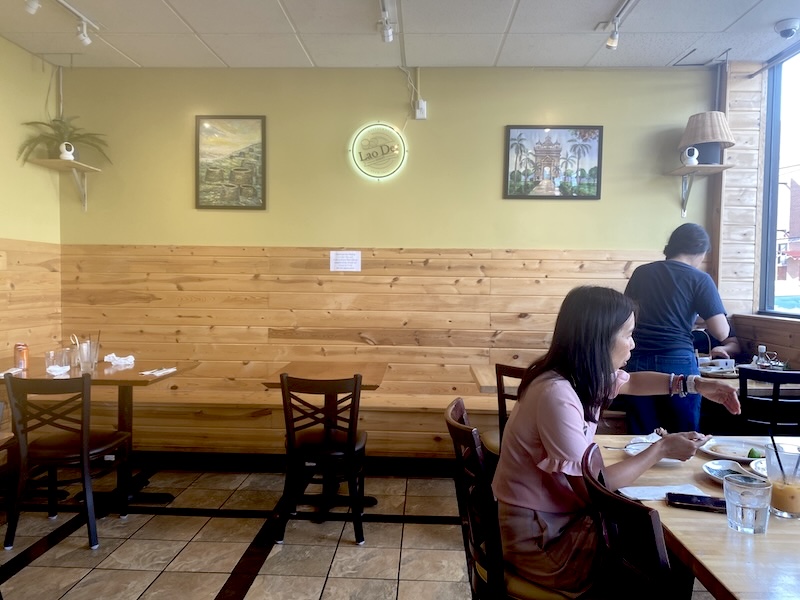
The conventional wisdom is that there’s no Lao food in Chicago. Which is not strictly true—years ago Keng Sisavath invited me to a dinner at a place called Ryuu Asian BBQ & Sushi because, he said, the chef was Lao and had some authentically Lao dishes on the menu. In any case, it’s a small part of the world, relatively, so there’s an awful lot of overlap between Lao and Thai food, say.
Lao Der in Avondale is the Lao restaurant of the moment, but anyone familiar with Thai food will recognize a lot on the menu and even more the flavors—the best things were the pungently fish-saucy dipping sauces. Dipping the sticky rice in that was tasty; but the proteins with it didn’t always live up to it. Gai tod, normally (in Chicago) called Thai fried chicken, was a flat piece of chicken breast, lacking most of the character of fried chicken (and losing temperature almost instantly). Similarly, beef jerky was a dry, gnarled piece of beef, that I wished was thicker and meatier. Isaan (here spelled “Esan”) sausage was good, plump balls with fermented sourness, and I liked the papaya salad which cut up the green papaya in big flat slices—as I found at Lao Lao Bar in Toronto, the difference in texture makes it nearly a different dish. (See: omniscience, food writers pretending to.)
Surprisingly, one of the things I liked the best was a simple chicken soup with flat (rice?) noodles; it reminded me of soup we tried on a food tour in Bangkok, nothing terribly new but the depth of chicken flavor was impressive. A couple of desserts, a kind of muffin and a tapioca dessert with (I think) pandan, were fine, though I don’t really go to Southeast Asian restaurants for dessert (besides mango and sweet rice).
Anyway, it doesn’t knock any of my favorite Thai places off their perch, but it’s worth a try for something (frankly, only slightly) different.