

This week’s issue was delayed to include the Banchet Awards Sunday night.
BOOK NEWS
Last week I said we were offering reserved tickets for the launch party on February 3. Well, they all went quickly, so you’ll have to wait for other media experiences in the coming weeks—watch here for more, but in the meantime, here’s a mention in a list of upcoming Chicago books at The Chicago Review of Books (they’re listed by release date, so scroll down till you hit February). More news coming soon!
1. THE BANCHET AWARDS
It was a lively and busy Banchet Awards Sunday night—but you don’t have to take my word for it; you can watch the ceremony as it was livestreamed by NBC 5 in various places—Roku, Peacock etc. Start here on YouTube, that’s easy.
Several of the early awards proved to be a strong showing for the South Side, as Mahari in Hyde Park won Best Neighborhood Restaurant, Sanders BBQ in Beverly took Counter Service and Nine Garden in Chinatown took Heritage Restaurant. Though Erick Williams of Virtue won Best Chef a few years ago, I believe the other two were the first winners in those parts of town.
There were two big winners among restaurants—as I said in my top ten list for ’25, Feld has had one of the more remarkable year and a half’s in Chicago restaurant history—from a very mixed opening and social media response, it is now pretty much universally acclaimed, and continued that with two Banchet awards, for Best New Restaurant and Best Hospitality. Taking a potshot at the online coverage of his restaurant (which was negative at first, but quickly grew positive), Feld owner Jake Potashnick said that it was easy to bash restaurants from a keyboard, but “this room is full of people who put in the work.” And John Manion’s restaurants, El Che and Brasero, scored big with, first, Best Sommelier to Alex Cuper, and close to the end with a Chef of the Year win to Manion, who observed that looking at the crowd, it was hard not to feel like an impostor. But there’s nothing fake about the satisfying food at his restaurants.
Javauneeka Jacobs, the Frontera sous chef who won TV’s Chopped, won Rising Chef. Bar of the Year went to Gus’ Sip and Dip, a second win for one of its beverage directors, Kevin Beary, who won a few years ago for the Bamboo Room. Best Restaurant Design went to The Alston, which could have won longest thank-you speeches as well. Best Pastry Chef went to Justin Lerias of the Filipino Del Sur Bakery. And finally, in a night that went everywhere from the American South to the Philippines, the upscale Indian restaurant Indienne took Restaurant of the Year.
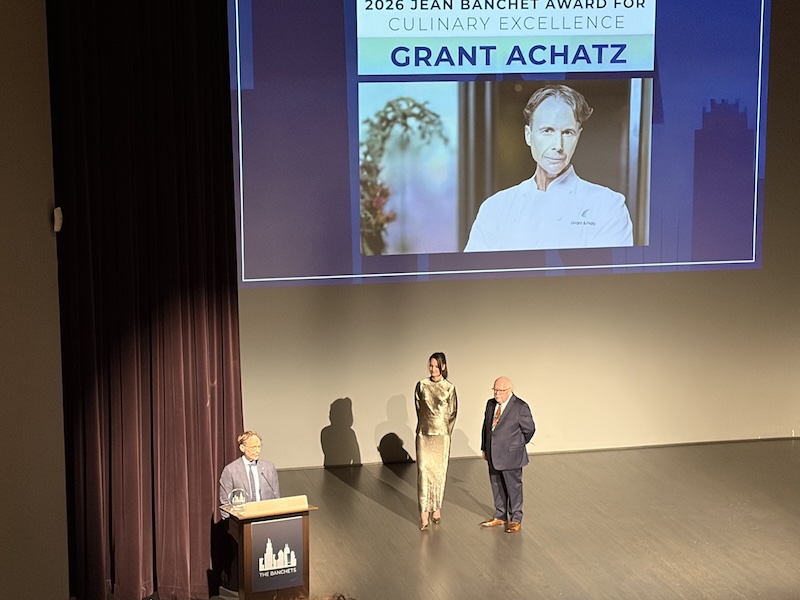
But that wasn’t the climax of the evening. That surely belonged to Grant Achatz, who won the Culinary Excellence Award in the year of Alinea’s twentieth anniversary. First he was introduced by former Tribune reviewer Phil Vettel, who recalled Achatz coming to town to take over Evanston’s Trio and take it into uncharted waters, and then, a few years later, launching Alinea, which rocketed to worldwide acclaim. As Achatz observed in a moving speech which ended with a standing ovation, “We wouldn’t have been able to do this in any other city, I don’t think, with any other community of industry professionals.”
2. IN OTHER AWARDS
Meanwhile, the James Beard Awards issued a ton of semifinalist nods this week, far more than they can actually nominate—the Best Chef Great Lakes award, which normally has five nominees, lists 20 restaurants as semifinalists, nine of them from Chicago alone. (WTTW’s Daniel Hautzinger has a good recap of the Chicago semifinalists here.)
Not that every award or best-of list doesn’t play the DEI game to a certain extent, but the Beards have been especially clumsy and obvious about it, so it was hard not to be sardonically amused by the response of Danny Espinoza at Santa Masa Tamaleria to his semifinalist honor, emphasis on his:
Today I received lots of “congratulations” for being @beardfoundation nominated [sic] for best chef Great Lakes, I didn’t even know about any of it, like I mentioned to a friend, “we don’t chase awards” and also here’s the thing, I’m a part timer at @santamasachicago it’s a husband and wife restaurant ran by @jhoananais and my father in law and our kitchen manager Meleidi. This nomination needs to say Jhoana Ruiz as well because my amazing wife runs the ship and executes the consistency and drive of it all. @eater_chicago @eater @wttwchicago
@jhoananais congratulations and I apologize for the lack of research many should do more of for a WOMAN who works on her dreams and goals everyday while being the best mom ever to our 4.5 year old ❤️❤️❤️
Yeah, if there was anybody on the Beard committee from Chicago, and more to the point anybody who actually had been to a northwest side tamale joint in an old diner, they’d know—like I did from actually talking to the people there—that Danny has a full-time job and it’s his wife, Jhoanna Ruiz, who’s there working the counter all week. (The Beards sheepishly updated it to reflect both Danny and Jhoanna.)
3. DEPT. OF SKEEZY FINANCES
A pair of stories about skeezy financial behavior. At Eater Chicago, not known for digging deep into such stories, Ximena N. Beltran Quan Kiu notes the timing of Time Out Market’s closing and when the small businesses who invested in their spaces at the fancy food hall actually found out about it:
In the months leading up to Time Out’s decision to shutter its Chicago food hall, the parent company also continued to sign on new vendors such as Craft & Cravery and seafood restaurant Hooligan, a project from former Atelier chef Christian Hunter. Hunter’s restaurant was initially scheduled to debut in November, but a rep confirms that Hooligan never officially opened. Vendors with a longer relationship at the food hall also appeared to be caught off guard by the closure. Jesse Li of Qing Xiang Yuan Dumplings told Block Club that the abrupt closure was a “surprise,” while a support staff member told the Chicago Tribune that the announcement left some workers scrambling.
When asked why the company continued to contract with small business owners so close to the announcement, a spokesperson for Time Out said in a statement, “At that time, there was no decision to close the site.”
If that seems like kind of shaky operations, it all seemed to be pretty poorly run after a certain point:
[Evette’s owner Mitchell Abou-]Jamra alleges that when Time Out Market Chicago’s general manager left the company, “everything went downhill.”
Jamra alleges that following the general manager’s departure, Time Out forgot to renew the building’s liquor and patio licenses. A spokesperson for Time Out Market confirmed in an email the building’s liquor license did lapse, describing the episode as “a very brief administrative oversight, a human error, several years ago that lasted only a few days and during which we ceased alcohol service to ensure we remained in compliance with local regulations.” The rep added: “we overhauled our internal compliance tracking as a result to ensure this doesn’t happen again.”
Well, that much is true: it won’t happen again now that the market is closed.
Meanwhile, at the Tribune, pretty much a one-sided story about the last days of the Signature Room in the John Hancock tower and the union that’s suing them, but it sounds solid enough to go to court:
The suit alleges that after the bankruptcy, [co-owner Richard] Roman fraudulently transferred assets from Infusion to an LLC in order to pay off his own and Pyknis’ personal debts to the Signature Room’s landlord.
The Signature Room’s lessor had sued Roman and Pyknis personally after the Signature Room’s closure because they had signed personal guaranties for the lease agreement, according to the lawsuit.
The problem with that is that they also owed money to the employees who were abruptly let go and got nothing. It’s the timing that sounds especially guilty:
But on Sept. 25 — days before the Signature Room shut down — RSR paid that $500,000 directly to Roman and Pyknis, the lawsuit alleges. On Sept. 28, the Signature Room announced it was closing.
4. FREE RADICLES
The Radicle is the new mostly-bar from the Daisies crew, in the space where Daisies used to be. Michael Nagrant is impressed:
It is silly in the most midwestern nostalgic way. There are more reverberations, a callback to the now defunct Big Kids that once roared up the street with its pizza smash burgs and ranch-scented dino nugs.
There is no Ecto-cooler on tap here, but instead a “Scoop of Blue Moon”, rum soaked, wafting vanilla, almond, and bubble gum – a cocktail manifestation of the ice cream classic replete with sprinkles clocking in at an eminently fair $12.
I’d tell you to drink your dessert, but that would be wrong because you’d miss out on Leigh Omilinsky’s decadent sweet dimes, and we can’t have that.
I’m not hip enough to know what a sweet dime is, but I won’t argued with Leigh Omilinsky’s desserts.
5. WORD, SMYTH
Grimod, who’s been to Smyth roughly eleventy billion times, talks about what it’s like now that it’s got three Michelin stars and become the most expensive restaurant in town (obviously, not unrelated):
Smyth has always evolved—hence why it rewarded repeat patronage. Nonetheless, after the pandemic (and with the collaboration of a new, outside chef), the restaurant completely transformed itself. It adopted a new language, rooted in an obsession with strange ingredients (e.g., seaweeds, nut oils), and said goodbye to a whole fleet of signature preparations without ever really replacing them. The kitchen closed the door on a beloved chapter that many Chicagoans never had a chance to try and one which those who did may still pine for.
6. MMMBAP
Especially this week, I’m not heading downtown. But the next time I have to, Nick Kindelsperger has the place for me—82 Kimbap, in Sterling Food Hall:
Kimbap (often also spelled gimbap) is often described as Korean sushi, or at least like maki, since it features rice and fillings rolled up with nori. But that’s where the similarities end. Instead of being seasoned with vinegar, the rice in kimbap is drizzled with sesame oil. And instead of being filled mostly with raw fish, kimbap traditionally contains cooked fillings — and a lot of them. It’s not unusual to find meat, multiple pickled vegetables, and egg rolled up in each one.
When kimbap connects, it’s because all of these components add up to one perfectly composed bite — savory, crunchy, juicy, and acidic.
7. FAT OF THE LAND
Charlie McKenna (Lillie’s Q) and the Fifty/50 Group have a new business opening soon—Fatback, a sandwich shop and market on Wacker Drive. Anthony Todd at Chicago mag:
McKenna has had a sandwich concept in the back of his mind for a long time, but (like so many restaurant ideas) it really came forward during COVID isolation when he was living in Florida and constantly making sandwiches. “It’s a concept I’ve wanted to do for a while; I love sandwiches, they are my favorite things to make,” McKenna says. Fatback is inspired by the look and feel of a 1950s butcher shop, combined with the sort of market that McKenna wants to visit himself. “I love the sandwich shops where you walk through a bodega and the sandwiches are in the back, so I wanted to recreate that.”
8. LISTEN UP
The Dining Table talks about why Chicago is a great steakhouse town.
Joiners talks to Rosemary Waldmeierof Joe’s Stone Crab.
Dish from Chicago mag talks about where to go when it’s way too cold out—to feel warm.
The Chef’s Cut talks to Michael Anthony of Gramercy Tavern.