

GET YOUR FREE TICKET FOR THE LAUNCH PARTY
So last week I announced the launch party for my book at LouLou by Lula, 3057 W. Logan Blvd., Tuesday, February 3 from 6 to 8 pm. Well, belatedly, we decided that we needed to have (free) tickets for it to keep track of the crowd. So: if you’re interested in going, please go to the EventBrite page and get a ticket. (Note that the ad for the event below now goes to that link as well, so feel free to click on it instead.) For all we know, tickets may go fast—or not!—so don’t delay.

1. TIME’S UP, MARKET
Time Out Market, the all-star, “editorially curated” food hall in Fulton Market, is closing next Friday after six years. I wrote about it when it was opening in 2019, and my concern then was how you could be in business with a bunch of chefs and still maintain the editorial independence of a magazine publishing reviews. Oh, Gebert, you sweet summer child! Reviewing was over, being in bed with the chefs was the future. Well, Time Out Market had something of a hard road—chefs who ran into controversy (they had a stand with Abe Conlon of Fat Rice right at the height of chef cancel culture) and then of course, it all shut down for two years during COVID, and downtown traffic remains an iffy thing. But the real question for me was, did Chicago even need such a thing? I guess it works in certain cities, like Dubai, but I’m not convinced tourists in Chicago needed their hand held this much to find deep dish pizza and Italian beef. Nor do I think the mall that Fulton Market has turned into was the best place to expect tourists looking for unusual food. Anyway, Block Club has a piece on it:
Michael Marley, CEO of Time Out Market, said in a statement that the decision was driven by decreased and inconsistent foot traffic following the pandemic, which has led to a hybrid work environment. Marley also pointed to increased operating costs.
In his column this month, John Kessler talks about what I think was the original Time Out Market, in Lisbon, and why Chicago’s fell short:
When I was in Lisbon a few years ago, the Time Out Market was a destination because it took the market part seriously. As tourists, we weren’t just looking for a quick box lunch but rather an organizing principle that helped us make sense of this city and of Portuguese food. We could try the best presunto (cured ham) and compare it to Spanish jamon, the best cheeses, and the famous pastries made only at a historic bakery elsewhere in Lisbon and at the stand here. We could splurge on oysters and langoustines sold by the piece, and foie gras toasts. We could shop for gifts and, yes, also have the burger, donut, or stir-fry that brings one to a food court midday. But we could also sample an expensive plate of food designed by a chef with two Michelin stars.
…Time Out Chicago did attract local talent but the overall effect was mall food court.
2. HISTORY OF THE WORLD, COURSE ONE
Tasting menu joints keep opening, from chefs nobody’s ever heard of—as I called them several years ago, they’re mostly “a Hail Mary play for instant acclaim from chefs who’ve been working out of the limelight.” The other thing that keeps happening. of course, is that every year there are more such places but fewer places to write about them. The ones that do still exist, like Chicago magazine, only have about 11 review slots a year, and they would be foolish to fill them up with nothing but $200 twelve-course menus—that’s not how real people eat, nor is it the only area of creativity on the scene. So reviewers have to pre-scout which ones are promising for full analysis—last year it was Cariño that got all the reviews, this year Feld. Other places hope in vain for that kind of attention—who’s reviewed LIA, the art-focused place backed by a Detroit restaurant group that opened last summer? Not a word that I’ve seen (and I notice that it has since evolved into LIA Tavern, emphasizing pizza).
So we get a surprising bonus this year—having already reviewed Feld, John Kessler also reviews Class Act, a conceptual tasting menu from a chef named Nicholai Mlodinow, whose current theme is… the entire history of humanity, in a dozen courses from cavemen eats to the present:
It’s pure hokum. But it’s also kind of fun to meet people and engage in a novel group activity, like you’re at one of those pottery-painting studios. Unfortunately, the food ranges from cute to dismal. Mlodinow, a self-taught chef who has staged at many of Chicago’s tasting-menu palaces, does not in my experience cook with the skill this restaurant demands. Raw, untempered spices scream from some dishes; others, such as gummy Cantonese dumplings and damp, dense focaccia, seem like a second attempt at a home-cooking project. Nor does the $212 menu buy much in the way of premium ingredients: Three dishes feature chicken, and three are vegetarian.
If you’re feeling game, though, Class Act has its charms. I attribute much to head waiter and emcee Matthew Didier, who narrates the meal with good-natured zeal and manages to sell lines like “When we were hunter-gatherers, we just ran around eating raw things all the time” as he offers beef tartare decorated with microgreens. “Me Zorg,” I think. “Tiny leaf make food pretty.”
It’s as interesting an example of the reviewer’s art as the chef’s—clearly Kessler was not that impressed by the actual food, and occasionally found the concept risible, but at the same time, he hates to respond to such bounding ambition by growling for a steak like a caveman, so he walks the tightrope of encouraging the concept while admitting that the reality is a 1/2 star mess.
Again, John Kessler ‘s column this month covers this basically social dining:
This kind of cocktail hour also kicks off a meal at Class Act, which I reviewed in this month’s issue. Guests huddle around three small tables and help themselves from communal plates as they sip a cocktail. You’re close enough to others that not engaging in conversation would be almost rude. Once the meal begins, everyone sits around one large table, and over the course of the evening the conversations turn from sotto voce discussions with only the guests seated alongside you to cross-table storytelling. This is the best part of the experience here. It’s also fun to retreat with your date afterwards and talk about the people you just shared a two-to-three-hour meal with.
3. ART OF CHICKEN SANDWICHES
Back in the day I wrote a piece for Serious Eats about a completely unheralded Chicago specialty: the grilled chicken sandwich, the chicken marinated in Italian dressing, sometimes served on a pita. When my kids were little and loved hot dogs, I would often order the arguably healthier chicken alternative, and one of the places I did so many times was Art’s Drive-In on Elston at North. But it closed after a fire, and I assumed that was it for Art’s. But a relation of the original owners reopened it—and upgraded the food, as Titus Ruscitti tells at Chicago:
In 2022, a fire forced the closure of the Goose Island staple Art’s Drive-In, which had been slinging diner classics since 1967. Then, last February, it returned. It’s now under the ownership of Alex Stratakos, an industry vet who ran spots like his grandfather’s Milwaukee gyro stand. Stratakos’s wife’s family ran Art’s from 1981 until the fire, but now the restaurant is better than ever. Stratakos overhauled the menu (you won’t find the mass-produced gyro cones you see at other Greek diners here) and is committed to using high-quality ingredients.
4. SANABEL ISLAND
I often hit Sanabel Bakery for the freshest possible pita, and have bought things like hummus and labneh there, but Mike Sula reveals a whole culture in balls of labneh and such, called “mouneh” and basically translating as “nosh”:
Look down to the left where there’s a modest display of unlabeled glass canning jars. There’s probably some labneh balls—eggshell-white orbs of soft cheese glowing through golden olive oil like the moon on a foggy night. Maybe there’s a melange of chopped vegetables that looks and tastes suspiciously like giardiniera.
If you’re lucky, makdous are in stock. Those are oil-cured baby eggplants stuffed with a mix of coarsely chopped walnuts, red peppers, garlic, and chiles.
5. SLICE OF LIFE
Michael Nagrant goes to Chomp, the pizza place in a subway station that Dennis Lee also went to a few weeks back:
What I do know is that [owner Travis] Hezel’s pizza is incredibly delicious. It has a sharp red chili-tanged sauce, a puffy end with a bubblicious bread structure, a crisp edge, and a sooty booty.
6. GO GO KYOTENGO
Grimod’s latest piece on Kyoten is interesting because it comes after he’s just been to Japan for two weeks:
I’ve been in this position a couple times before (encountering Phan’s menu only 24 or 48 hours after stepping off the plane): evaluating his omakase from a position on the hedonic treadmill that, so numbed to indulgence, almost precludes the enjoyment of fine dining altogether. Still, Kyōten has always performed well in such circumstances. I’ve never noted a steep drop in ingredient quality or gotten the foreboding sense I’ve been enjoying bastardized, Americanized sushi this entire time. Rather, in comparison to the language barrier that persists at many counters in Japan, the chef’s quirks and humor and the baseline of comfort he establishes actually feels rather refreshing. Ultimately, there’s really no better way to beat jet lag than to reorient one’s palate with the native style of nigiri and a bottle or two of wine.
7. PERU IN THE LOOP
It’s hard enough to find anything Mexican in the Loop, so to find Nikkei-style Peruvian there seems downright surprising. Nick Kindelsperger on Ayayay:
The sign out front declares that it’s a Mexican eatery. Then tempura, wasabi, and tare definitely point to Japan. But it’s the acevichada, along with Nikkei in the dish’s name, that truly clue you into the real culprit: Peru.
8. CHICKEN SOUP FOR THE LISTICLE
I just ran into Maggie Hennessy and one thing we talked about was the prevalence of listicles and how they’re often soulless. But here’s Maggie at WBEZ with one that is truly warming and nourishing: a thoughtful piece about local soups, in this cold winter. Here’s an example:
Hudut baruru tikini at Garifuna Flava, Marquette Park
This Marquette Park spot specializes in cooking from coastal Honduras, Belize, and Guatemala. And though known for fiery jerk chicken wings that’ll make you sweat like it’s a sticky summer day, this eatery also churns out plenty of sustaining stewed meat and fish, like this savory, sweet and sour tikini, meaning brown stew. As it simmers, kingfish infuses its oily umami into the rich, cabbage- and sweet pepper-laced gravy seasoned with warming cumin and allspice. Scoop your own dumplings from the accompanying, dough-like hudut, or boiled and mashed green and ripe plantains, which soften at the edges when you dunk them in the spoon-coating liquid.
9. MIDDLE EASTERN ON NORTHERN KEDZIE
And speaking of things I was just talking with someone about, here’s Daniel Hautzinger at WTTW on a sudden outcropping of Turkish and middle eastern cafes to pop up near Lawrence and Kedzie:
Along one mile-long stretch of Kedzie Avenue in Albany Park and North Park, near a Starbucks that closed in September, four separate Middle Eastern coffee shops have opened in the past year, offering light-roasted coffees brewed with spices, desserts featuring nuts and honey, strong teas, and, of course, colorful, social media-ready lattes and refreshers.
10. TICK AND TOCK
This originated on TikTok, so I may be the last old fogey to know about them, but Jase and Josh are a pair of Brits in their 20s who make short videos about their travels experiencing America—marveling at the excesses of aspects of American life from college basketball to eating American fast food, (They LOVED biscuits and gravy, after explaining how those words conjure up something very different in the UK.) You might expect sarcasm, but it’s all rather sweet; they’ve been in the southwest but currently seem to be in Michigan, freezing their bums off. Go here on Instagram. UPDATE: Gulp! I wrote this a couple of days ago and as of Sunday afternoon, the latest posts show Josh being carried off in an ambulance. They just went tubing in the snow, hopefully all it is is some seriously pulled muscles…
11. MANDELBROT
One thing that comes up in my book, when we’re talking about the late Abby Mandel founding the Green City Market, is why it never found a permanent home. Well… now it’s about to! Several pieces about it this week, but hat tip to Bob Benenson’s Local Food Forum for some of the first and definitely the most thorough coverage, including an interview with executive director Tish Steele, who talks about how it will serve Mandel’s legacy:
Q: So we’re standing in the brand new space. Does it have a name yet?
A: We do not have a name yet. It will still be related to Green City Market. What we really want to do is include the name of our founder [the late Abby Mandel] in some way that would be meaningful to her and her family. I’m going to be meeting with her daughter Holly Sherr in a few weeks to talk about this… Holly was on the original committee when Abby first started talking about a permanent home back in 2008, and I want to be able to include her as much as she wants to be included honoring the legacy.
The vision of what Abby had set up is really important to me, and I know it’s important, really important to our farmers. Just the whole way that she stewarded this in the beginning, and I want to make sure that we’re holding true to that. I’m looking for all of those voices that knew about this from the beginning. It’s been a long time coming, and I feel like a lot of voices have probably dropped off waiting for this to happen or navigating different spaces at different times. So I am in the process of finding those people and bringing them back in.
12. LISTEN UP
Joiners talks to the ultimate food podcast guest: Poochie from Wiener’s Circle.
Supper With Sylvia talks to Tony Priolo (Piccolo Sogno).
Haven’t listened yet but The Chef’s Cut had me at “Michelin guide controversy.”
The Dish from Chicago Magazine talks about 2026 dining trends.
IN MEMORIAM
Kirstin Pierce-Sherrod, CEO of Harold’s Chicken (and daughter of the late Harold Pierce), died at 55. Block Club has a piece on her:
[Harold] Pierce opened a takeout spot at 47th and Greenwood to serve the crunchy fried chicken, and the original Harold’s Chicken Shack was born. The rest is over half a century of history. Several Harold’s Chicken restaurants now exist across the nation from North Carolina to suburban Illinois.
Pierce-Sherrod, who was raised in Beaverville, Illinois, joined her mother in 2000 to “share the full capacity” of managing the family business, she said in a 2022 interview. She served as the CEO of the chicken chain for over 20 years.
Sofia Solomon, who helped change the Chicago food scene as a local distributor for gourmet items like caviar and artisan cheeses, died at 78. Friend of Fooditor Rebecca Fyffe wrote a memorial to her for Les Dames d’Escoffier:
She approached cheese as both craft and living thing. “They’re living, breathing things,” she once said. “Not Kraft slices.” She delighted in teaching chefs and buyers how proper handling, aging, and patience transformed flavor, often describing affinage as “the finishing school for cheese.” For Sofia, cheese was visual, tactile, and expressive, equal parts science and romance, and a metaphor for life’s cycles.
Her influence is perhaps best symbolized by a cheese named in her honor, Sofia, a soft-ripened, ash marbled goat cheese created by acclaimed cheesemaker Judy Schad. The gesture reflected not only Sofia’s impact, but also the deep respect she earned among producers who shared her values of craftsmanship and integrity.
WHAT MIKE ATE
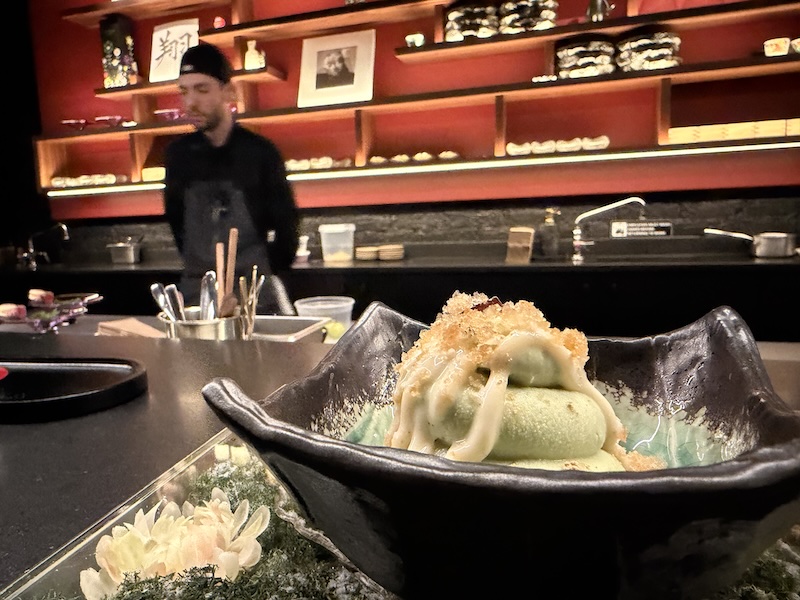
I never went to Yugen, but it was a train wreck as a business that nevertheless won a Michelin star. So I was immediately intrigued when its chef, Mari Katsumura, whose parents had Yoshi’s, teamed up with Adam Sindler whose family has Kamehachi, one of Chicago’s first sushi restaurants, to open SHŌ Omakase on Wells in Old Town.
Well, cancel the train wreck. Maybe it was in part because there were just three of us on a blustery cold night, but SHŌ is welcoming, relaxed and, not least, interesting. At one point Katsumura said something about omakase meals often being predictable, following a rigid pattern, and SHŌ tries to break the pattern by mixing up various forms of Japanese dining—comfort food for two chefs who grew up with it in the family—while mixing Japanese classics up with the whole world of cuisine. (Yoshi’s was Japanese-French fusion, so it runs in at least one family.)
So one of the first bites is okonomiyaki—made into a croquette. Chawanmushi is topped with Spanish flavors—chorizo and octopus. Toward the end, a cute little bowl of tonkotsu ramen, with hunks of iberico.
Nigiri are nearly a commodity across all the Japanese places we have now, so SHŌ breaks that pattern by making several middle courses handrolls—black cod, king crab salad, a slice of wagyu. We get the stuff to roll our own—a small square of nori, some grated wasabi and some pickled ginger, a little eyedropper bottle with a housemade sauce. Honestly, I don’t love the flavor of nori—it makes everything inside it kind of taste like tea leaves—but still, points for doing something different. It ends with a soft serve, the specific flavor of which I don’t remember, but it was a nice sendoff. Except in this case, we had one more thing; at the start they offered us an extra course, with Hokkaido uni and grilled eel, but we declined it because we didn’t know how much food they would serve overall. But they were making it for two new guests, so they made it for us too. To me uni is either very good or very bad; this was very good.
This is the fourth omakase I’ve had in about a month and a half, but I’m starting to appreciate how much variation you can get in a stye of dining that tends to follows as mentioned, a pattern. I can’t say that any of these has stood out either wildly above, or below the others; they all seem to give the chefs involved a chance to make it work in their own style. So I’ll happily recommend SHŌ, first for the quality and flavor of what was crafted, and second for the intimate, welcoming hospitality. And maybe third for the portrait of Dennis Rodman (ask for the story behind that).