

1. BOOK NEWS
The big coverage of my book continues, but while there will be podcasts and appearances ahead, I think at this point I’ve had most of the attention I would have hoped for. The big one this week was in Chicago magazine—and if you want to know what the book is like before you buy it, here’s your chance. It’s the first chapter of the book, about Louis Szathmary and The Bakery, trimmed down a bit (but expertly so).
Monica Eng, who’s an interviewee in the book, also did a short piece about it at Axios here.
Not short was my presentation to Culinary Historians of Chicago and Greater Midwest Foodways Association, to an audience (over Zoom) including a number of people who were interviewed in the book. They’ve posted the video of the Zoom call here, but it will be up as a podcast at all the usual places in a few days, I am told.
That’s it for last week, but if you’re up Friday morning, tune in to Bob Sirott’s show on WGN Radio at 6:48 am (repeated later in the show, which runs 6 to 10 am).

2. NADU, NADU, YOU KNOW IT REALLY IS THE THING TO REVIEW
John Kessler reviews Nadu, the more modest-priced regional Indian restaurant from owner Sujan Sarkar (Indienne):
The menu at Nadu, which [chef Sanchit] Sahu developed with chef-owner Sujan Sarkar, pulls a 180 from the modern tasting-menu stylings at Sarkar’s Michelin-starred Indienne. Here, Sahu, who traveled broadly as a chef for the hotel chain Taj, replicates regional recipes from throughout the subcontinent. From the omnivorous, coconut-heavy fare of southern Kerala to the stir-fries of Kolkata’s Chinatown, the menu reads like an Indian culinary survey course. Some dishes are mild and creamy, others ferocious with chile; all are meant for sharing and quintessentially Indian.
Meanwhile, in his column this week, Kessler talks about how Chicago, identified with Italian food, tends not to have very many excellent examples of same:
Despite our long and illustrious history with Italian-American restaurants, we really don’t have many great ones today. We’ve got a lot of good — very good! — spots for pizza and pasta and, my god, we must be the chicken Parmesan capital of the world. Nowhere do they come as big and over-the-top insane with breading, tomato sauce, and so much of Wisconsin’s finest mozz that you’re guaranteed a cheese pull with every bite.
What we don’t have are the restaurants that rethink the pleasures of red-sauce Italian.
Well, I think this is largely true, and it’s not surprising—it’s a direct result of immigration patterns in the early 20th century that brought Southern Italians—from Capri, Calabria, and even Sicily—here, with heavy, garlic-laden Italian food. Having mostly traveled, Italy-wise, in Friuli-Venezia-Giulia in recent years, the food I have there (pizza aside) never seems that much like what’s seen as Italian food here. Kessler again:
What I’m looking for is an Italian restaurant where the chef’s building blocks are tomatoes, garlic, basil, cured meats, eggplant, rapini, sweet peppers, hot peppers, pecorino cheese, olive oil, coarse bread, eggless pasta, and finesse. I would love to see dishes that look simple on the plate but taste complex because the ingredients are so good.
There’s a very good movie—actually a miniseries that was cut into a movie in the US—that you can see on the Criterion Channel called Christ Stopped at Eboli. It’s not a religious film, the title is ironic: it’s about a remote part of the south of Italy, and the joke is that the closest the train gets to it is the town of Eboli—and that’s the closest that Christianity ever got to it, either. It’s still basically pagan. Anyway, one of the things that the main character observes is that are a lot of men in the village who have never been to, say, Rome or Milan, but they’ve been to New York. Because they came to America to work and save money, and they return to the village as rich men (comparatively). That’s very much the story of Italian immigrants in early 20th centuryChicago, too.
3. IT IS TRULY A GREAT LAKE
To be honest, I had forgotten that Nick Lessins and Lydia Esparza, the couple behind Great Lake, a food media sensation circa 2010, had recently reopened it after being closed for 13 years. And to be honest, I don’t get that worked up about pizzas offered under very specific policies—only certain toppings, only certain days and times, lines out the front door, few places to sit. If there’s anything you can find in this town, it’s pizza! My kids were small the last time we went to Great Lake… and they did not have a bathroom for customers (they barely had seats!). So going there with the kids was, let’s just say, a calculated risk, requiring many things to work out perfectly, that I chose not to tempt fate with more than once or twice.
But here’s a lavish piece by Louisa Chu about Great Lake 2.0!
When you do find the artist’s atelier-meets-industrial kitchen space on a quiet side street just around the corner from busy Clark Street, it remains difficult to identify, literally and figuratively speaking.
“It’s a daytime operation,” Lessins said. “As opposed to the previous Great Lake, which was more dinner-oriented and focused strictly on pizza and salads.”
Esparza still makes all the ethereal seasonal salads, along with some notable new items.
“What’s great is we’re starting to feel it out,” she said. “And people are feeling us out too.”
The magnificent mushroom pizza, however, needs no introduction for those who’ve willed its return. Showered with feathery shavings of earthy cremini mushrooms, over buttery bits of aged Gouda cheese, and pops of heat from Tellicherry black peppercorns, it is their signature creation. The crust, though, is different, even better than when we last met, transformed by time apart. Russet and rustic, it captures the crisp tang and lingering chew of artisan sourdough bread, rendered artfully in pizza form. It’s thin, but absolutely not a Chicago-style tavern. It’s puffy and blistered around the edge, but not Neapolitan.
So what is their style of pizza?
“I don’t know what it is,” Lessins said. “It’s just making a crust that meets what I consider my ideals in terms of texture and flavor.”
4. STYLIN’
Grimod sees a new Oriole:
It is enough simply to reiterate that chef Noah Sandoval, with the backing of his team, has reinvigorated the restaurant’s cuisine. This does not necessarily mean abandoning the preparations of foie gras, truffle pasta, and wagyu that have cemented his kitchen as Chicago’s greatest guarantor of pleasure. Rather, it involves a skillful process of preservation, adaptation, and refinement all counterbalanced by the bravery to dream: to harness the skills and experiences of the supporting chefs in the creation of a new set of ideas.
As the resulting recipes collide with the established house style, many voices become one. Nonetheless, through the process, Oriole’s own identity broadens and deepens in its expression. Guests, taken along for the ride, are gently nudged toward textures and flavors they might not have considered before. Yet a sense of comfort and security (so essential when shelling out $325 per person) still reigns.
5. GOLDEN OX
Titus Ruscitti goes to Ox Bar and Hearth:
Every time I travel I seem to come across a place like Ox Bar & Hearth. I’m talking about the restaurants that revolve around a hearth where live fire cooking is done in an open kitchen setting. These places are usually decked out in exposed brick giving it the feel of a loft. Another common trait you’ll find in these places is a commitment, or at least the claim of being committed, to seasonal and local ingredients. It was only a matter of time until a restaurant like this opened in Lincoln Park.
6. HAIRE, SHIRT
Michael Nagrant has a new T-shirt design for sale, but more than that, there’s a new Haire’s Gulf Shrimp near Manny’s:
When I got my order, I ran straight to the car, ripped the white baggie open like a rabid dire wolf and popped the first shrimp nug in my mouth. This might have been the best Haire’s shrimp I’ve had yet. The crust is lithe and the butterflied bodies are flayed to tongue-pleasing scrims. I love Red Hot Ranch fried shrimp. Fatso’s Last Stand has its moments, but if you want truly bangin’ barnacles, Haire’s new location is the sea’s knees.
7. MAGILLA PERILLA
I went to the opening of Perilla Steakhouse, but have not been back, not being a steakhouse guy. Nick Kindelsperger makes the case for it:
One glance at the menu proves that Perilla is not a traditional American steakhouse. If you need a baked potato and creamed spinach, you’re in the wrong place. A better way to describe Perilla is that it’s a Korean barbecue restaurant with steakhouse flourishes, which turns out to be far more intriguing anyway.
…Befitting a Korean barbecue spot, you can get short rib. But unlike what you’ll find at most spots outside downtown, there’s also a lot of wagyu; I counted six options on the latest menu.
8. SAUCY POULTRY
The big weekend for chicken wings just passed, but Kevin Pang wants us to know about the quest for the perfect wing by owner Pete Naughton at Big Sauce:
His theory is this: Most restaurants selling hot wings aren’t focused on the hot wing. Chicken is a side act to beer, the real moneymaker. And so the act of cooking the hot wing is reduced to its most basic functions—bread, fry, sauce, serve.
Naughton said he fastidiously researched how to cook chicken wings, from selecting the right pieces, to the flour ratio, to the cook and resting time.
After many years of trial and error, the fruits of his chicken labor are manifested in a takeout-only joint dubbed Big Sauce, located at 831 North Sedgwick near the former Cabrini Green site.
9. KOBAYASHI ATSUMERU
At Chicago mag, Amy Cavanaugh offers a profile of Atsumeru, the Nordic-Japanese tasting menu in the former Temporis space:
Culinary mash-ups are nothing new in the Chicago dining scene, but here’s a fresh one: Japanese and Nordic. The two cultures intertwine at Atsumeru, the tasting-menu restaurant that Devin Denzer opened in September in West Town. “Both [regions] are surrounded by cold water and are seafood-heavy cuisines,” the chef explains. “And there’s simplicity in both, whether that’s the way something looks on the plate or the way something is prepared.”
10. HATARI!
Following its Banchet Awards win for Best Neighborhood Restaurant, Mahari in Hyde Park gets a nice profile piece at the Sun-Times, by Ximena
“I’ve been in Hyde Park since 2011 and the bond that I have with this community of Hyde Park is something special,” said Johnson. “It’s hard for me to even just walk down the street and my arm not [to] hurt from having to wave at so many people. I know most of the business owners in Hyde Park. In fact, the chef that used to own [Mahari’s location], I lived right behind her. I used to help her find employees. I would help her wash dishes if she needed it.”
As [owner and chef Rahim] Muhammad hinted at, there is no fancy restaurant group, big-time investor or culinary darlings behind Mahari (which means gift in Swahili and is the middle name of Muhammad’s daughter). But as the restaurant’s win demonstrates, a strong vision combined with execution is more than enough.
11. DUE GEESEFEET
Two bits of news about familiar restaurants in a post on Reddit: I didn’t know that Due Lire, Italian in Lincoln Square, had closed. But honestly, I didn’t know if it was still open, either. So it closed… and the space is in the process of becoming a new location for Goosefoot, which for some reason (the friendly couple who own it?) was always a favorite among older customers. It will be interesting to see if the new iteration successfully draws the same crowd.
12. PACZKI DRUNK LOVE
Lots of paczki-related stories around this week, as there are every year at this time, but here’s one that was new, at WTTW: according to local Poles, we’re eating paczki on the wrong day:
Residents across Chicago and the Midwest celebrate paczki — the fried, jam-filled Polish pastries — every year on Fat Tuesday, better known to some as Paczki Day.
But for the Polish community, paczki are eaten on the Thursday before Ash Wednesday, the first day of Lent. It fell on Feb. 12 this year.
“(Thursday) is the biggest day for the Polish people for paczki. That’s very traditional,” said Anna Niziolek, co-owner of the Polish Paczki Cafe on Chicago’s Far Northwest Side.
By the way, that restaurant and bakery (which I went to last summer—h/t Rebecca Fyffe) is getting a lot of paczki-related attention this Paczki Day. Here’s a piece about them at WBEZ as well.
13. BUST FROM THE PAST
Remember Michael Ferro, the would-be newspaper tycoon who tried to sell the world on shoving news stories up the funnel of TRONC, only to sell the Trib in the end to the odious Alden Capital? Well, the Trib reports that his name turned up in the Epstein files:
Michael Ferro, the former chair of the Chicago Tribune and the Chicago Sun-Times, was set to meet with Jeffrey Epstein at the disgraced financier’s home in Palm Beach, Florida, on April 15, 2019, according to emails published online by the Department of Justice.
On the morning of the scheduled meeting with the convicted sex offender, Ferro’s assistant emailed an eleventh-hour cancellation.
“I found out who he was, canceled immediately,” Ferro told the Tribune. “Never met the guy in my life, never talked to him.”
14. CHEESE ZOMBIES ATTACK WASHINGTON!
Cheese Zombies are a real thing, according to Sandwich Tribunal:
So it is with the cheese zombies of Yakima, Washington and the cheese zombies of Concord, California. Both were invented on a similar timeline, in the late 1950s or early 1960s. In both cases, local lore holds that the recipes were developed in order to find uses for sudden windfalls of processed cheese in local school cafeterias, but have since become locally beloved snacks served in bakeries and cafes as well. And both are, essentially, just bread baked with American cheese inside it–though variants exist, embellished with ham or sausages, BBQ chicken or taco meat.
15. LISTEN UP
Joiners talks to Dan Smith of Wicker Park’s Queen Mary bar.
“Valentine’s Day romance versus reality” is the theme at The Chef’s Cut.
Whoa, Chewing has its first new episode since September. Monica looks into sylvanas, a Filipino frozen sweet treat, and then challenges Louisa to eat “clean crackers,” whatever that means.
WHAT MIKE ATE
A year and more ago, I went to Jenner Tomaska’s Esme, and while I liked some things a lot, others fell prey to the tendencies of tasting menus—a rose made out of cold wagyu was visually striking but not especially pleasant to put in your mouth, an idea that didn’t quite rise to a pleasing dish. I have not been to The Alston, the luxe steakhouse he runs. But a couple of friends (who were also not that wild about Esme) were very happy with Petite Edith, Tomaska’s new French restaurant in—north end 0f River North? South end of Old Town? I’m not sure where, exactly, but I suggest you figure out where it is, pronto. It’s great.
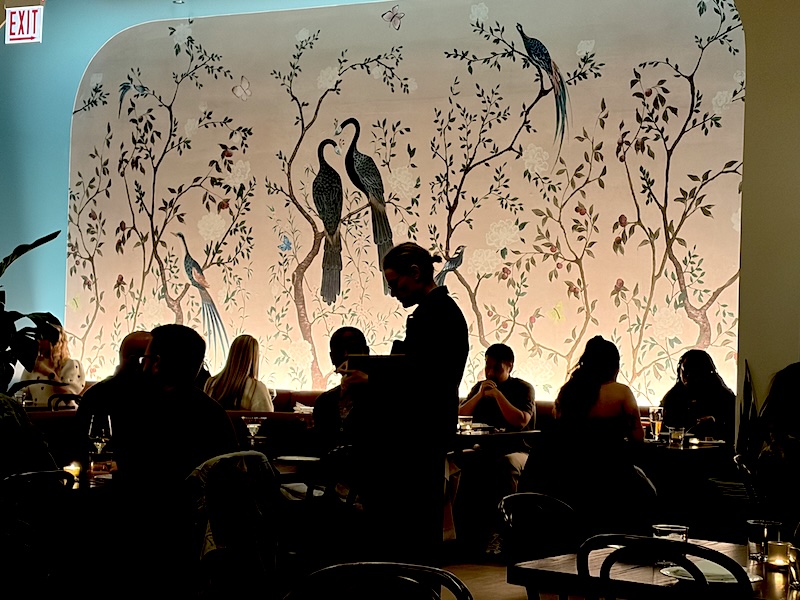
It’s in a big concrete hall of a new apartment building, but I really liked the interior, particularly the wall painting seen in this week’s photo. The service started with the usual jabber—left side is starters, right side is entrees, everything’s meant to be shared , we recommend one from each category and three entrees for two people. (You wish, given the entree prices which mostly started with threes and fours.)
We ignored most of that and mostly ordered what the hell we wanted. A leek tart was like tarte flambee, deep caramelized flavor, some red shrimp with espelette pepper were juicy and with a subtle heat. My wife had duck for an entree, classically prepared with a fruit-tasting sauce, while I had a square of turbot in a delicate brioche pocket, served with a beurre blanc sauce with herbs in it—chives and parsley, certainly, maybe other things (maybe a hint of Dijon mustard, or something). It was fantastic. For dessert we ordered a creme caramel, which came in a red miso-based sauce.
Time after time I was pretty wowed by what we had—wowed in a classically French way, no funny modernist tricks. Okay, the espelette peppers might have been less classical, but still, nothing felt like it had to prove its creativity with weird tricks. That turbot was one of the very best things I’ve eaten in a very good year so far, and the shrimp and leek tart was close behind. My wife just polished off the rest of her duck for dinner, and gives it a thumbs-up as well.
My friends mentioned above compared it to the other Franco-American restaurant of the moment, Creepies. But honestly it didn’t really seem much like it—Creepies has its own niche of French food with a midwestern twang, and much of what they offer doesn’t have to be thought of as French at all (e.g., roasted chicken). Petite Edith is unmistakably French food, executed at a very high level.
Just one complaint I have to share, because both my wife and I felt it. One of the things restaurant owners will say is that you want your chairs to be comfortable, but not too comfortable—you don’t want people sacking out there for the night. In my book there’s a story about Louis Szathmary calling his chairs “90-minute moneymakers.” When I did this piece for Chicago magazine several years ago, it was Erick Williams of Virtue who had the quote about:
Women have one-hour shoes and eight-hour shoes. We know the same thing about restaurant furniture: There are one-hour seats and there are eight-hour seats. And you better be careful if you pick eight-hour seats, because people will camp. There has to be a good balance of comfortable and not too comfortable so people move along.
Williams, of course, is a longtime mentor to Jenner Tomaska of Petite Edith, from their days at MK. And I will just say that we were an hour into a two-hour meal when we both started feeling that the cane chairs in the dining room were, well, one hour chairs. So if you’re sensitive to that—as I did not think I particularly was—I would aim for the soft cushy banquettes at some of the tables. That I’m strategizing how to sit where I want to next time is proof that I liked it and there will be a next time.