

1. FOOD ISSUES
I think it’s been a couple of years since the Reader did a food issue—I contributed to a couple of them in the 2010s—but here it is, with a piece about serviceberries, a native tree with edible berries, along the 606 (my favorite place I ever spotted them was in front of the Target on Addison):
The serviceberries on the 606 are monitored by about a dozen trained volunteers, citizen scientists who track when the trees leaf out, flower, bear fruit, change color, and drop their leaves. The serviceberry study is a long-term phenology project; that’s the study of the timing of biological events, and it’s critical to agriculture, forest management, and tourism industries (not to be confused with “phrenology,” the spurious study of bumps on human skulls). The serviceberry project is intended to measure the effects of Lake Michigan and, over time, climate change, on the fruit-bearing trees.
Other stories include Mike Sula on what Danny Espinoza (Santa Masa Tamaleria) does at his day job for a food company.
2. CARNITAS HOLD ME TIGHTER
The Trib ran a piece on the new fancier Carnitas Uruapan in La Villita not long ago, and now Lousa Chu writes a review about it as well:
Carnitas by the pound cannot be dethroned as their all-around bestseller, but the most popular cut has changed from the old neighborhood to the new, reflecting changing demographics. In Pilsen, they now sell a lot more lean shoulder, [owner Marcos] Carbajal said. Meanwhile, the pork ribs and fantastically funky skin are a lot more popular in Little Village.
The silky chicharrón guisado, fried pork rinds simmered soft in red sauce, remains a weekend-only item at the original store, but is available every day at the sibling locations to tuck into tortillas.

3. EVERY CRITIC MUST GET STONED
I kind of expected more 0f a reaction to John Kessler’s piece on reviewing while high—that somebody would say it’s irresponsible to to cover someone while in an altered state (as if alcohol was not a big part of the dining experience), that only punk kids would write about how it tasted while you were messed up, etc. Here’s Kessler making his case for the virtues of cannabis in dining:
Like many users, I find that THC can quell the judgmental or overly rigid thinking patterns to which I’m prone, as well as the grumpiness that sets in with age like wrinkles on the soul. Paradoxically, being less judgy means being more clearheaded and dispassionate, separating feelings and biases from critical observation. This is because THC suppresses the central nervous system, decreasing the release of transmitters that can affect my mood and cloud my perceptions. In other words, it takes the edge off. So when I find a restaurant not worthy of recommending, the slight tweaks to my brain chemistry help me understand with more clarity why.
4. NIC & JUNIOR SAMPLES
Grimod goes to Nic & Junior’s, the sort-of-Italian-Brazilian concept in the former Beacon Tavern space:
Two months in, it’s fair to say that Nic + Junior’s is still finding its feet. The restaurant, on the back of cheery service and fairly priced drinks, is equipped to please those who live nearby and crave something a little different. On the back of the aforementioned pastas and meats (as well as other salads and sandwiches I trust are executed better), the concept also seems well positioned to satisfy all manner of tourists who are looking for something nicer, with a bit more personality, among the area’s sea of casual options.
Nic + Junior’s just needs to play to its strengths—clever bites that speak to the chef’s journey, twists on traditional forms that don’t resort to lazy flourishes of luxury—and respond to what can be seen on the ground: a tasting menu nobody wants to splurge for (at least on the two nights I was there) that precludes the use of an otherwise attractive, possibly memorable (or at least promotable) dining room.
5. NASHVILLE SKYLINE
Titus has things to eat on a Nashville road trip, and they’re not all country and western:
Asian food is having a moment not just in Nashville but the rest of the south too. Quite a few of the restaurants on my Nashville “to try” list were Asian and SS Gai would be the first of the two I got to try. It’s located at The Wash which is a culinary incubator made up of multiple micro-restaurants testing out their concepts before making the leap to a permanent brick and mortar. Dare I say the Gai Tod (Thai Fried Chicken) at SS Gai is some of the best fried chicken in the south? 100% YES! Absolute best is debatable but this is every bit as satisfying as some of the well known old school spots. As they say it’s “fried chicken that hits a little bit different.”
6. RING OF FIRE
Both WBEZ and WTTW talk with Curtis Duffy about his memoir Fireproof. At WTTW, Daniel Hautzinger talks to him; at WBEZ it’s Courtney Kueppers.
7. VEGHEAD NEWS
I’ve long said if there’s any cuisine where I could stand being a vegetarian, it would be Indian. There’s a chance to test my theory next weekend at the 15th annual Veggie Fest in Lisle, and I mention Indian because leading the list of chefs—and being the name on the press release I got—is Sahil Sethi of Indienne (others include Rodolpho Cuadros of Bloom Plant Based Kitchen). It’s Friday and Saturday; go here for more info.
8. LISTEN UP
Chewing is back for the first time since March, and Monica Eng talks to the owner of My Pi about shutting the local chain down; they also talk the history and decline of Maxwell Street with Professor Steve Balkin.
The Dining Table talks to Bill Kim about life at Trotter’s and his new Dimmi Dimmi.
Supper With Sylvia talks with Erick Williams (Virtue).
Joiners talks to Erin Carlman Weber of all-day cafe All Together Now.
The Chef’s Cut talks to one of Joe’s predecessors at Spiaggia, Missy Robbins.
Dish From Chicago talks sbout reviewing while stoned. What about recording podcasts that way?
WHAT MIKE ATE
As noted below, I interviewed Meathead at Paul Virant’s Petite Vie, in Western Springs. I’ve long been a fan of Virant—he has a great story in my book about getting burned out at Trotter’s, and Charlie’s reaction—and I assumed that Petite Vie, which is about a block from where Vie was for 20 years, was simply a smaller version of the same kind of farm to table, preservation-based cooking. In fact it’s a French brasserie, with a lot of classic French dishes from trout amandine to pithivier with ratatouille. (One of the earliest places Virant worked in Chicago was for Jean Joho at Everest.)
Anyway, some friends of mine went a few weeks ago and they came back grumbling about an off night, this and that was overcooked, etc. So I was fine with going there, but wasn’t expecting to be wowed. But I was; in fact it’s probably the best meal I’ve had so far this year, classically French (I had halibut in a veronique sauce—a cream sauce with vermouth, invented by Escoffier—dotted with warm grapes; also a foie pate topped with a rhubarb sauce, a tomato salad with bright herbs and craggy hunks of blue cheese, attributed to Joe Beef in Montreal; and executive chef Vinny Gerace brought us, as a table of slightly known names, a bowl of fingerling potatoes tossed with truffle, which is how I’m doing my potato salad from now on). But also, as those ingredients suggest, a lot of summer produce, which, how could you not be happy? It was packed for a Tuesday night, and a little steamy inside given the temperature outside, but it was bliss. Not that I pass through Western Springs terribly often, but I’ll find a reason to go again, soon.
From a brasserie, let’s go to jiangbing, the eggy Chinese crepe thing that occasionally has a home in Chicago. Monkey King Jiangbing used to be in Chinatown, but for whatever reason it moved north, and is now on Dempster near McCormick Boulevard. Crepe is one way to describe it, burrito is another; I got the one they say is the original, which has veggies inside as well as a crunchy layer of something—the menu says wonton chips though my guess was fried tofu skin. The crackle of the whatever-it-was, the egginess of the wrapper, the squirt of “little spicy” sauce—it was all highly scarfable and craveable, and won’t be my last time having it, for sure.
* * *
BOOK REPORT
The book
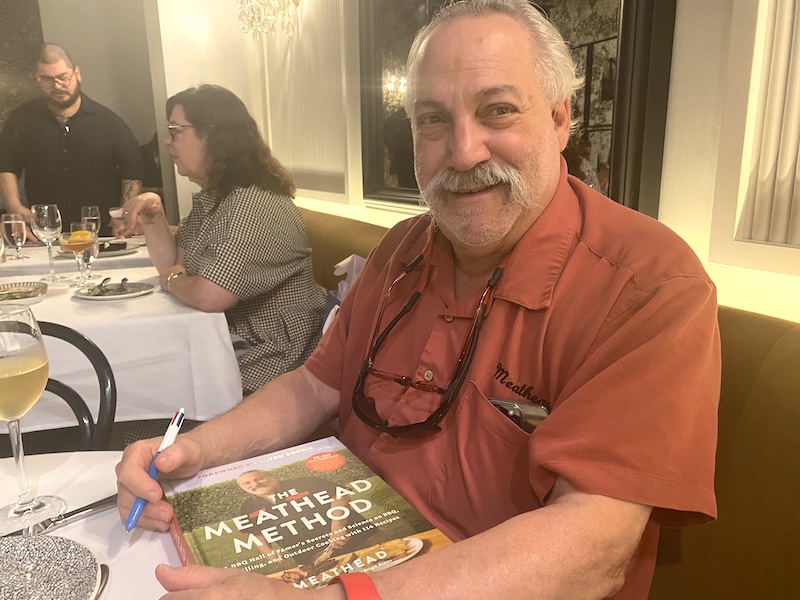
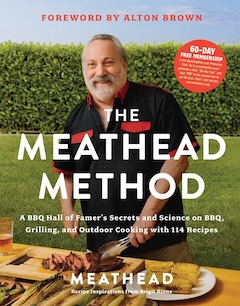
You’ve been seeing the ad for Meathead‘s second book, The Meathead Method, here all summer. With his books (the other is 2016’s Meathead) and his popular site Amazingribs.com, he’s taken a field—backyard barbecuing—that was full of what he calls “old husband’s tales” (e.g., cooking a chicken with a beer can stuffed up its hiney), and replaced them with science about what actually happens to meat over fire (e.g., all the beer boils off and hardly touches the chicken). Following his evidence-based approach will undoubtedly up your grilling game—hell, opening the book to any page at random will probably do that.
In a previous life he was Craig Goldwyn, a wine writer for the Trib and elsewhere with a syndicated column, among other things. He got “Meathead” from his conservative dad by way of a certain 70s TV show, and when his interests shifted to barbecue, it seemed a natural monicker. Based in Brookfield, the Barbecue Hall of Famer (who, speaking of honors, was in one of my Sky Full of Bacon videos), and I met for dinner at Paul Virant’s Petite Vie in Western Springs to talk about his latest book no serious barbecuist should be without:
FOODITOR: I couldn’t compare the two books because one of my sons ran off with the first one, but tell me, what’s new about this book?
MEATHEAD: The first book was very much about culinary science, very much about what happens when heat hits meat, protein, amino acids, fats. A lot of myth busting, because all of us learned how to grill from our dads, and he learned from his dad, and he learned from his dad. So it’s just myth after myth passed down.
But now we’re in an era of food science. I mean, if you’re not using a good thermometer, you’re not cooking anymore. We now know just what happens at what temperature. Both books are divided in half, the first half is the text, the second half is recipes. First half is geeky and sciencey. Second half applies that information.
But it’s a book. It’s not a website. I’ve had a website since 2005, it’s the biggest website on barbecue, 2000 free pages, more than a million visitors every month. The problem is is if, you go to Google and you say, how do you cook ribs, it’ll send you to our ribs recipe. But you need to understand some other things before you just dive into the recipe. You need to know what ribs are made of and why they’re different than other cuts of meat, and why you treat them differently. With a book, there’s a beginning, a middle and an end, so you can tell a story, and you can teach better than you can on the web.
So the first book has a lot of myth busting and science and that sort of thing. The new book is more about method and technique, how to do stuff. Some very creative stuff, like, you like fried chicken, don’t you? But you don’t make it at home.
I do, in a cast iron pan, and then the whole house smells like chicken for a week.
You can fry on a grill and now you’re outdoors. Who cares if it stinks up? Who cares if it spatters all over the place?
Get a Dutch oven, which confines most of the spattering. A couple inches of oil is all you need. Bring it up to 350, 375, in that range, and dredge your chicken however you want to, and in it goes. And when it’s ready, you take it out and you set it over to the cooler side of your [two-zone setup] and it stays warm. I teach deep frying onion rings, calamari, chicken, you can do all that on your grill.
I know you must cook in a wok at home, right? And it’s good. It’s delicious. But it’s never quite as good as the neighborhood Chinese joint. Because they cook over a volcano. Well, you can get a volcano, too. How do you start your charcoal fire? With a chimney starter, put your wok on top of the chimney. That’s 800 to 1000 degrees. You can sear your beef for Mongolian beef, whatever you’re doing in your wok on top of a charcoal chimney, far better than you can indoors.
Traditionally there’s about five barbecue meats—burgers, ribs, pork shoulder, brisket, chicken. Maybe salmon in some places. What do you wish people would cook more of?
Their favorite foods. Seriously, whatever they like indoors, they can cook outdoors, and usually it comes out better.
My last book had a really great ribs recipe and a really great brisket recipe and a really great pulled pork. So what am I going to do with this book? I’ve tried to bring a lot of Asian ingredients and other things into the recipes—I mean, Dorie Greenspan’s Pork a la Normande, that’s a French recipe [that he adapted to the grill]. And I went to the competition chefs, because they cook very differently than we do in the backyard.
I want you to try this. This time of year, buy more cherry tomatoes than you need. When you get them home, take a paring knife, sharp tip. Stab them a few times, put them on your grill at a low temp. They’re like grapes. They have the same very sweet, very tart, but with the smoke flavor, you dehydrate them. You don’t want to dry them out, so you keep temperature low. They should be like raisins. And the texture is soft, pliable. Put them on a pizza, focaccia, a salad–there’s a million things you can do with them, anything you would do with regular raisins. And they’re so much better. Put them in a baggie and throw them in the freezer, and they last all winter.
What’s the most important thing for people to understand about the science?
Well, one really important concept that I teach is that there’s three types of energy, and I speak of energy, not heat, because there’s a difference. Heat is a type of energy. In an oven or just in a grill, you have warm air circulating—that’s convection airflow. You also have hot metal that you put the food on, that’s conduction energy. But you also have infrared, and that’s the important one. People say, Well, my Big Green Avocado goes up to 600 degrees. I don’t care, that’s air temperature. You’re not going to sear a steak with air temperature. For a sear, you need infrared radiation. You need flowing coals or flame.
I talk about setting up your grill in two zones, a hot zone and a cool zone. That’s like standing in the sun or moving into the shade. And it’s the difference between cooking with infrared and cooking with convection airflow.
People who buy either one of my books always tell me that they end up slapping their forehead, oh, my God. Now that makes sense. I get it now. There’s a lot of revelation in both of them that makes perfect sense once you hear it.
What bad ideas do you want to stop people from doing?
Dial back the heat. Guys particularly are like, “Give it all she’s got, Scotty.” You’re cooking too hot. Proteins shrink when exposed to high energy. When they shrink, they squeeze out juices. You’re drying out the meat.
Cook more vegetables. Milk Street, I’m doing a live feed for them, August 12, and I’m cooking vegetables—Meathead Goes Veghead. And I’ll be cooking from my wife’s garden, she’s a certified master gardener. In fact, she’s out today at the the local VA hospital, because they have a garden for the veterans there, and she works with them.
Anyway, come August, I cook a lot of vegetables. I do a hell of an eggplant parmigiana on the grill. You just slice up the eggplant, give it a light coat of oil. If you want brush it lightly, season it with some salt, or if you want to throw some garlic powder and then grill it.
You know, this time I wrote essentially two books and cut it down to one. Obviously, I saved all that. I haven’t decided if I’m going to try to massage that into a third book. It’s a big job.
What would it be?
A manifesto, a philosophical treatise? I want to rant and rave about authenticity. I want to talk about creativity and how it applies to food. I’ve written a lengthy essay on how culinary arts should be considered alongside of all the other arts, painting, sculpture, dance. It is an art form, and it has some aspects that are superior, and some of them are not, but it’s a legit art form, and it needs to get legit.
I’ve written a lot about organic and what’s good about it and what’s bad about it. I’ve done an awful lot of research on the intelligence of plants. Plants are pretty smart. They try to protect themselves. They communicate with their neighbors. They’re as sentient as many animals,—vegetarians and vegans don’t want to know this!
Your carrot has feelings! Let’s talk about how you got into this, from being a wine writer—two pretty different sides of the food and beverage world.
I learned about both wine and barbecue in college in Gainesville, Florida. I was the assistant manager of an ABC Liquors, about 120 stores. I got into wine. I would wander into the wine department, and I would bring back wine to the fraternity house. We’d all sit around and taste it and talk about it. My professors would come in and say, Well, what do you recommend? And they’d come back and say, That was fantastic. I don’t know if it ever affected my grade, but I like to think it did.
The ABC Liquor stores were divided in half. One half was a package store and the other half was a bar. So all the liquor into the bar came in at dirt cheap prices from the front half of the store. And every Thursday or Friday, some guy would come in from the distant suburbs, with a big old beer cooler filled with ribs wrapped in aluminum foil. I had a smoker, and he was doing really good southern barbecue ribs, and he’d sell them to the patrons in my bar. Turned out that was Sonny [Tillman of the Florida chain Sonny’s BBQ]. He was just starting out cooking in in his own backyard, and I was really fascinated by the taste of this stuff, and so I started going into the neighborhoods that the other white college kids didn’t go into.
And I stumbled into a place called Y.T. Parker’s Barbecue. And old Y.T. was a big old, heavy guy, always had a cigarette on his lip with a big old ash and you know, he’s standing there stirring the potatoes and sprinkling in the black pepper, and I’d look up and the ash was gone. I would order the barbecue, and I’d ask him questions, and eventually he’d let me go out back where they actually had a pit in the ground, and three or four of his buddies were sitting around tending the fire. And I learned to cook from these old black guys, and that got me on the path.
I lived in an apartment complex, one of these U-shaped complexes where they had those grills that they put in parks, you know, the cast aluminum grills that are anchored in the ground. And they had them scattered around the interior of the U so anybody could use them. But that one happened to be right outside our apartment. So my roommates made me grill every night, and I got pretty good at cooking. I actually changed my class schedule so I could watch Julia Child in the mornings, she was on at like 10 o’clock and I wouldn’t take any classes until after Julia was off the air. She was eye opening. So that’s the Meathead story.
Well, the beginning of it, at least. How did Amazingribs.com come into being?
I’ve been on the internet in a publishing capacity since the late 80s. There was an early site called LA Online, type R for red wine, type W for white wine. You know, it was all command line. And when AOL appeared with icons, based on the Macintosh interface, I jumped over there, and I met Steve Case, who was a young entrepreneur, and I brought a bottle of wine, and we sat in his office with our feet on his desk, and he hired me to run their food and drink section. I ran that for eight years or so, and I brought Julia Child online, her first online event. Then I launched, well, I ran a company called Beverage Testing Institute, which still exists. I sold it in the year 2000.
I was a wine critic for The Washington Post and the Tribune, syndicated. I was in the Syracuse Post Standard, I was in El Nuevo Dia in San Juan, Puerto Rico in Spanish. And of course, that allowed me to travel the wine world. I got a deep exposure to tasting. And of course, that exposed me to food. And I’d always been interested in food, but when I sold BTI, I spent a year or so trying to figure out what to do with the rest of my life. I was building websites for small businesses, and I finally decided, well, why not build one for myself? And I built Amazing Ribs, with one recipe, ribs, hence the name. There was no barbecue website at the time, and Google found it, and they sent us traffic.
Now they’ve f’d up their algorithms so badly, we’re getting ready to start an ad campaign. Google has always said that if you go to any of the chatbots and ask, what’s the best barbecue website? They all say we are, but they’re not sending us any traffic, so we’re rejiggering our business model.