

1. TIGERSMYTH
John Kessler goes to Mister Tiger, the homestyle Korean joint:
When you arrive, you’ll join a diverse crowd of neighbors who appreciate the soulful cooking, warm hospitality, and (yay, yay, yay) decent prices. I’m always happy to have dinner here, whether it’s a best-in-show bibimbap and a cocktail at the bar or a full meal with a group of friends around a table, wrapping slices of juicy short rib in lettuce and clinking spoons in a shared bowl of uni rice. Still, I do have a couple of notes. The family’s inexperience in running a restaurant shows, particularly in terms of pacing and service. (I suspect the kitchen gets overwhelmed at times.) Also, while the food tastes admirably homemade, it can sometimes come off muted. I’m happy with it because so many youth-oriented Korean restaurants dial up the sugar, salt, and spice to 11, so it’s a treat to eat food that tastes Mom-approved. (You may even spy the siblings’ mother, Inae Park, in the restaurant feeding Lee’s daughter.) But if you crave more K-pop flash in your food, this may not be your jam.
Actually, I felt the opposite, that it didn’t entirely deliver on the promised homestyle-ness. Kessler also takes a look at how Smyth has evolved, now that it’s the only other three-Michelin-star joint in town, with Alinea, and incidentally, the most expensive restaurant in town:
When I returned two weeks ago, Smyth seemed a subtly different restaurant. I’ve been to a handful of three-star restaurants in my life, and you can always feel it — the intentionality in every detail and sense of import. The restaurant is defining excellence on its own terms. That doesn’t necessarily mean you will have a great meal, but this meal at Smyth was indeed great. Half the dishes vie for the best bites I had this year. But what were they? What were the pictures telling me?
I suppose I could call up [chef-owner John] Shields and ask him to walk me through the ingredients and preparations, and I could dutifully re-report these details to you. Instead, let’s start with what I remember, which is the consistent mood these dishes evoked. They largely tasted familiar at first and then swooped gracefully into something else, something more savory and unexpected. Natural flavors — there all along — were framed in such a way that my brain couldn’t elide over them. Corn cream mirrored the sweetness of the king crab it draped over, but the little pops of snipped herbs shot throughout were so fresh, wild, and grassy they seemed more like raw vegetables. They weren’t garnish, they were the point.
2. THE PATIO THAT STARES AT GOATS
The increasingly suburban-focused Tribune looks at all the new tasting menu options opening in Chicago and… goes to a farm to table picnic spot, The Cafe at Elawa Farm, in Lake Forest:
It is, in fact, a cozy place for breakfast or lunch with delicious pastries and coffee in an extremely lovely setting. With an idyllic patio, I might add, overlooking the adorable goats in their paddock. Meanwhile, the market could be an aesthetic set for any Nancy Meyers film.
But dining at the farm, all of which Elawa Farm Foundation executive chef Lee Kuebler oversees with his kitchen team, also features a series of events, from buffet burger nights to seated grill nights, to spectacular private birthdays to weddings to celebrations of life, which give the once quiet fields open to the public a surprising festival atmosphere.
I did Key Ingredient with chef Lee Kuebler at Milwalky Trace years ago, and he seemed a good guy. So it’s an appealing-sounding place. But, you know, either you want to drive to Lake County for an idyllic patio brunch with goats you can pet—or you don’t. A review isn’t going to change that.
3. IN THE LAND OF BIG SANDWICHES
You know the Big Sandwich at Publican Quality Bread, serving meats and cheeses on a craggy loaf of bread? The sandwich at Seedo’s Levantine Bakery, in Sterling (formerly Revival) Food Hall, looks similar but is different inside, says Maggie Hennessy at Chicago:
Breathe deep, then follow the aromas of toasted sesame seeds and sumac to Seedo’s Levantine Bakery, where Mutaz Abdullah explores the flavors of Palestine, Jordan, Turkey, and Iraq through flatbreads, sandwiches, and pastries. Hospitality runs in his veins; his father opened Hyde Park’s Cedars Mediterranean Kitchen in 1992, and his grandfather ran a bakery in Jordan. (“Seedo” means “grandfather” in Palestinian Arabic.)
4. TABLE MEETS STICK
Grimod at Understanding Hospitality looks at the neighborhoodness of one of the city’s quintessential neighborhood spots, Table Donkey and Stick:
In the past, I’ve always sat at the smaller two-tops set in the nooks opposite the bar: intimate confines that also allow one to feast on the front room’s energy. Tonight, with a bright greeting, I am led to a space in the back that centers on two communal tables awash with natural light. Even accounting for the lingering influence of the condo buildings, I like it here. The room is cool and spacious with a view of the restaurant’s tented, tree-topped patio and a couple hanging quilts (serving to impede a sightline that would have guests looking out at a brick wall and some refrigeration units).
5. DONER ADVISED
I noticed Titus Ruscitti’s opening point a few months back: the far end of Argyle is not more Asian food, but food from all over the world. One is called Turkish Doner:
The end of Argyle street, just before it hits Sheridan road, has turned into a bit of an international eating enclave, much like the rest of Argyle. But unlike the Vietnamese and Thai eateries that dominate the street, this block houses a Nigerian, a Venezuelan, and now a Turkish restaurant too. The generically named ‘Turkish Doner’ recently took the place of the old Don Pablo’s Chilean Bakeshop which was said to be moving to the suburbs. Turkish restaurants continue to see a sharp rise in the Chicagoland area but there’s no specific area as to where – they’re opening all across the city and the suburbs.
6. WHERE IS CARMINE’S, SAN DIEGO?
Michael Nagrant mentioned to me what he thought he was going to review next—but he didn’t. Instead he talks about two other places. First, Carmine’s, on Rush Street:
My son loves Carmine’s because he comes here with his friends after rousing bouts of Skee-Ball at Dave and Buster’s next door.
Carmine’s is the first place my son dined by himself. Thankfully, those servers treated him and his high school buddies like Viagra Triangle ballers, comping them tiramisu, knowing they’d already spent everything they had on plates of cheese ravioli in tomato basil sauce.
I don’t know if it’s always been this way or they just have a good management team right now, but my son is right about the food at Carmine’s.
If I’ve ever been there, it was a million years ago. He also goes to the rare Lao place, Lao Der:
By now, most of you know my desert island meal is Thai food. If you’ve been in Chicago for more than ten years, you’ll remember when we once had an abundance of riches in this vein, whether it was TAC, Spoon, Rainbow, etc..
Over the last few years some of those places have closed. Many of the ones that remain open have dropped off in quality. JJ Thai, Opart Thai, Inn on Thai, and Ghin Khao all remain and are pretty good.
But none of them serve Lao cuisine and none of them serve my absolute desert island dish, Nam Khao, aka crispy rice “salad” with fermented pork. A study in crisp and soft rice glazed in bright lime, it explodes on your palate like an Indiana fireworks store that’s been set on fire by an errant cigarette.
After a bite of Lao Der’s version featuring pan seared rice nuggets and a crispy top layer of puffed rice and toasted peanut, I rejoiced that finally, I’d found a version as good as the one served at Rainbow Thai prior to 2020 (my former go-to).
7. YOUTS AT HAGEN
At WBEZ, David Hammond visits old school smoked fish joint Hagen’s:
There are places you go to eat, and then there are places you return to, again and again. For me, one of those latter places is Hagen’s Fish Market, tucked near the corner of Montrose and Central avenues in Chicago’s Portage Park neighborhood. My first trip there was before I even started kindergarten; my grandmother took me. I remember the Viking ship painted on the side of the building, seeming to pre-Kindergarten me to be an impossibly exotic invitation to a grand culinary adventure.
Decades later, walking into Hagen’s is like stepping into a perfectly preserved time capsule. The doorbell jingles, the crowd of shoppers murmurs, and the air hangs heavy with the rich, unmistakable scent of smoked fish.
8. IT’S SERPENT GOURD SEASON, MF’ERS
Serpent gourds are a variety of squash from Siciliy, and my friend Rebecca Fyffe tells about a locally-grown serpent gourd feast happening at Sarah Stegner’s Prairie Grass Cafe in Northbrook:
As part of a new collaboration between chef Sarah Stegner and gardening maven Jeanne Nolan, North Shore residents can feast on rare garden delicacies starting with the Serpent Gourd of Sicily this summer and fall.
Stegner, a James Beard Award-winning chef and co-founder of Northbrook’s beloved Prairie Grass Cafe, is teaming up with Nolan, founder of The Organic Gardener to help their community better understand the terroir of the North Shore, and the culinary heritage of its residents with a series of special dishes using rare, locally grown heirloom veggies of the season. The gardener and the chef will choose vegetables that are culturally significant to North Shore residents, and bring them from farm to table within just a few square miles of the restaurant.
9. WHAT TROTTER MEANT
One of the real challenges in my upcoming book was explaining what stood out so much about Charlie Trotter. A piece in Wine Spectator tries to answer the same question:
Trotter brought incredible intensity to the kitchen, his drive based on the idea that he could offer guests the best dining experience in the world. To that end, within a few years of opening he began serving tasting menus exclusively at a time when the concept was seen only in high-end European restaurants. He doubled down and offered a vegetarian tasting menu as well, proving that vegetables could have a starring role.
His dishes changed every night as he crafted each menu based on the ingredients that arrived that day—there was no walk-in freezer at Trotter’s. And he took wine more seriously than American chefs had before, working with his sommeliers to perfect wine pairings for each night’s menus and even altering his recipes to harmonize with whatever bottle a customer may have ordered.
Most of all, Trotter brought a belief that American dining could equal and even surpass the gastronomic temples of Europe. His fervent dedication put Chicago on the culinary map and crystallized the concept that chefs were auteurs and artists, thoughtful and creative and provocative.
10. EATER BEAT
The only local coverage I’ve seen of Eater Chicago editor Ashok Selvam getting the boot is at WBEZ, and honestly the only thing in it that wasn’t in my newsletter last week is this:
In an emailed statement, the company said the layoffs were due to “the rapidly changing media landscape and shifts in audience behavior.”
“While difficult, these changes are necessary to allow Eater to reallocate resources toward the areas where it has the biggest opportunity to grow and continue to serve its audience: the Eater app, social-first storytelling, tentpole brand moments, and trade coverage via its industry newsletter Pre Shift,” the statement reads.
The company did not respond to WBEZ’s questions about whether Eater will continue to cover Chicago or if it will have staff members or contract employees based here going forward.
In other words, they shot first, and now they’re figuring out what they were aiming at, and like media outlets always do, they are not responding to the precise questions they would pose to the subject of a story.
11. THEY YAM WHAT THEY YAM
Now that Edzo’s is gone (though it just did a pop-up at Honey Butter Fried Chicken), if I had to name the best restaurant in Evanston it might well be Evanston Chicken Shack, which does first class fried chicken. So I don’t see a burning need in Evanston for a Popeye’s chicken, to be located at “an intersection already home to Burger King, McDonald’s, Starbucks, Subway, Dunkin’ and various other chain stores and restaurants,” according to this piece in Evanston Now.
Admittedly, Popeye’s looks pretty good next to that list! But not to the protesters who attracted a crowd of dozens—dozens!—last week:
The protestors are led by Nancy Floy, who owns the tax-exempt Heartwood Center, an alternative health center next to the restaurant site at 1830 Dempster St.
They’ve been calling on [Evanbston mayor Daniel] Biss to — in the words of the mural painted this week on the center’s wall — “Say no to Popeyes.”
…Floy has argued that Popeyes would “not [be] in harmony with our village,” and instead suggested she be allowed to buy the property and rent it to Gabi Walker-Aguilar, owner of 4Suns Juice Bar, who plans to open a food market she says would offer healthier options than Popeyes.
So someone who owns a business is trying to procedurally block another business for the benefit of a crony, and wrapping it in New Age nonsense? Sure looks that way. Among those backing Floy’s protest is Kat Abughazaleh, the “26 year old content creator” who seeks to win Jan Schakowsky’s seat (as does Mayor Biss) and become the AOC of Evanston. I’m more impressed by the response of Ald. Krissie Harris:
“I’m not going to let anybody tell Black and brown people what to eat,” Harris said. “What we will do is go through the process … but the audacity for anybody to tell anybody how to eat is a privilege.”
12. LISTEN UP
Supper With Sylvia talks to Curtis Duffy about his memoir, Fireproof.
Joiners talks to Johnny Stramaglia, son of Supreme Lobster founder Dominic Stramaglia.
The Dining Table—David Manilow talks about recent places that wowed him—or not.
The Dish from Chicago magazine looks at the best openings of the first half (well, two-thirds by now) of the year.
The Chef’s Cut talks favorite condiments.
WHAT MIKE ATE
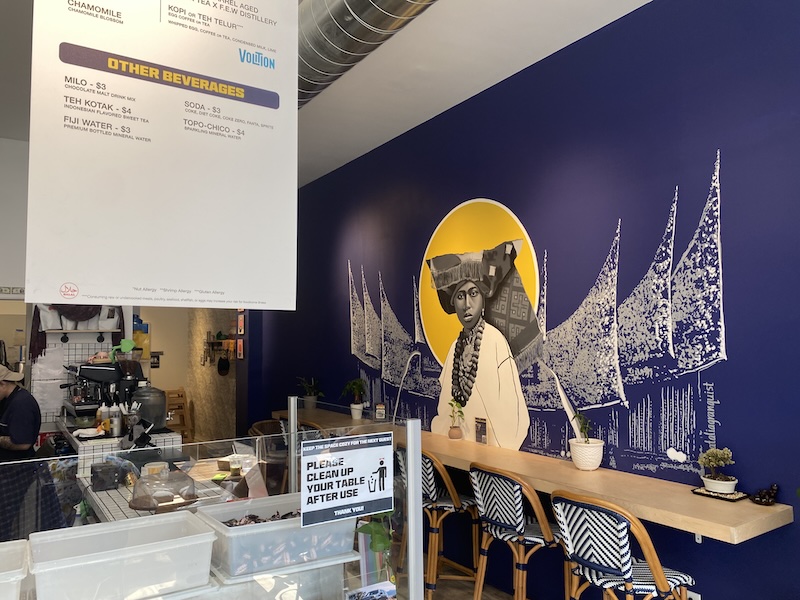
I went to Rendang Republic, the Indonesian restaurant in Wrigleyville that has gotten a lot of attention for things like an Indonesian hot dog (using a Duck Inn chicken dog) and a rendang Italian beef. I had the dog, not the beef, but I can’t say it did a lot for me. It has half a dozen Indonesian relishes on it, and a friend was telling me how it had this superb balance of flavors… and I just can’t say I agreed.
What I did like, though, was the straight up Indonesian food. I ordered a chicken leg-thigh with coconut rice, accompanied by a couple of sides including some peanut-sauced stewed greens—all of that was comfy and satisfying. A friend ordered some chicken satay, which could easily have been standard like you get in a Thai restaurant, but instead it was expertly grilled in a sweet sauce. And another friend ordered a special of some Indonesian arancini (!) which turned out to be creamy and delicious. There’s a lot to like about this food, it doesn’t really need the stunt casting of making Indonesian hot dogs or whatever.
I’ll be traveling next week, so no Buzz List. We will return on September 1.