

1. DINERS, DRIVE-INS AND DRELLAS
I think sometimes I’ve been to every old school greasy spoon diner in town (usually with son number two, who loved Belmont Snack Shop, RIP), though I know unknown ones must exist scattered in odd corners I’ve never been to. Still, Titus Ruscitti’s new post about five such diners surprised me in that I had only been to two of them—the Golden Nugget not far from me in Avondale, and Parkview Grill in Pilsen. I went there years ago, don’t remember how or why; I was underwhelmed, but it’s distinctly possible I just didn’t know what to order in a Mexican diner then (chilaquiles mainly, though I recently had an excellent plate of cheesy, 1940s-style huevos rancheros in Palm Springs). Anyway, Titus makes me want to go back, better informed:
Our next stop serves up some of my favorite chilaquiles in town. Parkview Diner at the corner of 19th and Damen is a mother and son run spot that’s been serving the people of Pilsen for more than 35 years and the more Pilsen changes, the more this place stays the same. The menu is a fun mix of American and Mexican breakfasts and also a few Chicago style items too. The Mexican food here is old fashioned and similar to what you would find elsewhere in Chicago back in the 90’s. But it’s a step above as they put care into their food such as making their aguas frescas and soups on site. They also grow their own peppers for their salsas. Whatever you get from here it’s going to be a hefty plate of food for a more than fair price but I can’t get past the chilaquiles loaded with tender hunks of steak.
There’s another point that struck me here. He talks about a place called Cinderella’s on 47th. A bazillion years ago (2006, to be precise) I set up an event at LTHForum called the 47th-a-Thon, in which a bunch of us ate our way down that South Side street. I remember at some point there was what looked like a dead ice cream shop, advertising Cinderellas—and nobody, not even Peter Engler (Rene G), knew what that meant. Was that in fact the same Cinderella’s, merely closed rather than dead? Is a Cinderella some kind of south side specialty specific to the 47th street area, that gave its name to this hamburger stand? I don’t know, but this is why there’s so much to be discovered in Chicago food than merely reviewing the latest openings in trendy neighborhoods.
2. FORMERLY CHUCK’S
The faux-folksy name Gus’ Sip and Dip suggests that it’s a Lettuce joint, and it is, but Amy Cavanaugh at Chicago mag says there’s a lot to like about how it goes against the flow of current bar openings:
There’s much for cocktail geeks to explore, but the most talked about part of Gus’ is the price, a very affordable $12 per drink. Beary (who is also the beverage director at Three Dots and a Dash) and Kitsmiller (another Three Dots veteran) reimagined the menu at R.J. Grunts in 2023, creating a list of cheap classics, which are just $5 during happy hour. That experience laid the groundwork for Gus’. As Beary says, “We realized that the demand was going to be there.”
3. THE CRAZY WORLD OF ARTHUR BROWN
Fire, the reinvented Roister, has moments that wow Maggie Hennessy at Time Out:
Take the opening course, which conveyed three miniature expressions of hearth-“seasoned” Spanish prawns atop a charred wood box heavy with stones and seaweed. A tiny shiso leaf “taco” packed an umami bomb of cold-smoked prawn meat seasoned with crunchy garlic and chocolatey barrel-aged soy sauce, like oceanic forcemeat. Grilled prawn shells infused a prescriptively decadent bisque shooter with toasty depth. A technicolor prawn tail, steamed till tacky-soft like crudo, was shellacked with raw honey and garnished with chili threads. Subtle though it was, every element magnified the meat’s sweet, briny umami.

4. BROMAKASES BEFORE OMAKASES
A couple of new short pieces at Understanding Hospitality, both ID’d as dating to March 2025 (but published recently. One is on Kyoten, and I liked this bit about the crowd there (and for sushi generally):
It can be jarring when one’s “special occasion” seems a little less special due to the familiarity other guests bring to the table and the unique connection they seem to have with the chef. But Phan, as long as I have known him, has been an outspoken critic of “bromakase” culture. This is not to say that’s what’s happening here. Rather, the chef is sensitive to how his interactions with repeat (or simply more sociable) customers can appear, and he always makes an effort to share the love and attention across the full breadth of the counter. Given the polarizing image Phan has sometimes maintained, I find this quality (a total rejection of snobbishness or exclusion) really helps clarify his intentions. The chef deeply appreciates the presence of his diners and, indeed, fights as hard as he can to make them all “regulars.”
The other is about a special menu at Le Bouchon, inspired by the sugar shacks of Quebec:
The inspiration here is simple: replicating the kind of wanton feasts—stuff like “platters of thick-cut ham, sausage links, piles of crisp bacon, golf ball-size meatballs, meat pie, omelets, mashed potatoes and baked beans”—originally served as a “daily reward” for workers tapping and processing maple sap in Québec’s cabanes à sucre (or sugar shacks). Of course, the resulting syrup also features heavily, and these cabins have become family-run, public-facing gastronomic destinations since the 1980s.
Nicolas Poilevey admits the brothers haven’t actually been to a sugar shack (though they visited Québec last fall). Certainly, they want to, and they have a clear vision of the kind of excess and indulgence these meals represent (both in the popular consciousness and as a unique “France meets North America” culinary extreme). Given that this team (not just the Poileveys, but the rest of the Obélix kitchen too) is already so adept at pushing the boundaries of its chosen cuisine, I kind of liked the idea of them designing this menu with a blank slate. Of course, they had a sense of what this fare is about—what kind of ingredients and recipes typically feature—but they could go about shaping the experience in a singular way rather than being tempted to replicate exactly how it’s done in Canada.
5. HAI SOUS ME
I don’t know how long Hai Sous has had a tasting menu offering, quite reasonable at $65, but they show a number of previous menus, so “a while” seems a good guess. In light of my recent discussion of tasting menus in town, part of what comes with the name is expectations—and Michael Nagrant’s account of his visit to Hai Sous shows them not being met, for reasons somewhat beyond anyone’s control:
My wife either loves me or couldn’t stand the thought of drinking alone and she asked a food runner where my wine was. The same server who had tried to talk me in to a Gruner returned and stared as though he’s been zapped by the memory-eraser from Men In Black and said, “I’m sorry, what did you order again?”
I felt bad for him and for myself, but this is how it was all night, one server and a food runner responsible for about ten tables. I asked our guy, “How many servers do you usually have back here?”
He said, “Three, but everyone is on vacation, and we got slammed. I’m actually a sous chef.”
6. VALDEZ IS COMING
At WTTW, Lisa Futterman talks to Ivan Valdez of Taquizas Valdez to ask him his favorite spots in town. You might be surprised that Mexican doesn’t turn up much until the end, when he’s asked to name the person he admires.
7. SEN SEI
A top expert on Indian food in America lives in Chicago—and is not Indian. At NewCity, Cynthia Clampitt talks to author Colleen Taylor Sen (her husband, Ashish Sen, is Bengali):
Sen is quick to point out that talking about “Indian food” is like talking about “European food.” It’s not monolithic. India is an entire subcontinent, and today’s states were once separate countries, with different cultures. She notes that, in addition, “there is the added complication of eight religions and hundreds of languages. So no one can really ever capture all this diversity. My husband is Bengali, which has a distinctive cuisine, so I have some firsthand knowledge of that. I’ve been to India more than twenty times and have travelled all over the country, and there is still always more to learn.”
8. LAGERDOCCIO
The Reader had me at “The Lager Beer Riot of 1855″:
Chicago’s first police riot started with beer.
In his inaugural speech on March 13, 1855, newly elected, Kentucky-born mayor Levi D. Boone proposed the wholesale prohibition on the sale of alcohol in Chicago or, barring that, a substantial increase in the price of tavern licenses. To enforce his temperance agenda, Boone also outlined his vision for a reorganized, professionalized police force made up entirely of “native-born” citizens. Immediately upon taking office, Boone cracked down on violations of a never-before-enforced 1851 law that banned saloons from operating on Sundays. He also pushed through an ordinance that hiked the cost of tavern licenses sixfold, from $50 to $300.
This was a direct affront to Irish and German immigrants, who traditionally spent Sundays—their only day off from work—drinking in taverns.
9. RIVERWALK ALL OVER HIM
Robert Guzman owns a couple of restaurants, including the Beat Kitchen on Belmont. He also had a Beat Kitchen on the Riverwalk downtown—but when it came time to renew his lease, he says the city jerked him around:
When the lease came up for renewal last year, he applied again, competing against just one other applicant. But the process dragged on for months, and the space remained closed for the entire 2023 season.
Eventually, the city awarded the spot to someone else.
Gomez says the city hasn’t told him why he was passed over, who made the decision, or even who the other applicant was. He also hasn’t been able to get answers through a Freedom of Information request.
Well, that’s his side of the story, told to Fox 32. But the city’s lack of a frank response certainly doesn’t make their side seem more convincing.
10. ENCAPSULATE THE POSITIVE
Having had a week or two in my food (obsession? vocation?) that was mostly unrewarding and full of complaints, it was very pleasant to come across this, by Jake Potashnick of Feld, reposted on Instagram by David Posey of Elske:
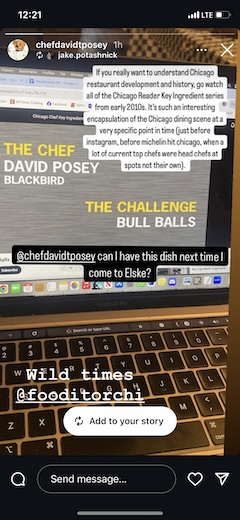
Potashnick had mentioned to me when I hung out there for the day that one of the ways he had learned about chefs and “gone inside” kitchens as a youth was watching the Reader’s Key Ingredient. I replied that, um, yeah, that was me. (And Julia Thiel.) I was too modest to include that moment in the article then, but after getting knocked around a few times recently, I have no such qualms.
By the way, if you want to see young David Posey cooking testicles in 2010, go here. They weren’t bad! But I can’t say I’ve had them since.
11. LISTEN UP
The Dining Table—Alton Brown, in town for a couple of live shows this past weekend, talks about his role in inventing food TV (and getting tired of it as it became all competition shows).
Culinary Historians of Chicago—Jason Hammel giving a talk from Lula Cafe’s basement about how he became a chef-owner and how Logan Square changed over time.
J0iners talks to Peter Vestinos, whose latest venture is the Banchet Award-winning bar Bisous.
IN MEMORIAM
An Irish guy who worked for Charlie Trotter—but owned a Mexican restaurant? That was Patrick Concannon, who ran his Mexican mom’s Don Juan in Edison Park (a second location on Halsted eventually became Boka). The Sun-Times remembers Concannon, who died in January at 58:
Culinary rumbles about Don Juan’s restaurant in Edison Park began to build in the early 1990s. That was when owner Maria Josefa Concannon brought in a new chef: Patrick Concannon, her son.
He’d bounced around at fine dining spots in Hawaii, France and California and spent time working at the now-closed Charlie Trotter’s before elevating the menu at his family’s unpretentious Mexican eatery.
Creativity blossomed in his daily specials. Regulars knew to expect the unexpected. There was the roasted Chilean sea bass with wilted greens, six-hot-pepper-rubbed guinea fowl with sweet potato chipotle gratin and confit of duck leg with a chile pasilla apricot glaze.
A Chicago Sun-Times dining review in 1995 gushed: “Don Juan’s is the type of restaurant people dream about finding. It’s an informal, fairly accessible place with a wunderkind chef whose specials compete with many high-priced, reservations-two-weeks-in-advance eateries.”
WHAT MIKE ATE
There’s a breakfast place way up in Rogers Park called Honey Bear Cafe which I tried going to on the weekend once—no chance, it’s crazy busy then. So I went on a weekday and it looked promising— I got an omelet that was the size of a burrito. Unfortunately that size threw its proportions out of whack—quantity of egg overwhelming the things inside it (mostly bacon and tomato, I forget what else). It came with a side of hash browns cooked into sharp, dry sticks of potatoes, which were about as hard to pick up with a fork as the pine needles under the Christmas tree. In short, I have no idea what’s packing them in at this inexplicably popular place.
Last week I went to Cafe Yaya, from the Galit guys, for breakfast. Liked the pastries, but the system at breakfast had some kinks to work out. Still, I was eager to check out what they’re doing for dinner, so I went again and sat at the bar. Talking to the bartender/server, I went for a nicely crisp glass of chenin blanc, and a bowl of labneh with caramalized onion, miso and chives which was surprisingly lush and bright (with the fresh chives), dipped with a Yemeni type of bread called malawach (which my server described as being like a flattened croissant—it certainly produced a comparable shower of shards and crumbs). For a main, I ordered a half chicken seasoned with za’atar, which came with a tart salad of greens and radicchio. Chatting up the bartender and the manager, and mentioning I’d eaten the breakfast pastries of pastry chef Mary Eder-McClure, in the end I was given one of her baklava with the urging that it was the best baklava they’d ever had, one that puts other places’ ordinary baklava (maybe served from a box of frozen such) to shame. My feeling about baklava had been that it’s like David Mamet’s description of flan—there’s not really much difference between good and bad. Well… they were so right about it being the best baklava I’d ever had. Bright with cinnamon, fresh and dripping with honey, it was one that makes most others seem routine.
Honestly, two things—the labneh and the baklava—could find a place on my ten-best list at year’s end, and that’s not to say anything against the chicken which I happily took half of home to make lunch out of the next day. But I had just ordered an utterly ordinary middle eastern meal a few days earlier via GrubHub, and this meal drove home what a treasure the careful, inventive middle eastern food at Galit, and now its sibling next door, is.