

1. THE NEW ROMAN
At Chicago mag, John Kessler reviews Il Carciofo, the new Roman restaurant from Joe Flamm (Rose Mary), coming soon. He only gives it a star and a half, but the way I read it he sees much to like—but it does seems to be a thing that Flamm’s restaurants need time to grow into themselves. When I finally went to Rose Mary after something like a year, it seemed far more assured than the reviews after a month had said, and Il Carciofo seems on the same path:
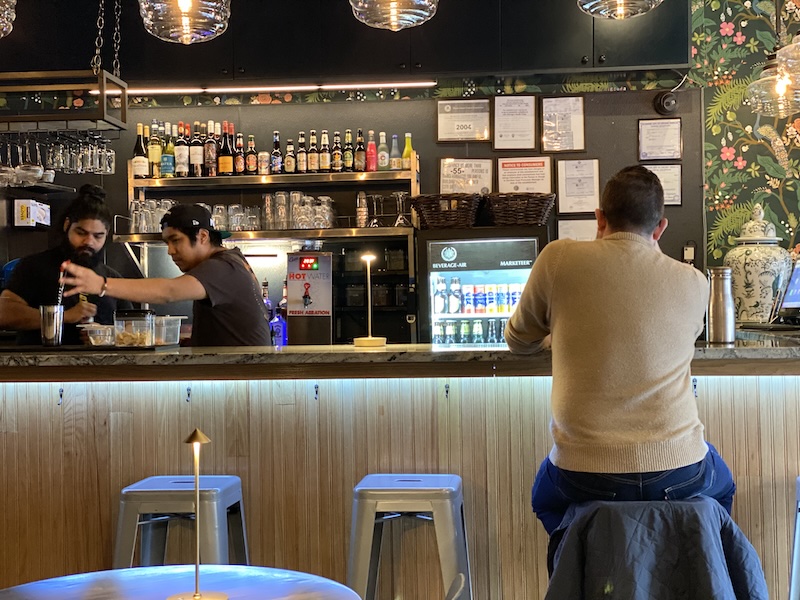
While Rose Mary focused on the Adriatic fare of eastern Italy and Croatia, Il Carciofo explores the traditions of Roman trattorias. This style offers many familiar reference points, from cacio e pepe to the fried artichokes that give this restaurant its name. I find it an easy restaurant to like and one that I may learn to love once it finds its groove. Because so much of the food comes together à la minute, the kitchen team needs to figure out timing so that every plate goes out as baller as that rigatoni. Likewise, the front of the house has to learn to work this rugby pitch of a room, which has a dining bar, a bar bar, and an always-in-use private room. Il Carciofo has been packed from day one, so expect service that’s friendly, if mechanical, and occasionally out of sync.
2. WRATH OF M’DAKHAN
M’daKhan is the middle eastern place, located in the former Oozi Corner space in Bridgeview, that uses a Southern-style barbecue smoker and was featured by Steve Dolinsky some months back. Now Louisa Chu reviews it at the Trib:
At M’daKhan, you’ll find an Ole Hickory Pits commercial smoker out back, constantly cooking beef ribs and brisket, lamb shanks and necks, and chicken wings.
The bestselling smoked beef ribs, piled high on a platter, explore the convergence of culinary cultures.
“We serve it two different ways,” [owner Muhammad] Baste said.
One presents the plump ribs over a bed of rice, with a side of creamy cucumber yogurt salad. The other over fries with coleslaw, the traditional American Southern way, in his opinion.
“We started out with fries and coleslaw only,” he added. “And a lot of customers would ask me, ‘Can I get rice instead?’ So we changed.”
3. THE CLOUDS OF PANEER
Michael Nagrant checks out the revamped Proxi, under new executive chef Jennifer Kim:
Earlier visits to Proxi had more of an Indian flair, but these days the menu has added a little more Eastern and Southeastern Asian from what I remember.
Honeynut squash glistens with brown butter and pecans and finishes with the brininess of gordal olives.
Clouds of paneer and crisp veg float in an ethereal creamy butter sauce swizzled with cumin-perfumed yogurt, the perfect dip for a side of puffy paratha.
A plank of flaky king crab nestled in a zen rock garden is swizzled with ponzu aioli and capped with crispy bubu arare or tiny pebble-like Japanese rice crackers.
4. MY NAME IS IVAN
It’s a rare day that Titus Ruscitti is catching up to other people on Mexican food, but Taquizas Valdez on Irving Park has already found an audience for excellent tacos, tortas and other things. Here’s Titus’ take on owner Ivan Valdez’s joint:
The taco portion of a Mexican restaurants menu is pretty much the first thing I peep when looking over the menu of a new to me spot. You can get a good idea of what type of cooking they’re doing based off the taco options. Too many spots serve up the same uninspired menu with the usual taco suspects – steak, chicken, and “al pastor” which I put in quotes because it’s rarely the real thing. But not here where the tacos are unique and creative with options like the El Americano made with skirt steak, muenster cheese, lettuce, tomato, and lime crema on a toasted flour tortilla. Chicago wing enthusiasts should take note of the Taquiza Wings which come in four flavors – spicy red salsa , spicy green salsa, Mexican lemon pepper, or tossed in Valdez’s moms mole sauce made with three different chilies (árbol, mulato, ancho), sesame seeds, and bananas among other things. Each order comes with a refreshing made on site ranch sauce plus pickled vegetables known as escabeche.
5. OUT Of THE TASTOPHERIC
Tasting menus are stratospheric these days—with its third star, Smyth is now past the $500 per person mark—and J0hn Kessler, who has mixed feelings about them at any time, sees a way out:
Today’s new crop of tasting menus are tighter, more affordable, and feel more like a really great meal than a gastronomic blowout. John’s Food & Wine in Lincoln Park recently debuted a tasting menu to complement its popular à la carte offerings. At first it was more of a reach, priced at $185 and featuring eight or more courses. Maybe their guests didn’t want all that and they read the room. Now it’s a tight five at $125, and it’s terrific. Cold seafood, hot seafood, pasta, duck, ice cream dessert. There’s balance, tension, a story arc. It’s expensive, but not White Lotus shit.
To me, though, that’s more like just a prix fixe. The point of a tasting menu (however often or rarely it’s achieved in reality) is that it’s a cohesive vision, a journey from here to there—and a way for chefs to deliver innovative tastes that would never get chosen on an a la carte menu, like the cured egg yolk at Smyth. Five dishes at Johns is maybe one more than I would normally order a la carte.
6. IKO IKO
At Understanding Hospitality, Grimod’s latest morsel is Kumiko, as he goes through the history of the sibling bar to Oriole, which I’ve been to a couple of times but which, in this mostly post-food media age, remains pretty opaque as to what they’re up to foodwise, the kitchen now apparently being helmed by creative director and mixologist Julia Momose:
Alex Ching and Josh Mummert would begin jointly leading the kitchen around the midpoint of 2023. They would launch Kumiko’s first tasting menu of the post-pandemic era in December of that year (earning a feature—as a restaurant and not just a bar—from 50 Best Discovery), with the latter rising to the position of sole executive chef in 2024.
Mummert would earn Michelin’s Young Chef Award in December of 2024—a second individual honor granted to the Kumiko team—but stepped away from the kitchen at the end of the same month to focus on his health. This development has led Momosé out from the bar and placed her squarely in the kitchen, where, stepping wholly into the role of chef, she has looked to build on the tasting menu’s momentum and adapt it even more intently to her palate.
This was quite a turn: transforming the creative director’s usual role (overseeing the culinary side of things and leading the cocktail program firsthand) into something like the inverse (personally executing the food menu while entrusting the shaking and stirring of drinks to her team). Certainly, I’ve grown accustomed to seeing Momosé work any role, as needed, over the years. But this marks a semi-permanent shift—a reshuffling and reimagining of how Kumiko has operated and where its headlining craftsperson’s expertise has been traditionally deployed. It also won’t last forever, which has inspired me to pay special attention—at this very moment—to what is coming out of the kitchen.
7. THERE’S THE RUB
A name from several years ago is in the news: Jared Leonard, who had Rub BBQ Supply on Western and a few locations of The Budlong, doing Nashville hot chicken. He sold out of his Chicago businesses and moved to Denver. Well, sounds like he’s at the end of that run, too:
“There were a ton of red flags over the years,” says Patrick Klaiber, who worked for restaurateur Jared Leonard for seven years and was the general manager and pitmaster of AJ’s Pit Bar-B-Q for six — a run that included the eatery being named one of the Bib Gourmand restaurants in Colorado’s first Michelin Guide in 2023. (It was omitted from that list in the 2024 guide.)
Now, AJ’s — which was Leonard’s last remaining Colorado restaurant after the closures of Grabowski’s in Lakewood and two Campfire locations in Lakewood and Evergreen last month — is in the pits.
According to Klaiber, on February 28 the staff made the decision to walk out and shut down the restaurant located at 2180 South Delaware Street after recently discovering that Leonard had both over- and under-reported payroll taxes over the years, causing some staffers, including Klaiber, to owe thousands of dollars to the IRS.
8. YES RESERVATIONS
At WBEZ, Maggie Hennessy talks about how restaurants are getting fed up with people who make reservations but don’t keep them:
Lacey Irby, owner of French-Canadian restaurant Dear Margaret in Lake View, agreed that COVID-era isolation made people “feel more entitled to whatever they want,” which could be contributing to a lack of decorum.
Diners’ carelessness takes many guises, from serial canceling to showing up super late or early without notice to booking multiple restaurants simultaneously. For restaurants, last-minute cancellations and no-shows, whether malicious or not, can spark a cascade of frustration, harried dining room readjustments and, at worst, financial pain. This last comes in the form of lost revenue and squandered labor and ingredient budgets — more acute now due to thinning margins as labor and ingredient costs continue to climb.
It might cost more now, but to some extent it’s an eternal problem and is at least a little better now, with tools like texting and reservation platforms, than it used to be. From my book, coming out sometime next year, here’s Maggie Abbott Trboyevic, widow of Jovan Trboyevic (Le Perroquet, Les Nomades), talking about the 70s and 80s:
MAGGIE TRBOYEVIC: The problem was always that secretaries in those days, they’d book a lot of restaurants. The boss is coming into town for whatever reason, and they would give him a list—there’s six restaurants that you can choose from, where would you like to go tonight? And he would make his choices, and she would never cancel anything. This was infuriating to Jovan.
He was the first person that I know of in this city that ever took phone numbers. When they booked a big table, he would ask for a name and phone number. We’d call them that morning, or maybe the day before, and we’d call and say “Are you coming for your reservation?” And usually it was “Oh no, you know, we’re not coming”—then we could release the table and book someone else because we always had a little waiting list.
Assuming they gave a real name—which they often did not:
What happened was people were getting annoyed that we asked for phone numbers because nobody ever used to do that. What do you want my phone number for? They’d give phony names, which were usually obscene. And the woman who worked in the office was Czech, and she didn’t realize it.
9. I SHOT THE TARIFF
Who knows what’s going on with Trump’s tariffs, but Ari Bendersky looks into what effect they’ll have on what you drink:
“Right now, there are very few increases that I’ve seen on the shelf,” [Candid Wines owner Damien] Casten noted. “We have not increased anything right now because everything we have came in pre-tariff and we paused all shipments before tariffs hit. But this is going to start happening.”
Large retailers like Binny’s Beverage Depot or Total Wine & More might be able to absorb some of the tariff impact. It’s the smaller retailers that may see a bigger hit and could have to increase prices just to stay afloat.
“I’ve been in business for 17 years and selling many of the same wines for 17 years,” said Craig Perman, owner of Perman Wine Selections in Chicago. “If the price shifts dramatically and I lose that business, I can’t just shift to something else. This will impact my business because the costs of what I am buying is going up for the same quality.”
10. OH FISHY FISHY FISH
It’s too late now—they all ended by Friday, file it for next year’s Easter season—but Daniel Hautzinger at WTTW has a nice piece on one of the many Lenten fish fries around town, at St. Christina’s in Mount Greenwood:
For some 22 years, Bob O’Malley has descended to the basement cafeteria below St. Christina’s Catholic School in Mount Greenwood to join fellow members of the community in enjoying fried fish on Friday evenings in the spring. For the last five years, since his wife died, he’s been serving up the fish himself. “Once they get you volunteering, you’re not leaving,” he jokes.
There’s an element of truth to that. As St. Christina’s carries on its 30th year of fish fries, there are still volunteers working it who helped out at the first one.
11. HELP THE GOOD, CATCH THE BAD
A server at El Taco Azteca in Pilsen was dealing with two women running the low-rent scam where you eat most of what you order, then say it wasn’t very good and you want a refund. The restaurant refused—and so they attacked her, beating her on the floor. The Tribune has the story:
According to police and Garcia, two women entered the restaurant about 9 p.m. last Saturday and began arguing with the server, demanding their money back for a food order they did not like. The server refused to refund the money because they had nearly finished the dish.
When she refused, the women began to vandalize the restaurant, ripping decorations from the ceiling and going behind the bar, throwing items around. The server asked them to stop and when she confronted them, the two women threw her to the ground and started to hit her.
…but leaves out a link for the GoFundMe for the woman; go here.
12. SAVELOY TRUFFLE
Sandwich Tribunal explores a damned odd-looking English delicacy, the Sunderland Saveloy:
Descriptions of the sausage invariably mention 2 things–it is “highly seasoned,” a phrase that I am applying a sliding scale to, given that this is a British food item; and that the sausages are usually dyed bright red, a feature they share with the “red snapper” Frankfurters of Maine, leading some to speculate a common lineage between the sausages.
That red dye is only skin deep though–Saveloys feature a beef collagen casing that is often peeled from the sausage before eating, revealing a pale pink finely ground forcemeat that for all the world looks exactly like a regular hot dog, which it essentially is. Saveloys are commonly served in chip shops and takeaways around the UK and in other Commonwealth nations, sometimes battered and deep-fried on a stick but more commonly simply boiled and served with chips. But in the Northeast, in and around Sunderland, they’re often served as part of a sandwich called a Saveloy Dip.
13. LISTEN UP
Joiners: Talks to Erick Williams, of Virtue, Daisy’s Po-Boy, Cantina Rosa etc.
The Dining Table: You may have heard of Farrand Hall, a 170-year-old farm property in Colon, Michigan co-owned by former Chicago chef James Gray where guest chefs come to cook in the boondocks.
Supper With Sylvia: Talks to Sandwich King Jeff Mauro.
WHAT MIKE ATE
I haven’t heard anyone mention Bigsuda, which is a Korean/pan-Asian spot in Wicker Park. For some reason I found myself in that area one night (despite being quickly reminded that that stretch of Milwaukee is kinda scuzzy) and decided I might as well give it a try. Officially the menu is built on Korean flavors, notably mandoo (dumplings) and various flavors of a noodle soup called Dombe Guksu (“inspired by Jeju Island’s traditional noodle soup”). But it’s fleshed out with a bunch of Chinese and other Asian dishes—xiaolongbao and so on; some of them playfully fusiony—galbi cargot, which is somehow a mix of galbi (beef) and something to do with escargot, or Kung Pao Clam Spaghetti.
I had hopes of a noodle house to compare with, say, Minyoli. And maybe there are great things in the somewhat lengthy menu. But most of what I had was rather ordinary—the dombe guksu with beef that hadn’t stewed long enough to soften up, the giant xiaolongbao (which made them dangerous if the soup inside was still boiling), and the admittedly tasty deep fried eggplant. I’ll wait to see if anyone else reviews it and find some good things; it seems a friendly place, but I did not find its main attractions, if any.